

Most people expect their bankruptcy hearing to feel like a high-stakes courtroom drama, but the reality is much more like a ten-minute administrative check-in from the comfort of your own home. It's completely natural to feel anxious about being judged by a Trustee or to worry that creditors might show up on your screen to claim your property. However, once you understand what happens at a 341 meeting in Illinois, you'll realize it's often the simplest part of the entire legal process.
We're here to help you trade that stress for a solid plan. In this 2026 guide, you'll discover exactly which questions the Trustee will ask you under oath and which documents you need to have ready on your desk for the Zoom call. We'll also walk through how the latest Illinois exemption rules protect your home and car, and what the timeline looks like for your final debt discharge. By the time you finish reading, you'll feel prepared, calm, and ready to move toward your fresh start.
Key Takeaways
- Learn how to navigate the shift to remote hearings and the specific Zoom protocols required by Illinois courts to ensure your meeting goes off without a hitch.
- Get a clear, step-by-step breakdown of exactly what happens at a 341 meeting in Illinois, including the specific questions the Trustee will ask you under oath.
- Understand why creditors almost never show up to these hearings and how the latest 2026 exemption rules help keep your home, car, and personal property protected.
- Discover which identification documents you need to have ready on your desk to avoid delays and complete your hearing in as little as ten minutes.
- Find out what happens once the meeting ends, from the 60-day window for objections to receiving the "No-Asset Report" that signals your fresh start is close.
What Is a 341 Meeting and Why Does Illinois Require It?
When you're trying to understand what happens at a 341 meeting in Illinois, it's best to start with the law itself. Under Section 341 of the Bankruptcy Code, every person who files for Chapter 7 or Chapter 13 is required to attend a meeting with their case trustee. This isn't just a local rule; it's a federal mandate designed to ensure the integrity of the bankruptcy system. Whether you're filing in Chicago, Rockford, or East St. Louis, this meeting serves as the official bridge between your written petition and the final discharge of your debts.
It's helpful to remember that while the official name is the "Meeting of Creditors," the title is usually the most intimidating part of the whole day. You might imagine a room full of bank representatives and credit card lawyers waiting to grill you about your spending habits, but that almost never happens. In reality, creditors rarely show up. They've already seen your financial schedules and usually decide it isn't worth their time or legal fees to attend a ten-minute hearing. Instead, the meeting is primarily a conversation between you and the person managing your case to verify that your paperwork matches your actual financial life.
The most important thing to keep in mind is that this is an administrative hearing, not a judicial trial. You aren't being prosecuted, and you aren't there to argue your case in front of a jury. You're simply there to confirm, under oath, that everything you filed is true and correct to the best of your knowledge. It's more like a brief financial audit than a courtroom drama, which is why most meetings are finished in less time than it takes to grab a cup of coffee.
The Role of the Bankruptcy Trustee in Illinois
When you file your case, an interim trustee is appointed to oversee the administrative details. This person is an impartial third party, often a local attorney with deep experience in bankruptcy law, whose job is to review your assets and ensure your creditors are treated fairly. They aren't your "enemy," but they aren't your advocate either; they're a procedural gatekeeper.
The Trustee's primary task is to look for "non-exempt" assets that could potentially be sold to pay back a portion of what you owe. However, don't let that detail cause you unnecessary stress. Because of the generous exemption laws in Illinois, the vast majority of filers keep everything they own, from their homes to their wedding rings. The Trustee is simply there to check the boxes and make sure the rules are followed so your case can move toward a successful conclusion.
Why Judges Are Prohibited from Attending
You won't see a judge at your 341 meeting. In fact, federal law specifically forbids bankruptcy judges from attending. This rule is strictly enforced to ensure the judge stays completely impartial. If a legal dispute pops up later in your case, the judge needs to be able to hear it with fresh eyes, without having heard your informal testimony during the meeting.
Because there's no judge present, the "vibe" of the meeting is much more relaxed than a traditional court date. There's no robe, no gavel, and no bench. For many Illinois residents, this brief Zoom session is the only time they'll ever actually "see" the court system during their entire bankruptcy journey. Knowing that the person on the other side of the screen is a professional administrator rather than a judge can go a long way in settling those pre-meeting jites.
Preparing for the Zoom Era: Illinois Meeting Logistics
The transition to remote hearings has fundamentally changed the landscape of Illinois bankruptcy. If you're filing in the Northern District, you'll likely be appearing from your living room rather than a federal building. While this is much more convenient, it doesn't mean the rules are any less strict. Knowing exactly what happens at a 341 meeting in Illinois starts with mastering the digital logistics. You'll need to complete a specific Zoom Registration Form required by the court to receive your meeting link. This isn't a "click and join" situation; the court needs to verify your identity before you're even allowed into the digital waiting room.
One of the most critical steps you can't afford to miss is the "7-Day Rule." Your Trustee must receive your photo identification and Social Security verification at least seven days before the call. If these aren't submitted on time, the meeting will almost certainly be rescheduled, which just drags out your case and adds unnecessary stress. Understanding what happens at a 341 meeting in Illinois involves realizing that the administrative legwork happens well before your camera turns on.
Technical glitches are the last thing you want to deal with when you're already feeling a bit nervous. Set up a quiet space in your Northbrook home or office where the Wi-Fi signal is strong and reliable. Test your camera and microphone a day early to avoid any last-minute panics. If you're worried about missing a deadline or misplacing a required document, consulting a bankruptcy attorney can give you the peace of mind that every technicality is handled correctly.
The Essential Document Checklist
Even though the meeting is virtual, you need to have your physical documents within arm's reach. The Trustee will ask you to hold your photo ID and original Social Security card up to the camera to verify your identity. You should also have your most recent tax returns, pay stubs, and a copy of your filed bankruptcy schedules on your desk. Having these ready prevents the awkwardness of shuffling through drawers while the Trustee and other participants wait on the line.
What to Wear and How to Act
Think of this as a professional business meeting. Business casual is the sweet spot; you don't need a full suit, but you should look presentable. It's also vital that you're alone in the room unless your attorney is sitting with you. Trustees often ask you to confirm that no one else is present to ensure your testimony is entirely your own. Since the Section 341 Meeting of Creditors is recorded and you're under oath, treating it with the same gravity as an in-person hearing is the best way to ensure the process goes smoothly.
The Play-by-Play: What Happens During the 10 Minutes
Once you've joined the Zoom call and waited in the digital lobby, the Trustee will eventually call your name. This usually happens in a group setting where several cases are scheduled for the same time block. When your turn arrives, the Trustee will ask you to state your name for the record and raise your right hand to be sworn in. If you're curious about what happens at a 341 meeting in Illinois during these first few moments, it's largely about confirming you are who you say you are and that you're committed to telling the truth.
Your attorney, like O. Allan Fridman, will be right there with you on the screen. While you're the one answering the questions, your lawyer's job is to ensure the Trustee's inquiry remains fair and focused. For a standard Chapter 7 case, this meeting of the creditors is incredibly efficient. It often lasts less than ten minutes because the Trustee has already done the heavy lifting by reviewing your petition before the call even started.
Common Questions You Will Need to Answer
Understanding what happens at a 341 meeting in Illinois means being ready for a series of straightforward, factual questions. Most Trustees follow a standard script to ensure they've covered all the legal bases. You'll likely hear questions such as:
- "Did you list all your assets and all your debts?"
- "Have you lived in Illinois for the last two years?"
- "Does anyone owe you money or have you sued anyone recently?"
- "Did you read and sign the petition before it was filed?"
The best approach is to keep your answers short, honest, and direct. A simple "Yes" or "No" is often all the Trustee needs to move to the next item on their list.
Handling Surprises or Trustee Follow-ups
Sometimes a Trustee might ask for a specific document, like a bank statement or a vehicle title, that you don't have sitting on your desk. Don't panic. If this happens, the Trustee might "continue" the meeting to a later date to give you time to provide the information. This isn't a failure; it's just a standard procedural delay to make sure the file is complete. Your lawyer will step in to clarify any confusing financial entries or explain why a certain document might be missing, ensuring your case stays on the right track toward discharge.
Addressing the Big Fears: Creditors and Property
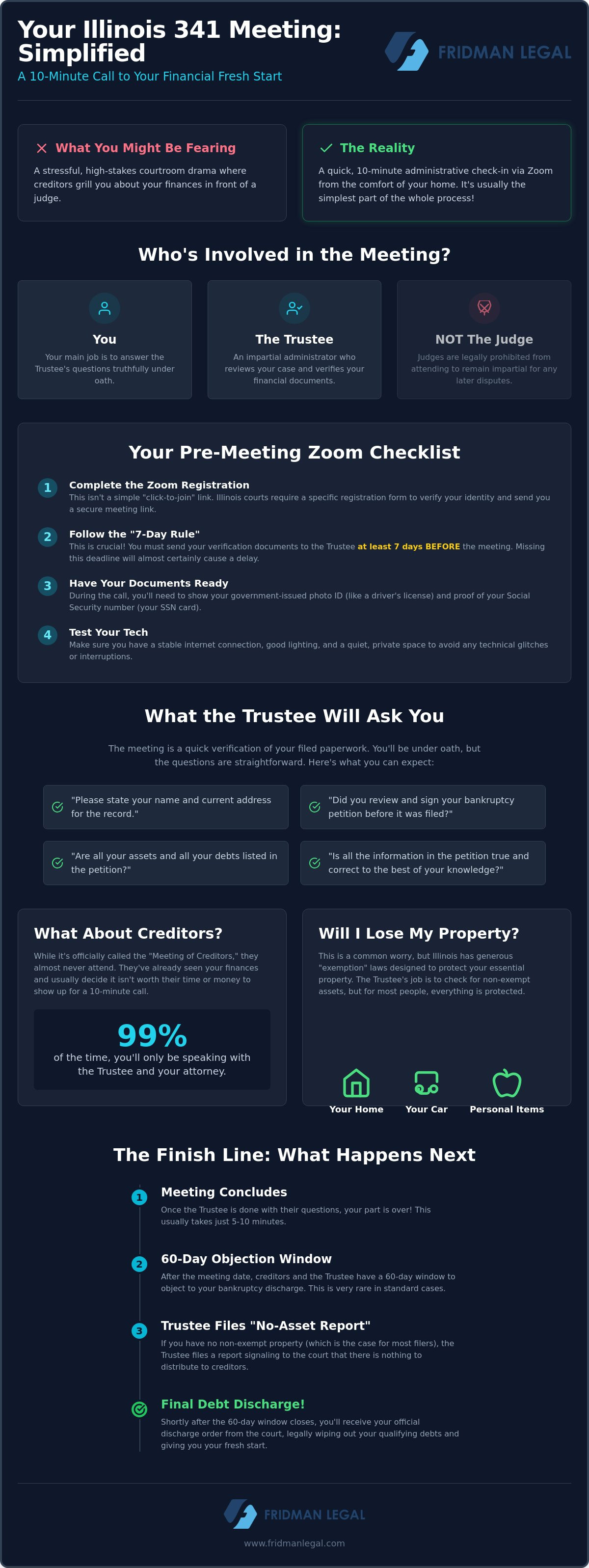
One of the most common anxieties people have is that their hearing will turn into a confrontation with angry creditors. It's a valid concern, but the reality is much quieter. In about 95% of cases, zero creditors attend the meeting. Most lenders realize that once you've reached this stage, there's little to be gained by spending money on a lawyer to ask you questions for five minutes. They've already reviewed your filing and know that the court is overseeing the process.
Even if a creditor does appear, they're strictly limited by the rules of the court. The "Automatic Stay" that went into effect when you filed your case protects you from harassment. Creditors aren't allowed to grill you about your past spending or make you feel guilty. They can only ask specific questions about where your assets are located. Usually, the Trustee will only give them three to five minutes before moving on to the next case. Knowing what happens at a 341 meeting in Illinois helps you realize that the system is designed for efficiency, not intimidation.
What If a Creditor Shows Up?
In rare instances, a former business partner or an ex-spouse might join the Zoom call. If they try to use the meeting as a platform for personal grievances, the Trustee will quickly shut them down. You won't have to "argue" your case or trade barbs with anyone. Your attorney's role is to keep the conversation focused on the facts of your petition and protect you from irrelevant questioning. If you're feeling overwhelmed by the possibility of a confrontation, securing Fridman Legal’s bankruptcy services ensures you have a professional advocate to handle the heavy lifting and keep the focus on your debt relief.
Will the Trustee Take My Stuff at the Meeting?
Another frequent fear is that the Trustee will somehow "seize" your property during the call. Rest assured, no one is coming to your house to take your car or your phone while you're on Zoom. The 341 meeting is strictly for testimony. Illinois law provides significant protections for your property. For example, as of 2026, the homestead exemption covers up to $50,000 for an individual, and you have a $3,600 exemption for a motor vehicle. Most people find that their belongings are entirely safe under these rules. For more details on protecting your assets in specific areas, check out our guide on Chapter 7 Bankruptcy in Northbrook.
If you want to ensure your property is fully protected before your hearing, contact us today to review your case and prepare with confidence.
The Finish Line: What Happens After the 341 Meeting?
The moment you disconnect from the Zoom call, you'll likely feel a massive sense of relief. The hardest part of the process is officially behind you. However, the legal work doesn't stop just because the camera is off. Understanding what happens at a 341 meeting in Illinois also means knowing what follows in the weeks ahead. Once the Trustee concludes the meeting, a "60-day clock" begins. This is the specific window of time during which creditors or the U.S. Trustee can file a formal objection to your discharge. While objections are rare in most consumer cases, this waiting period is a mandatory part of the federal bankruptcy timeline.
In a typical Chapter 7 case, one of the best things you can see on your docket is the "Report of No Distribution," often called a No-Asset Report. This document is filed by the Trustee to inform the court that they've found no non-exempt property to liquidate for creditors. If you're filing for Chapter 13, the meeting serves as a final verification before your case moves toward the Plan Confirmation hearing. Either way, the final goal is the same: receiving that "Discharge of Debtor" notice in the mail, which legally wipes away your qualifying debts once and for all.
Reaffirmation Agreements and Financial Management
After the meeting, you might need to address "reaffirmation agreements." These are contracts that essentially pull a specific debt, like a car loan or a mortgage, out of the bankruptcy so you can keep the asset and continue making payments. It’s a significant decision that requires a careful look at your long-term budget. You'll also need to complete your second required credit counseling course, known as the Financial Management course. The court won't issue your final discharge until they have proof that you've finished this class. If debt collectors try to contact you during this time, don't engage with them. Your attorney will handle any lingering creditors who haven't yet realized the "Automatic Stay" is still in full effect.
Life After Bankruptcy: Rebuilding in Northbrook
The day after your case closes is the first day of your new financial life. The stress of the 341 meeting will quickly fade as you start seeing the immediate impact of debt relief. Many people in Northbrook and the surrounding Chicago suburbs are surprised to find that they can start rebuilding their credit scores almost immediately. By managing your post-bankruptcy finances with precision and care, you'll find that your "fresh start" is a tangible reality, not just a legal term. If you want to ensure every step of your case is handled with professional integrity, contact us today to ensure your 341 meeting is a success and your discharge is secured.
Securing Your Financial Future with Confidence
Navigating the path to debt relief is a significant milestone, and the 341 meeting is simply the bridge to your new life. You now understand that what happens at a 341 meeting in Illinois is a structured, ten-minute verification process rather than a stressful courtroom battle. By preparing your documents early and knowing exactly what questions the Trustee will ask, you can move through this hearing with total clarity and move toward your discharge.
While the process is straightforward, having an experienced advocate by your side ensures that no detail is overlooked. Fridman Legal provides personalized representation at every 341 meeting, drawing on nearly 20 years of Illinois bankruptcy experience. We offer flat-fee Chapter 7 filing services designed to give you high-quality legal support without hidden costs or surprises. Our goal is to handle the administrative burdens so you can focus on rebuilding your credit and your peace of mind.
Ready to put your debt behind you for good? Schedule a free consultation with Fridman Legal to prepare for your bankruptcy hearing and take the final step toward a fresh start. You're closer to financial freedom than you think, and we're here to help you reach it.
Frequently Asked Questions
Do I have to go to a courthouse for my 341 meeting in Illinois?
No, you won't have to travel to a physical courthouse for this hearing. Currently, what happens at a 341 meeting in Illinois takes place entirely over Zoom. This remote format allows you to provide your testimony from a quiet, private location of your choice, such as your home or office. You'll receive your meeting link and registration instructions well in advance, so you have plenty of time to test your equipment.
What happens if I miss my 341 meeting date?
If you miss your date, the Trustee will generally reschedule the meeting for a later time, but you shouldn't rely on this. Failing to appear without a valid, documented reason can lead to the court dismissing your bankruptcy case altogether. If you realize you can't make the call due to an emergency, you must notify your lawyer or the Trustee's office as soon as possible to request a continuance.
Will the Trustee ask about my current job or income changes?
Trustees almost always ask if your employment status or income has changed since you filed your petition. They need to verify that the numbers on your forms still match your current financial situation before they can move forward. If you've recently received a significant raise, changed employers, or lost your job, be prepared to provide those details honestly while you are under oath during the call.
Can my spouse and I have our 341 meeting together?
Joint filers will always attend their 341 meeting together on the same Zoom call. The Trustee will swear both you and your spouse in simultaneously at the start of your ten-minute window. While the Trustee might direct specific questions to one person, you are both legally responsible for the accuracy of the information. It's a shared process designed to verify your household's combined financial schedules.
How long after the 341 meeting is my debt officially wiped away?
For Chapter 7 filers, the official discharge usually arrives in the mail about 60 to 90 days after the meeting concludes. This specific timeline accounts for the mandatory 60-day window where creditors are allowed to file an objection to your case. In Chapter 13 cases, the process is much longer; the discharge is only granted once you successfully complete your three to five-year repayment plan as agreed.
What should I do if I realize I made a mistake on my bankruptcy forms during the meeting?
If you catch a mistake during your testimony, you should disclose it to the Trustee immediately. It's always better to be proactive and honest about a clerical error or an overlooked asset than to have the Trustee discover it later. Your attorney can then file an amended schedule with the court after the meeting to ensure your official record is perfectly accurate and your discharge stays on track.
Is the 341 meeting open to the public?
Yes, these meetings are technically open to the public, though they are rarely attended by anyone outside of the legal community. On a Zoom call, you'll likely see other filers and their attorneys waiting in the digital room for their cases to be called. It's a standard administrative process, and most participants are focused on their own hearings rather than the details of your specific financial situation.
Do I need a lawyer for a 341 meeting in Chicago?
While you can legally represent yourself, having a lawyer is the best way to manage what happens at a 341 meeting in Illinois. An attorney prepares your paperwork, handles the Trustee's technical follow-ups, and ensures your exemptions are properly applied to protect your property. This professional oversight provides the stability and confidence needed to navigate the hearing and secure a successful debt discharge without unnecessary stress.

Article by
O. Allan Fridman
O. Allan Fridman has been practicing law since 2001. His practice is unique in that he does not view himself as a litigation attorney or transactional attorney. Rather, he views each area of law as a tool to pursue the best results for his clients. By practicing in both areas of law, he is able to take a 360-degree view of law. This enables the firm to catch potential drawbacks that are readily identifiable.
By practicing in litigation and transactional law and taking a holistic approach in dealing with our clients, he doesn’t put clients in box — rather, as we are all individuals, so too are the legal services we may require.
Whether it is bankruptcy or litigation or transactional, each client brings challenges and does not fit in any one box. Often times, bankruptcy clients end up not filing bankruptcy because we can achieve a better result through litigation or through an out-of-court resolution with the lender, or through a real estate sale. On the other end of the spectrum, a litigation client with multiple issues and lawsuit may fare better in a bankruptcy.
Since 2001, Allan has practiced in states and federal court, and he is a member of the trial bar of the Northern District of Illinois and admitted in the Northern District of Indiana.
We are a debt relief agency. We help people file for bankruptcy relief under the Bankruptcy Code
The materials on this site are for informational purposes only and do not constitute legal advice. Viewing this site or contacting us does not create an attorney–client relationship, and you should not act or refrain from acting based on any information here without seeking professional legal counsel.