

Illinois recently ranked among the top five states for foreclosure rates, and with 28 foreclosure starts already recorded in Evanston through June 2026, the pressure on local homeowners is undeniable. You probably feel like you're backed into a corner by rising costs and aggressive creditors. The most common fear we hear from residents is a simple one: will I lose my home if I file for bankruptcy in Evanston? It's a heavy question to carry, but the legal reality is often far more reassuring than the rumors suggest.
I understand that your home represents your family's stability, and the thought of displacement is overwhelming. This guide will show you how to use Illinois law as a strategic shield to protect your property. You'll discover how the 2026 increase in the homestead exemption to $50,000 for individuals and $100,000 for married couples can safeguard your equity. We'll also explain how specific filing strategies for Chapter 7 or Chapter 13 can stop a foreclosure immediately, allowing you to wipe out medical or credit card debt without packing a single moving box.
Key Takeaways
- Learn why the answer to "will I lose my home if I file for bankruptcy in Evanston" is a reassuring "no" for the vast majority of local homeowners.
- Understand how the 2026 increase in Illinois homestead exemptions provides a much stronger shield for your equity than in previous years.
- Discover whether Chapter 7 or Chapter 13 is the more effective tool for your specific goal, whether that's wiping out debt or catching up on a mortgage.
- Explore how recent 2026 legal updates for "Tenancy by the Entirety" can protect your home even if it's held in a trust.
- Get a clear preview of the Cook County court process so you can walk into your meeting of creditors feeling prepared and in control.
Addressing the Big Question: Can You Really Keep Your Evanston Home?
Let's address the elephant in the room right away. The primary fear for anyone struggling with debt is: will I lose my home if I file for bankruptcy in Evanston? The short answer is that the vast majority of people who file for bankruptcy keep their primary residence. Bankruptcy isn't a mechanism designed to leave you homeless. It's actually a legal framework intended to provide a fresh start while preserving your most essential assets. In a town like Evanston, where property values have remained robust despite broader economic shifts, it’s understandable why you'd worry about your equity. You've worked hard for that home. The law actually respects that effort more than you might think.
The "Automatic Stay" and Your Front Door
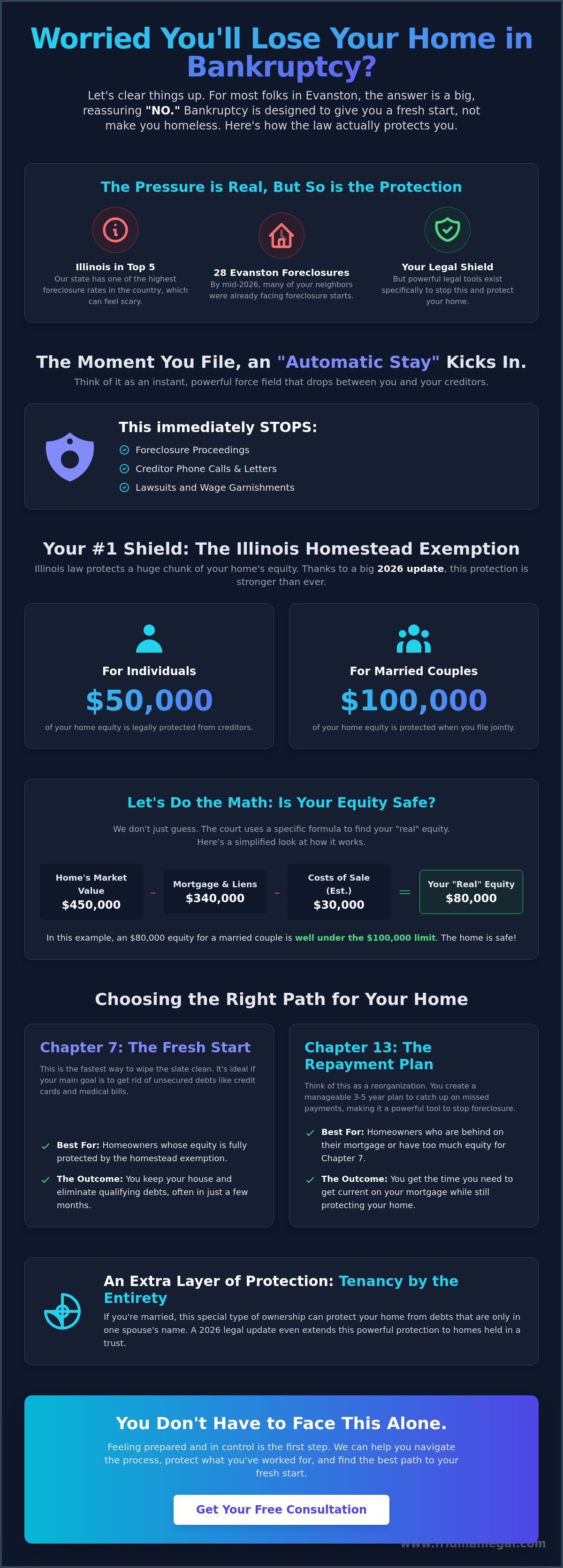
The moment your petition is filed with the court, something called the "automatic stay" kicks in. You can think of this as an immediate legal shield that drops between you and your creditors. It's a fundamental part of Bankruptcy in the United States that stops all collection actions in their tracks. This includes phone calls, lawsuits, and, most importantly, foreclosure proceedings. If you're currently facing a foreclosure start in Cook County, the automatic stay halts that process instantly. It gives you the necessary space to breathe. You can finally evaluate your options without the constant threat of displacement hanging over your head. It’s the first step in regaining control of your financial life.
Dispelling the "Liquidation" Myth
There's a common misconception that filing for Chapter 7 bankruptcy means you have to hand over the keys to your house. That's a myth. The system is built around the concept of "exemptions," which are specific categories of property that creditors can't touch. In plain English, if your home equity falls within the Illinois exemption limits, it's safe. We’ve seen a significant shift in 2026 with higher exemption amounts that reflect our local real estate market. At Fridman Legal, our approach to asset protection is meticulous. We analyze your equity and mortgage status to ensure we're using every available legal protection to keep your front door locked to creditors. You aren't just a case number to us. You're a homeowner looking for stability, and we're here to provide the professional guidance to secure it. Rest assured, your fresh start doesn't have to come at the cost of your address.
The Illinois Homestead Exemption: Your Primary Shield
When you start looking into debt relief, you'll likely hear about federal bankruptcy exemptions. However, Illinois is what's known as an "opt-out" state. This means we don't use federal rules here. Instead, we rely on specific protections set by the state. A major shift occurred on January 1, 2026, when the Illinois Homestead Exemption was significantly increased to better reflect our local housing market. For an individual, the exemption is now $50,000. If you're married or a joint homeowner, that protection doubles to $100,000. This increase is a game changer for local residents who are asking: will I lose my home if I file for bankruptcy in Evanston? In most cases, these updated limits are more than enough to cover the equity in a primary residence.
It's helpful to remember that these laws exist to ensure you have a place to live while you rebuild your finances. The state recognizes that a total liquidation of your life isn't productive for the community or your future. By choosing state rules over federal ones, Illinois provides a tailored safety net for its homeowners. Many residents ask, will I lose my home if I file for bankruptcy in Evanston, especially when they see property values climbing. The answer usually comes down to a simple mathematical calculation that we perform during your initial strategy session.
Doing the Math on Your Evanston Equity
Calculating your risk isn't as simple as checking a Zillow estimate. The bankruptcy court looks at "real" equity, which is the actual cash value the court sees after all deductions. First, we find your home's current market value. Next, we subtract your mortgage balance and any other liens. Finally, we subtract the "costs of sale," which is a buffer for broker fees and closing costs the Trustee would have to pay if they sold the house. If the remaining number is under $50,000 for an individual or $100,000 for a couple, your home is generally safe.
Strategies for High-Equity Homes
What if your Evanston home has appreciated significantly since 2020? Even if your equity is slightly over the limit, a Trustee might decide a sale isn't worth their time. They have to pay off your mortgage and give you your exemption cash first. If there's very little left for creditors after those payments, they often abandon the property. These same state rules apply if you were considering Chapter 7 bankruptcy in Northbrook or other nearby suburbs. If you're worried about your specific numbers, it's a good idea to connect with a professional to run a precise calculation before you make any decisions.
Chapter 7 vs. Chapter 13: Choosing the Right Path for Your Property
Choosing between Chapter 7 and Chapter 13 isn't just a matter of looking at your income. It's about your specific goals for your property. If you're asking, will I lose my home if I file for bankruptcy in Evanston, the answer often hinges on whether you're current on your mortgage or facing a foreclosure start. Each chapter offers a different set of tools to protect your residence, and the right choice depends on how much equity you've built and whether you've missed any payments lately.
Chapter 7 is generally the fastest route to debt relief, typically concluding in about three to four months. It's designed to wipe out unsecured debts like credit cards and medical bills, giving you a clean slate. However, it doesn't have a built-in way to help you catch up on missed mortgage payments. Chapter 13, by contrast, is a reorganization plan that lasts three to five years. It allows you to wrap your mortgage arrears into a monthly payment plan, effectively stopping a foreclosure and giving you a multi-year window to get back on track.
One technical but vital concept to understand is the "Best Interests of Creditors" test. In a Chapter 13 case, the court requires you to pay your unsecured creditors at least as much as they would've received if you had filed for Chapter 7. Because the 2026 Illinois bankruptcy exemptions are so high, many homeowners find they don't have to pay much to their unsecured creditors. Their equity is so well-protected that there wouldn't be anything left for creditors even in a liquidation scenario. In some specific cases, Chapter 13 even allows for "lien stripping," which can legally remove a second mortgage if your home's value is lower than the balance of your first mortgage.
When Chapter 7 is the Safe Bet
Chapter 7 is usually the most efficient path if you're already current on your house payments and your equity is within the state's $50,000 or $100,000 limits. By eliminating other debts, you free up the cash you need to stay current on your home. You can look at the Fridman Legal bankruptcy page to see how this timeline fits into your broader financial strategy. It's a powerful way to protect your home by removing the "noise" of other debt.
Saving a Home in Foreclosure with Chapter 13
If you've fallen behind and the bank is threatening a sale, Chapter 13 is the gold standard for protection. It stops the foreclosure clock immediately. You'll have three to five years to pay back those missed payments. Just keep in mind that while you're paying back the old debt through the court, you have to stay current on all your new mortgage payments. It's a commitment, but it's the most reliable way to keep your family in their Evanston home during a crisis.
Advanced Protections: Tenants by the Entirety
While the homestead exemption provides a solid baseline for protection, Illinois offers an even more robust shield for married couples known as Tenancy by the Entirety. This is often referred to as a "super-exemption" because of how it treats the family home. In many cases, if only one spouse is responsible for the debt and chooses to file, the home remains 100% protected. This is true regardless of how much equity you've built up over the years. For many families, this is the definitive answer to the question: will I lose my home if I file for bankruptcy in Evanston? It’s a powerful legal tool that prioritizes the stability of the marital home over the claims of most creditors.
There's a specific catch you should be aware of, though. This protection applies strictly to your primary residence. If you own a vacation home in Wisconsin or a rental property elsewhere in Cook County, Tenancy by the Entirety won't cover those assets. The law is designed to keep a roof over your head, not to shield an entire real estate portfolio. For Evanston families living in high-value neighborhoods, this distinction is vital for a successful filing strategy.
Checking Your Deed for "Entirety" Language
To use this protection, your property deed must contain very specific phrasing. You're looking for language like "not as joint tenants, but as tenants by the entirety." If your deed doesn't currently say this, don't rush to change it right before you file. Doing so can trigger what the court calls a "fraudulent transfer," which can actually lead to the Trustee undoing the change and seizing the asset anyway. The court looks back several years at deed changes to ensure no one is trying to hide assets from legitimate creditors. It's much safer to have your current documents reviewed by a professional who understands the nuances of the Cook County recorder's office.
Mortgage Reaffirmation: Keeping the Bank Happy
Even if your home is protected from liquidation, you still have to deal with the bank that holds your mortgage. This is where a "reaffirmation agreement" comes into play. Essentially, this is a contract where you agree that you'll remain personally liable for the mortgage debt even after your other debts are discharged. It’s a double edged sword. On one hand, it keeps the bank happy and ensures they keep reporting your on-time payments to credit bureaus. On the other hand, you're giving up your bankruptcy protection for that specific debt. A bankruptcy lawyer in Chicago can negotiate these terms to ensure you aren't signing away more than you should. If you're ready to see how these advanced protections apply to your specific situation, you can start your asset protection strategy with our team today.
Navigating the Cook County Bankruptcy Court with Confidence
If you're an Evanston resident, your bankruptcy journey will lead you to the Dirksen Federal Building in downtown Chicago. This is where the U.S. Bankruptcy Court for the Northern District of Illinois operates. While the idea of "going to court" often sounds intimidating, most of your interaction won't be with a judge in a formal courtroom setting. Instead, about a month after your case is filed, you'll attend the Meeting of Creditors, or the 341 meeting. This is a relatively brief administrative hearing where a Trustee asks a few standard questions about your petition and assets. Having local representation from the Evanston or Northbrook area is a significant advantage here because we understand the specific procedures of the local Trustees who handle these Cook County cases.
The process is structured to be efficient, but it requires precision. Small errors in your filing can lead to unnecessary delays or complications with your exemptions. This is why we focus on the details from the very beginning. We handle the heavy lifting of the legal paperwork and court communications so you can focus on your family and your future. Our goal is to move you through the system with as little friction as possible, ensuring that your rights as a homeowner are fully protected under the 2026 Illinois statutes.
The Role of the Bankruptcy Trustee
The Bankruptcy Trustee isn't your enemy, but they do have a specific legal mandate to look for assets that could potentially be used to pay back your creditors. This is why we spend so much time on the front end ensuring your paperwork is essentially "Trustee-proof" from day one. When we've already accounted for your equity and applied the 2026 homestead exemption correctly, the Trustee's job becomes much simpler. Transparency is your best friend in this process. Being honest and thorough on your petition is the most effective way to ensure the answer to will I lose my home if I file for bankruptcy in Evanston remains a firm "no." We prepare you for every question so there are no surprises when you're speaking with the court officials.
Your First Step Toward Peace of Mind
A lot of people spend weeks spiraling through Google searches, trying to piece together a legal strategy from forum posts and generic articles. While research is a good starting point, it can't replace a professional analysis of your specific home and debt load. Every Evanston property is unique, and every family's financial picture has different moving parts. We look beyond just the house to see how your credit card debt, medical bills, and income all interact. This holistic view is what allows us to stop foreclosures and protect your equity simultaneously. If you're ready to stop guessing and start planning, the best move is to reach out to our team for a detailed discussion. We'll take the weight off your shoulders so you can finally get some sleep.
Secure Your Home and Your Financial Future
You've seen that the 2026 Illinois legal updates have made it more predictable than ever to protect your equity. Between the increased homestead exemptions and the robust protections of tenancy by the entirety, the system is built to provide a fresh start without leaving you homeless. Choosing the right path between Chapter 7 and Chapter 13 is the final piece of the puzzle that ensures your property remains yours.
If you're still asking, "will I lose my home if I file for bankruptcy in Evanston," the most effective way to get a definitive answer is to look at your specific numbers with a professional. At Fridman Legal, we bring nearly 20 years of Illinois bankruptcy experience to every case we handle. From our convenient Northbrook office, we provide clear, strategic guidance and offer flat-fee bankruptcy filing options to keep your financial transition as smooth as possible.
Talk to O. Allan Fridman today to see how we can protect your Evanston home. You've worked hard for your residence, and you deserve a professional partner who will work just as hard to help you keep it. Relief is possible, and your fresh start can begin today.
Frequently Asked Questions
Can I keep my home if it is fully paid off in Illinois?
Yes, you can keep a paid-off home as long as its total market value falls within the Illinois homestead exemption limits. For an individual in 2026, this means the home's value should be $50,000 or less; a married couple can protect up to $100,000. If your home's value exceeds these specific amounts, a Chapter 13 filing might be a more appropriate tool to protect the property from being sold by a Trustee.
What happens if my Evanston home equity is more than $15,000?
You are still very likely protected because the Illinois homestead exemption was increased to $50,000 for individuals on January 1, 2026. The old $15,000 limit no longer applies in current cases. This significant change was specifically designed to help homeowners in markets like Evanston where property values have risen. As long as your equity stays under the new $50,000 or $100,000 thresholds, your home is generally safe from liquidation.
Will my neighbors find out that I filed for bankruptcy?
It's highly unlikely your neighbors will ever know unless you choose to tell them. While bankruptcy filings are technically public records, the court doesn't send notices to your neighborhood or publish your name in local newspapers. Unless someone is actively searching federal court databases or works for a credit reporting agency, your financial business remains private and discreet.
Can I file for bankruptcy alone if I am married and own a home?
Yes, you can file an individual petition even if you are married. This is often a strategic move when only one spouse is responsible for the majority of the household debt. If your home is held as "tenants by the entirety," filing alone can actually offer superior protection; the home often cannot be touched by creditors who only have a claim against the filing spouse.
How long does the bankruptcy process take in Cook County?
The timeline depends on which chapter you choose for your filing. A typical Chapter 7 case in the Northern District of Illinois takes about three to four months from the initial filing to the final discharge. A Chapter 13 case lasts much longer, requiring a three to five year commitment to a court-approved repayment plan. Both options provide immediate relief from creditors the moment your paperwork is submitted.
Do I have to keep paying my mortgage while my bankruptcy case is active?
Yes, you must continue making your regular mortgage payments if you intend to keep the property. Bankruptcy can wipe out your personal liability for the debt, but it doesn't remove the bank's lien on the house. If you stop paying during the case, the lender can eventually ask the court for permission to proceed with a foreclosure despite your bankruptcy status.
Can bankruptcy stop a scheduled foreclosure sale in Evanston?
Yes, filing for bankruptcy triggers an automatic stay that halts a foreclosure sale instantly. This is one of the most powerful tools for residents asking, will I lose my home if I file for bankruptcy in Evanston? Even if the sale is scheduled for tomorrow, a properly filed petition stops the clock and gives you the legal room to reorganize your finances and save your residence.
What is the difference between Illinois and federal bankruptcy exemptions?
The main difference is that Illinois residents don't have a choice; they must use state exemptions. Illinois is an "opt-out" state, meaning we use our own specific laws for protecting property rather than the federal list. This is actually beneficial for local homeowners in 2026, as the state's homestead exemption is now significantly higher than the federal equivalent. This ensures the answer to will I lose my home if I file for bankruptcy in Evanston is much more likely to be a "no."

Article by
O. Allan Fridman
O. Allan Fridman has been practicing law since 2001. His practice is unique in that he does not view himself as a litigation attorney or transactional attorney. Rather, he views each area of law as a tool to pursue the best results for his clients. By practicing in both areas of law, he is able to take a 360-degree view of law. This enables the firm to catch potential drawbacks that are readily identifiable.
By practicing in litigation and transactional law and taking a holistic approach in dealing with our clients, he doesn’t put clients in box — rather, as we are all individuals, so too are the legal services we may require.
Whether it is bankruptcy or litigation or transactional, each client brings challenges and does not fit in any one box. Often times, bankruptcy clients end up not filing bankruptcy because we can achieve a better result through litigation or through an out-of-court resolution with the lender, or through a real estate sale. On the other end of the spectrum, a litigation client with multiple issues and lawsuit may fare better in a bankruptcy.
Since 2001, Allan has practiced in states and federal court, and he is a member of the trial bar of the Northern District of Illinois and admitted in the Northern District of Indiana.
We are a debt relief agency. We help people file for bankruptcy relief under the Bankruptcy Code
The materials on this site are for informational purposes only and do not constitute legal advice. Viewing this site or contacting us does not create an attorney–client relationship, and you should not act or refrain from acting based on any information here without seeking professional legal counsel.


