

Did you know that bankruptcy filings in the U.S. increased by nearly 12 percent over the last year? This shift shows that more people are choosing to address their financial struggles head-on rather than letting debt define their future. If you're currently facing the stress of collection calls or looking for the clear signs you need to file for bankruptcy, you're certainly not alone in this journey. It's normal to feel anxious about wage garnishment or the possibility of losing your family home in Northbrook, but these fears don't have to be your permanent reality.
We believe that you deserve a clear roadmap to financial stability. Whether you're confused about the differences between Chapter 7 and Chapter 13 or simply want the phone to stop ringing, there's a strategic way forward. This guide will walk you through seven critical red flags and explain how an Illinois filing can protect your primary residence while providing the fresh start you've been waiting for.
Key Takeaways
- Recognize the clear signs you need to file for bankruptcy, such as using credit cards for daily basics or facing wage garnishment.
- Learn how the Automatic Stay acts as an immediate legal shield to stop collector calls, lawsuits, and foreclosure efforts.
- Understand the role of the Illinois Means Test in determining your eligibility for a Chapter 7 debt discharge based on your income.
- Discover the practical steps to prepare for your consultation, including gathering pay stubs and listing every creditor you owe.
Understanding the Weight of Debt: It Is Not Just About the Numbers
Living paycheck to paycheck in 2026 has become a grueling reality for many households. With total bankruptcy filings rising by nearly 12 percent over the last year, it is clear that the current economic climate is putting immense pressure on even the most diligent planners. If you find yourself constantly checking your bank balance before buying groceries, you aren't alone. Debt is rarely a reflection of your character or your work ethic. Most often, it's the result of a sudden job loss, an unexpected medical emergency, or the compounding weight of inflation that simply outpaced your income.
It's vital to remember that Bankruptcy in the United States is a legal right specifically designed to provide a "fresh start" to those who need it. It isn't a sign of failure; it's a strategic tool for financial recovery. Recognizing the signs you need to file for bankruptcy early can be the difference between a controlled transition and a total financial collapse. Seeking professional guidance during the early stages of distress allows you to explore your options before the situation spirals out of your control.
The Mental Toll of Financial Instability
Many people experience what psychologists call the "ostrich effect" when debt becomes overwhelming. It's that instinct to leave the mail unopened or silence the phone when an unknown number appears. This avoidance is a natural response to stress, but it doesn't stop the interest from mounting. Constant collector calls don't just disrupt your dinner; they erode your focus at work and strain your relationships at home. Taking the initiative to address these issues isn't a sign of weakness. It's actually an act of strength that puts you back in the driver's seat of your own life.
Why Waiting Too Long Can Cost You More
One of the most damaging mistakes we see is people draining their retirement accounts to pay off dischargeable credit card debt. In most cases, your 401k or IRA is protected during a filing. If you spend that money now, you're sacrificing your future to solve a problem that the law could have resolved for you. Waiting too long also opens the door for creditors to file lawsuits, which can lead to wage garnishments or even home foreclosures. Consulting a Chapter 7 bankruptcy Illinois expert early helps you protect your assets and ensures you don't lose more than you have to.
5 Clear Signs You Need to File for Bankruptcy Right Now
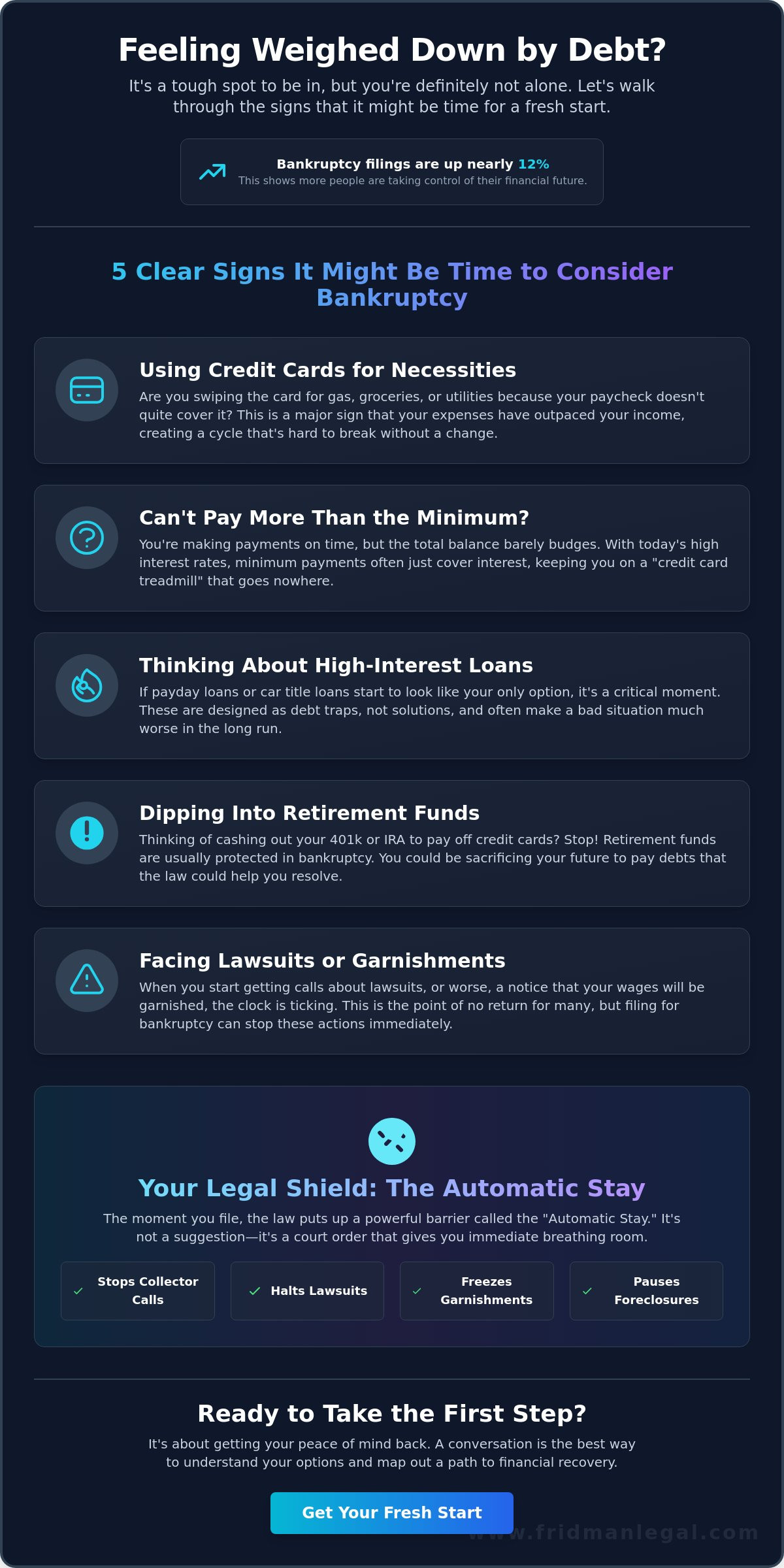
Many people wait until their bank account is completely empty before they start looking for an exit strategy. However, the most reliable signs you need to file for bankruptcy often appear much earlier. If you're regularly using credit cards to pay for petrol or groceries because your paycheck didn't stretch far enough, that's a major signal. This isn't just about having a "tight month." It's about a structural deficit in your budget that won't fix itself without intervention.
Another red flag is the realization that your debt balances haven't moved in six months. Even if you're making every minimum payment on time, high interest rates in 2026 mean you're essentially standing still. If you've started considering payday loans or high-interest title loans just to keep the lights on, you've reached a critical juncture. These loans are designed to be traps, not lifelines. Finally, if you're sitting on medical bills that would take more than five years of your disposable income to clear, the math simply isn't in your favor. It's often better to examine your debt relief options now rather than later.
The "Credit Card Treadmill" and When to Jump Off
In the current economic climate, interest rates have made it mathematically impossible for many to pay off high-balance cards. You might try "robbing Peter to pay Paul" by transferring balances to new cards with introductory rates. While this feels like progress, it's usually just a temporary fix that masks the underlying problem. When your total unsecured debt exceeds half of your annual income, it is frequently a valid reason to move forward with a filing to protect your future earnings.
Garnishments and Lawsuits: The Point of No Return
Receiving a summons or a notice of a pending lawsuit is a massive red flag that you shouldn't ignore. Once a creditor gets a judgment, they can move for wage garnishment in Illinois, which can take a significant chunk of your take-home pay. This is where The Automatic Stay: Your Shield Against Creditors becomes your most valuable asset. It immediately halts all collection actions, including lawsuits and garnishments, the moment your case is filed. Acting before a judgment lien is placed on your property is crucial, as those can be much harder to remove after the fact.
The Automatic Stay: Your Shield Against Creditors
One of the most powerful tools in federal law is something called the Automatic Stay. In plain English, it's a legal injunction that goes into effect the very second your bankruptcy case is filed. Think of it as a protective wall that rises up between you and everyone you owe money to. It doesn't matter if it's a local bank or a massive credit card company; they all have to stop their collection efforts immediately. If they don't, the court can actually penalize them with fines or force them to pay your legal fees. This is a serious legal boundary that creditors aren't allowed to cross.
This stay is comprehensive. It stops the constant phone calls, those stressful letters in your mailbox, and even active lawsuits. If you've been seeing the signs you need to file for bankruptcy, like a pending court date for a debt collection, the stay is what prevents that case from moving forward. It provides the breathing room you need to actually think about your future without the constant noise of threats and demands. It's the first step toward regaining control over your daily life.
Immediate Relief from Harassment
Once you have your case number, your interactions with debt collectors change completely. You no longer have to explain your situation or feel guilty when the phone rings. You simply provide the number and tell them to contact your attorney. This is a major advantage over working with a debt settlement lawyer. While settlement is a valid path for some, it doesn't offer the immediate legal protection of an automatic stay. In settlement negotiations, creditors can still sue you or garnish your wages while you're trying to reach a deal. Bankruptcy removes that risk instantly.
Stopping Foreclosure and Repossession
For homeowners in Northbrook or anywhere in Cook County, the stay is often a literal lifesaver. If your home is scheduled for a sheriff sale, filing for bankruptcy can pause that sale right away. It's important to remember that while the stay is an immediate fix, your long-term outcome depends on the specifics of your case and qualifying through The Illinois Means Test. At Fridman Legal, we handle these time-sensitive emergencies daily, ensuring our clients can keep their primary residences while we build a roadmap for their debt relief.
The Illinois Means Test: Are You Eligible for Chapter 7?
When you start noticing the signs you need to file for bankruptcy, the next logical question is usually about eligibility. In Illinois, the court uses a specific calculation called the Means Test to determine if your income is low enough to qualify for a Chapter 7 filing. This isn't meant to be a barrier, but rather a way to ensure that the total discharge of debt is reserved for those who truly need it. As of April 1, 2026, the income thresholds for Illinois households have been updated. For a single-person household, the limit is now $73,180; for a family of four, it rises to $137,902. If your gross income falls below these levels, you typically qualify for Chapter 7 automatically.
If your income is higher than the state median, don't assume you're disqualified. The second part of the test looks at your necessary monthly expenses. Even high earners can often qualify if they have significant "deductible" costs that leave them with little disposable income at the end of the month. If Chapter 7 still isn't an option after this deep dive, Chapter 13 bankruptcy serves as the primary alternative. It allows you to reorganize your debt into a manageable three to five year payment plan while still providing the protection of the court. Identifying which path fits your specific situation is much easier when you consult with an experienced bankruptcy attorney who understands the 2026 regulatory environment.
Income vs. Expenses: The Balancing Act
The Means Test accounts for the real-world costs of living in the Chicago area. You can often deduct expenses like your mortgage or rent, car payments, taxes, and even certain insurance premiums. Because these forms are incredibly detailed, the guidance of a bankruptcy lawyer Chicago is vital for ensuring every eligible expense is captured. A high income doesn't automatically bar you from relief if your cost of living is equally high.
Exemptions: What Can You Actually Keep?
A common fear is that filing for bankruptcy means losing everything you own. In reality, Illinois law provides generous exemptions to protect your assets. For homeowners in Northbrook, the homestead exemption is particularly significant; as of 2026, it protects $50,000 of equity for a single filer and $100,000 for a joint filing. There is also a "wildcard" exemption for personal property and a $3,600 exemption for a motor vehicle. Most of our clients discover they're able to keep all their essential belongings while still getting the fresh start they deserve.
Taking the First Step: How to Prepare for Your Consultation
Once you recognize the signs you need to file for bankruptcy, the focus shifts from worry to action. It's time to get your paperwork in order so your legal team can build the strongest case possible. Start by gathering your pay stubs from the last six months. This documentation is vital for the Means Test we discussed earlier. You also need to list every single person or company you owe money to. Yes, this includes family members or friends you've borrowed from. Leaving a creditor off your petition can cause serious legal headaches later, so it's best to be thorough from the very start.
Honesty is the most important part of your relationship with your attorney. We aren't here to judge your past financial decisions; we're here to solve them. If you've recently transferred property or made large payments to certain creditors, tell us. Knowing these details upfront allows us to protect your interests effectively. At Fridman Legal, we utilize a flat-fee model for our bankruptcy services. This approach ensures you'll have predictable costs without worrying about being billed for every short phone call or email. It's about providing professional support without adding more financial stress to your plate.
What to Ask During Your First Meeting
During your initial consultation, you should focus on the practical impact on your daily life. Ask specifically whether Chapter 7 or Chapter 13 is the better fit for protecting your specific house and car. You'll also want to know exactly how quickly the automatic stay will stop a pending wage garnishment or a scheduled foreclosure. Finally, ask what your financial life will look like six months after the discharge. Getting a clear picture of the timeline helps manage expectations and reduces the anxiety of the unknown.
Life After Bankruptcy: Rebuilding Your Credit
Many people are surprised to learn that their credit scores often start to climb shortly after their debts are discharged. This happens because your debt-to-income ratio improves overnight. Once the old balances are gone, you can start the rebuilding process by getting a secured credit card. By making small, on-time payments, you'll show lenders that you're a responsible borrower again. If you're ready to move past the stress and start this new chapter, Contact Fridman Legal to discuss your specific situation.
Your Path to a Fresh Start Starts Here
Recognizing the signs you need to file for bankruptcy is the most important step toward reclaiming your peace of mind. We've explored how the automatic stay provides immediate protection and how the Illinois Means Test determines your eligibility for Chapter 7. These aren't just legal hurdles; they're the actual mechanisms designed to help you move forward. You've seen that bankruptcy isn't a failure, but a strategic tool to preserve your long-term wealth and stability.
You don't have to navigate these complex regulations alone. With nearly 20 years of local Illinois legal experience, O. Allan Fridman provides personalized, results-driven representation to ensure your home and essential assets are protected. We value transparency, which is why we offer a flat-fee model for bankruptcy filings so your costs stay predictable and manageable from day one. You deserve a clear roadmap to debt relief that removes the anxiety of the unknown and stops the collector calls for good.
Get a Fresh Start: Schedule Your Consultation with Fridman Legal Today
You've carried the weight of this debt for long enough. Today is the day you decide to look forward instead of over your shoulder. We're here to help you turn the page and start your new chapter with confidence.
Frequently Asked Questions
Will I lose my house if I file for bankruptcy in Illinois?
You likely won't lose your home if the equity falls within the Illinois homestead exemption limits. For cases in 2026, single filers can protect up to $50,000 of equity, while joint filers can protect $100,000. If your home has significantly more equity than these amounts, we might look at Chapter 13 as a strategic way to keep the property while catching up on any missed payments over time.
How long does the bankruptcy process take from start to finish?
A typical Chapter 7 case usually takes about four to six months from the day we file until you receive your final discharge. Chapter 13 is a longer commitment because it involves a court-approved repayment plan that lasts between three and five years. While the final discharge takes some time, the legal protection that stops creditors starts the very second your case is officially filed with the court.
Can I file for bankruptcy without my spouse?
Yes, you can absolutely file for bankruptcy individually even if you're married. Your spouse isn't required to join the petition, and their personal credit score generally won't be affected by your filing. However, their income will still be counted toward the household total when we calculate the Illinois Means Test. This helps the court determine if you qualify for Chapter 7 based on your combined household resources.
What debts cannot be erased in a Chapter 7 bankruptcy?
Most unsecured debts like credit cards and medical bills are wiped out, but certain obligations must still be paid. Debts that generally cannot be erased include child support, alimony, most recent tax debts, and student loans unless you can prove extreme hardship. If you've noticed the signs you need to file for bankruptcy but most of your debt is in these categories, we'll need to discuss a specific strategy.
How much does it cost to hire a bankruptcy lawyer in Northbrook?
While federal filing fees are currently set at $338 for Chapter 7 and $313 for Chapter 13, attorney fees depend on the complexity of your specific financial situation. At Fridman Legal, we utilize a flat-fee model so you know exactly what the professional representation will cost from the beginning. We believe in predictable pricing because you're already dealing with enough financial uncertainty and don't need surprise bills.
Will my employer find out that I filed for bankruptcy?
In most cases, your employer won't be notified about your filing. Bankruptcy is technically a public record, but courts don't actively send notices to employers. The only common exception is in a Chapter 13 case, where your plan payments might be deducted directly from your paycheck. We also might notify them if we need to stop an existing wage garnishment that's already being taken from your pay.
How soon can I buy a house or car after filing?
You can often qualify for a car loan shortly after your discharge, although your interest rates might be higher for the first year or two. For a home, you'll typically need to wait about two years to qualify for an FHA or VA loan. Many of our clients find that their credit score actually starts to improve faster than they expected once the old, overwhelming debt is officially cleared away.
What is the difference between Chapter 7 and Chapter 13?
Chapter 7 is a liquidation that wipes out most unsecured debt in just a few months, making it ideal for a quick fresh start. Chapter 13 is a reorganization plan where you pay back a portion of your debt over three to five years. Chapter 13 is often the better choice if you're behind on your mortgage and want to save your home from a pending foreclosure sale.

Article by
O. Allan Fridman
O. Allan Fridman has been practicing law since 2001. His practice is unique in that he does not view himself as a litigation attorney or transactional attorney. Rather, he views each area of law as a tool to pursue the best results for his clients. By practicing in both areas of law, he is able to take a 360-degree view of law. This enables the firm to catch potential drawbacks that are readily identifiable.
By practicing in litigation and transactional law and taking a holistic approach in dealing with our clients, he doesn’t put clients in box — rather, as we are all individuals, so too are the legal services we may require.
Whether it is bankruptcy or litigation or transactional, each client brings challenges and does not fit in any one box. Often times, bankruptcy clients end up not filing bankruptcy because we can achieve a better result through litigation or through an out-of-court resolution with the lender, or through a real estate sale. On the other end of the spectrum, a litigation client with multiple issues and lawsuit may fare better in a bankruptcy.
Since 2001, Allan has practiced in states and federal court, and he is a member of the trial bar of the Northern District of Illinois and admitted in the Northern District of Indiana.
We are a debt relief agency. We help people file for bankruptcy relief under the Bankruptcy Code
The materials on this site are for informational purposes only and do not constitute legal advice. Viewing this site or contacting us does not create an attorney–client relationship, and you should not act or refrain from acting based on any information here without seeking professional legal counsel.