

What if the bankruptcy filing you thought was a financial dead end is actually the moment you became a highly attractive candidate for a loan? It sounds backward, but since your debt-to-income ratio just hit zero, you've cleared the single biggest hurdle to credit growth. I understand the anxiety that comes with seeing that 10-year mark on your report. You're likely worried about constant rejections or feeling lost in a sea of conflicting advice. The process of rebuilding credit after chapter 7 in Chicago shouldn't feel like a mystery, especially when you're trying to protect your future under the new 2026 Illinois exemption rules.
You deserve a clear path to a 700+ credit score and the confidence to walk into a mortgage closing in just a few years. This guide outlines the exact, conversational steps to bounce back from bankruptcy using tools that work specifically in our local market. We'll look at how to leverage credit builder loans with rates starting at 5% and secured cards to reset your profile. By the end of this article, you'll have a professional roadmap to turn your 2026 fresh start into lasting financial power.
Key Takeaways
- Learn why that 10-year bankruptcy mark on your report isn't a dead end and how a zero debt-to-income ratio actually makes you look better to lenders.
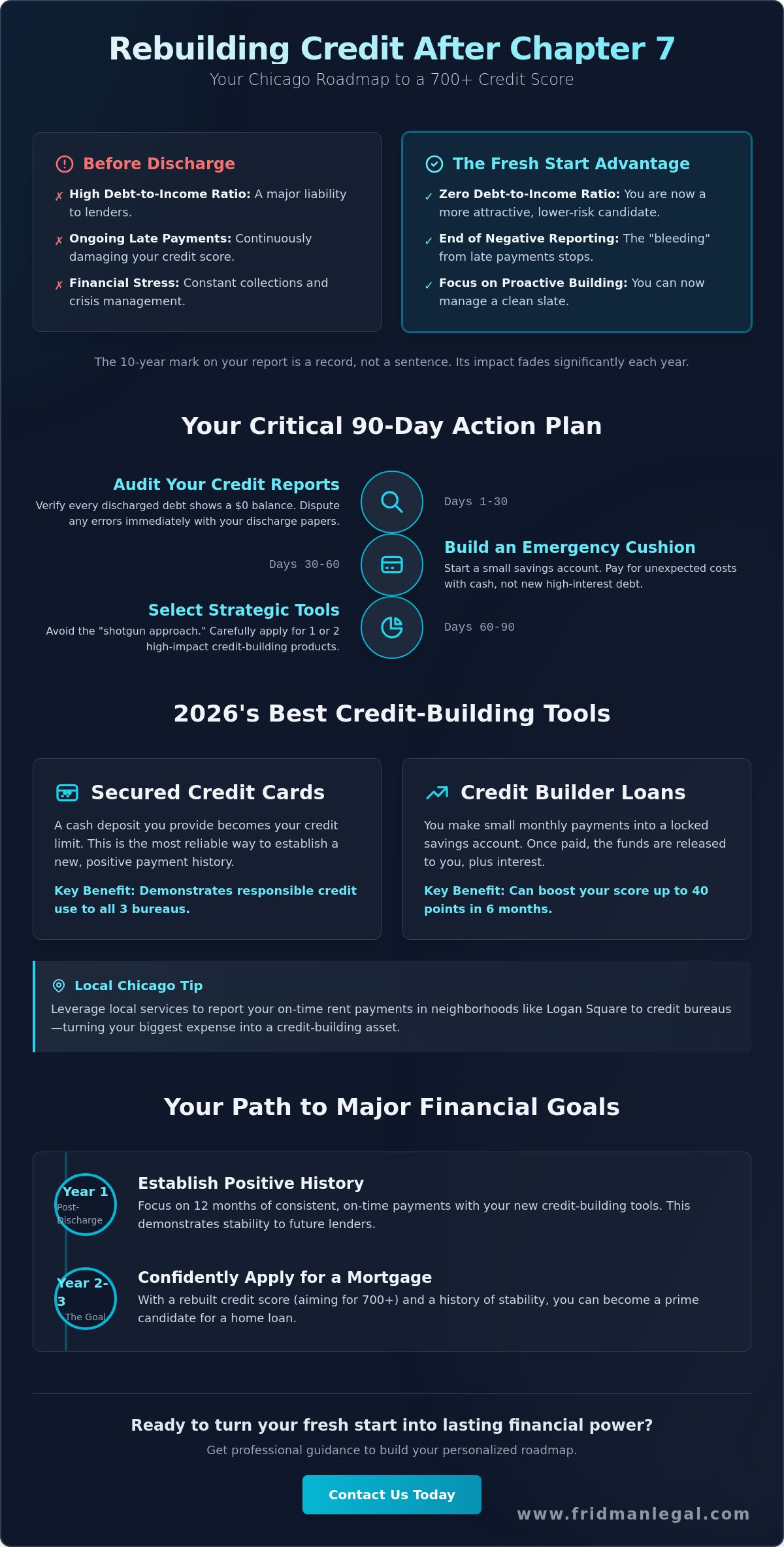
- Discover why the first 90 days are your most important window for rebuilding credit after chapter 7 in Chicago, starting with a simple audit of your discharged accounts.
- Get the facts on 2026's best credit-building tools, including secured cards and builder loans that can boost your score by up to 40 points in just six months.
- Find out how to navigate the local Chicago lending scene and get your rent payments in neighborhoods like Logan Square to finally count toward your credit score.
- See the exact steps you need to take right now so you're ready to move past the filing and confidently apply for a home mortgage in just two or three years.
The Truth About Your Credit Score After a Chicago Chapter 7
Let's be real; that 10-year mark on your credit report sounds like a financial prison sentence. It's the primary reason many people hesitate to engage with the Chapter 7 bankruptcy process. But here is the reality: it isn't a wall. It is a record of a strategic reset. In my experience with rebuilding credit after chapter 7 in Chicago, I have seen that the discharge is the exact moment you become a more attractive prospect for lenders.
Consider the perspective of a bank. Before your filing, you were likely maxed out and struggling with late payments. Your debt-to-income ratio was a significant liability. The moment your discharge is finalized, your debt-to-income ratio effectively hits zero. You no longer owe those old balances. For a lender in 2026, a Chicago resident with a stable job and no competing debt is often a safer bet than someone barely making minimum payments on five different cards. We view bankruptcy as a tool for a fresh start, not a permanent scarlet letter on your file.
Most Chicagoans see a score bump simply because the "bleeding" of late payments has finally stopped. It is the end of a cycle where your score was being hit every 30 days by accounts you couldn't afford to pay. By clearing the slate, you're giving the credit scoring algorithms something new and positive to work with.
Why Your Score Might Actually Go Up
It sounds counterintuitive, but many people see an immediate score bump. When old, delinquent accounts are wiped clean and marked as "discharged in bankruptcy," the constant cycle of late payments finally stops. Your credit utilization rate resets because you no longer have high balances relative to your limits. Crucially, the removal of collection calls lowers financial stress and improves planning, which allows you to focus on your recovery rather than crisis management. You are no longer reacting to old mistakes; you are proactively managing a clean ledger.
The 10-Year Myth vs. Reality
While the filing stays on your report, its influence on your FICO score drops every single year. Lenders in 2026 are looking for recent stability; they care more about what you have done in the last 12 months than a legal filing from several years ago. By the second year after your discharge, many people find themselves back in the "Good" credit range. You aren't stuck in a holding pattern. By following a disciplined plan for rebuilding credit after chapter 7 in Chicago, you're demonstrating that you've handled a complex legal process to stabilize your future and are ready for new opportunities, such as planning for a stable financial future.
Your 90-Day Roadmap After the Discharge
The first 90 days after your bankruptcy discharge are arguably the most important window for your financial future. It's easy to feel like the hard part is over once the court signs off, but the real work of rebuilding credit after chapter 7 in Chicago starts now. You're effectively operating on a clean slate, and how you handle these first three months determines how quickly you'll be able to qualify for a mortgage or a car loan. My advice is to avoid the "shotgun approach." Don't rush out and apply for five different cards just because you're receiving mail offers. One or two strategic, well-timed moves will do more for your score than a dozen desperate applications that lead to hard inquiries.
Your absolute priority is verifying that every single debt included in your filing is reporting a $0 balance. Creditors occasionally fail to update their records promptly, which can lead to "past due" notices appearing on your report even after the debt is legally gone. If you see a balance or a late payment status dated after your discharge, you need to dispute it immediately. Keeping a physical or digital folder of your discharge papers is essential here; if a bureau or a stubborn creditor pushes back, that court order is your ultimate leverage. This is a foundational step to rebuild my credit effectively and ensures your report accurately reflects your new status.
While you're cleaning up the paperwork, start building a small "emergency cushion." Even a few hundred dollars in a dedicated savings account can be the difference between staying on track and falling back into the high-interest debt cycle. If a tire blows out or an appliance breaks, you want to be able to pay cash rather than reaching for a subprime credit card. This financial buffer provides the peace of mind needed to stick to your long-term roadmap. If you have questions about how these steps fit into your specific legal situation, you can always consult with a professional to ensure your strategy is sound.
Audit Your Credit Reports Immediately
You should pull your reports from Experian, Equifax, and TransUnion right away. As of May 2026, you can still access these reports for free on a weekly basis. Look for any account that doesn't say "Discharged in Bankruptcy." If you find an error, use the bureau's online dispute portal or send a certified letter. This audit ensures that the "bleeding" mentioned in the previous section has truly stopped across all reporting agencies.
The "Authorized User" Shortcut
One of the fastest ways to see a score jump is to ask a trusted family member in the Chicago area to add you as an authorized user on one of their established, clean accounts. You don't even need to hold the physical card or spend a dime. By "piggybacking" on their long history of on-time payments and low utilization, your report gains instant credibility. Just make sure their card issuer actually reports authorized users to the major bureaus, otherwise, the effort won't help your score.
Choosing the Right Tools: Secured Cards and Builder Loans
In 2026, the financial landscape for rebuilding credit after chapter 7 in Chicago has shifted significantly. While average interest rates for new credit card offers sit at around 22.12%, secured products remain the most reliable gateway back into the system. You have much better choices than the predatory "subprime" cards that used to dominate the market. A secured credit card is a straightforward, transparent tool; you provide a cash deposit that serves as your collateral and your credit limit. It's a low-risk arrangement for the bank and, if handled with discipline, an incredibly powerful asset for your recovery.
The goal here isn't to spend money you don't have. It's about feeding positive data to the "credit robots" at the major bureaus. Because these cards currently carry variable APRs ranging from 23.89% to 28.99%, carrying a balance is a strategic mistake. You aren't using the card for its purchasing power; you're using the bank's reporting infrastructure to prove your reliability. If you're feeling overwhelmed by the options, reaching out for a strategic consultation can help clarify which tools fit your specific 2026 goals.
Credit builder loans are the other secret weapon in a post-discharge environment. Unlike a traditional loan, you don't receive the cash upfront. Instead, you pay into a locked savings account over a set term, and the lender reports those payments as on-time installment credit. Once the term ends, you get the lump sum back. It's essentially a forced savings account that repairs your "credit mix" by adding an installment element to your report. Responsible use of these products can boost a credit score by 21 to 40 points within just six months, providing a much faster path toward rebuilding credit after chapter 7 in Chicago than just waiting for time to pass.
How to Use a Secured Card Without Getting Into Trouble
The most effective strategy is to put one small, recurring bill on the card, such as your Netflix subscription or a Chicago utility bill. Set up an automatic payment from your checking account to clear the full balance every single month. This ensures you never pay a cent in interest despite the high 2026 APRs. Keeping your utilization under 10% is the golden rule for a rapid score increase. If your deposit and limit are $300, don't let the statement close with more than a $30 balance.
The Power of Credit Builder Loans
Lenders like to see that you can handle different types of debt, not just revolving credit cards. Many local Chicago fintech apps now offer these builder loans with APRs ranging from 5% to 16%. You can typically find loan amounts between $500 and $5,000. By the time you finish the loan term, you've not only improved your score but also built the start of that "emergency cushion" we discussed in the previous section.
Navigating the Chicago Lending Landscape in 2026
Chicago's financial market isn't just about the massive trading floors and skyscrapers downtown. It's a patchwork of neighborhoods with distinct lending cultures. When you're rebuilding credit after chapter 7 in Chicago, you'll quickly realize that where you bank matters just as much as how you bank. While the national "big banks" rely almost entirely on automated algorithms that might automatically flag a past bankruptcy, our city's credit unions often operate with a bit more nuance. They're usually more willing to look at the person behind the three-digit score, especially if you're looking for an auto loan to get to work or a small personal line of credit to stabilize your household.
It's also vital to stay away from the payday loan shops that dot many of our street corners. While they might promise a quick fix without a credit check, their interest rates are a trap designed to keep you in a cycle of debt. Falling into that cycle is the fastest way to end up back in a legal office. Instead, look toward local Chicago non-profits. Many organizations in the city now offer free financial literacy workshops specifically tailored for the 2026 economic environment. These sessions provide the tactical knowledge you need to manage your post-bankruptcy budget without falling back into high-interest habits. You've worked hard for this fresh start; don't let a predatory lender take it away.
Why Chicago Credit Unions Are Better Than Big Banks
Credit unions in Cook County are member-owned, which means their priority isn't just satisfying shareholders. For someone coming out of a bankruptcy, this is a massive advantage. Establishing a relationship with a local branch manager now can pay off significantly when you're ready to apply for a mortgage in two or three years. They value consistency and local stability over a single past event on a report. At Fridman Legal, we often point our clients toward these local resources as they take their next steps toward financial independence. If you're ready to map out your specific recovery path, you should schedule a consultation to discuss your specific credit goals.
Reporting Your Rent and Utilities
If you're renting an apartment in Logan Square or a townhouse in Northbrook, your largest monthly expense is likely your housing. In 2026, programs like Experian Boost and various Illinois-based rental reporting services are complete game-changers for rebuilding credit after chapter 7 in Chicago. Your landlord doesn't always report your on-time payments automatically, so you have to be proactive about opting into these services. These "alternative data" points act as a bridge, showing lenders that you're reliable even while your traditional credit history is still healing. It's a simple way to use the bills you're already paying to accelerate your score growth. Don't let your consistent Northbrook rent payments go to waste; make sure they're visible to the bureaus.
Why Expert Guidance Makes the Fresh Start Stick
Filing the paperwork for your discharge is really just the first half of the game. The second half, and arguably the more rewarding part, is staying debt-free and actually thriving in our local economy. We don't subscribe to the "file and forget" philosophy that many high-volume firms use. Instead, our goal is to see you signing papers for a new home in a few years. Rebuilding credit after chapter 7 in Chicago requires more than just a court order; it requires a sustained strategy and the knowledge that your legal rights are being enforced. Having an experienced advocate like O. Allan Fridman in your corner means you have someone to call if a creditor tries to bypass the law and collect on a debt that no longer exists.
Think of your discharge as a shield. It's a powerful legal barrier, but it only works if you know how to use it. Many people feel vulnerable after bankruptcy, but you should feel empowered. This is your chance to reset your financial habits and build a legacy that isn't defined by past mistakes. We're here to ensure that your recovery isn't just a temporary fix but a permanent shift in your financial trajectory. Let's make this the very last time you have to worry about debt collectors or credit score drops. You've cleared the path; now it's time to walk it with confidence.
Protecting Your Discharge Rights
Sometimes creditors "accidentally" forget to update their internal systems or report a balance to the bureaus. We help you hold these institutions accountable for their reporting errors. If you find yourself being harassed by collectors after your Chapter 7 bankruptcy Illinois, you need to understand that this is a serious legal violation. Our office provides the necessary oversight to ensure your fresh start is legally protected from predatory collection tactics that often follow a filing. We ensure that the credit bureaus see the $0 balances they're legally required to show.
Strategic Planning for Your Future
Our relationship with clients often extends far beyond the bankruptcy court. Whether you eventually need a real estate lawyer for closing on a new property or you're ready to secure your family's future through estate planning, we're here for the long haul. Rebuilding credit after chapter 7 in Chicago is much easier when you have a roadmap that leads directly to homeownership and long-term stability. We want to be your strategic partner through every milestone of your recovery. If you're ready to take that first step toward a secure future, reach out to Fridman Legal today for a consultation and let's discuss your specific path forward.
Secure Your Financial Future in Chicago
You now have the roadmap to move from a bankruptcy discharge to a rock-solid credit score. By auditing your reports, using modern 2026 tools like credit builder loans, and leveraging local credit unions, you're taking control of your financial narrative. Remember that rebuilding credit after chapter 7 in Chicago is a marathon; however, with the right strategy, you'll be ready for a mortgage closing before you know it. The key is to stay consistent and ensure your legal rights are protected every step of the way.
At Fridman Legal, we bring nearly 20 years of local legal experience to your side. Attorney O. Allan Fridman provides personalized service to ensure your fresh start is permanent and protected. We offer flat-fee options for transparent filing, so you never have to worry about hidden costs during your recovery. If you're ready to leave debt behind for good, start your fresh start with a free consultation at Fridman Legal. You've already done the hard work of filing; now let's work together to build the prosperous future you deserve.
Frequently Asked Questions
How soon after Chapter 7 can I get a credit card in Chicago?
You can apply for a credit card as soon as you receive your formal discharge order from the court. In fact, you'll likely see multiple offers in your mailbox before the ink is even dry on your paperwork. While it's tempting to jump at the first offer, focus on secured cards with no annual fees to keep your costs low. This is a critical first step in rebuilding credit after chapter 7 in Chicago without falling back into a debt trap.
Can I buy a car in Illinois immediately after my bankruptcy discharge?
You can purchase a vehicle immediately after your case is closed, though you should expect higher interest rates than a borrower with a clean history. Many Illinois dealerships have specialized departments for post-bankruptcy financing. It's often wiser to wait six months while your score recovers so you can qualify for a more competitive APR. Taking this time can save you thousands of dollars over the life of the loan.
How long do I have to wait to get a mortgage after Chapter 7?
Most Chicago residents qualify for an FHA or VA mortgage just two years after their Chapter 7 discharge. If you're looking for a conventional loan, the waiting period is typically four years. Use this time to build a solid down payment and keep your new credit accounts in perfect standing. Starting your credit building early ensures you're ready the moment you hit that two-year milestone.
Will my credit score ever get back to 700 after filing bankruptcy?
Reaching a 700 score is entirely possible and often happens within 18 to 24 months of a discharge. By following the roadmap of low utilization and on-time payments, you're proving to lenders that your financial habits have fundamentally changed. A bankruptcy filing is a single historical event, but a 700+ score is built on the daily consistency and discipline of your new financial life.
Should I use a credit repair company to fix my score after bankruptcy?
You don't need a credit repair company to fix your score after filing. These agencies often charge high monthly fees for services you can easily perform yourself, like disputing reporting errors or opening builder accounts. In 2026, the DIY approach is safer and more effective because it keeps you in direct control of your financial data. Most "repairs" are simply the result of time and consistent habits.
What happens if a creditor tries to collect a debt that was discharged?
Attempting to collect a discharged debt is a direct violation of federal law and the court's permanent injunction. If a creditor calls or sends a bill for a debt included in your filing, you should notify your attorney immediately. You may be entitled to damages if the creditor continues to harass you after being notified of the discharge. Your legal protection remains in force long after the case is closed.
Is it better to get a secured card or a credit builder loan first?
Getting a secured card first is usually the most accessible move for most people. However, using both a card and a builder loan creates a better "credit mix" for your report. While a card provides revolving credit, the loan adds an installment account. This combination is one of the most efficient ways to accelerate the process of rebuilding credit after chapter 7 in Chicago.
Do I need to tell my boss in Chicago that I filed for Chapter 7?
You aren't legally required to disclose your bankruptcy to your employer. While a bankruptcy filing is a matter of public record, most Chicago employers don't actively monitor the credit reports of their current staff. Unless you're applying for a high-level financial position or a job requiring a specific security clearance, your filing will likely have no impact on your professional standing or your daily work life.

Article by
O. Allan Fridman
O. Allan Fridman has been practicing law since 2001. His practice is unique in that he does not view himself as a litigation attorney or transactional attorney. Rather, he views each area of law as a tool to pursue the best results for his clients. By practicing in both areas of law, he is able to take a 360-degree view of law. This enables the firm to catch potential drawbacks that are readily identifiable.
By practicing in litigation and transactional law and taking a holistic approach in dealing with our clients, he doesn’t put clients in box — rather, as we are all individuals, so too are the legal services we may require.
Whether it is bankruptcy or litigation or transactional, each client brings challenges and does not fit in any one box. Often times, bankruptcy clients end up not filing bankruptcy because we can achieve a better result through litigation or through an out-of-court resolution with the lender, or through a real estate sale. On the other end of the spectrum, a litigation client with multiple issues and lawsuit may fare better in a bankruptcy.
Since 2001, Allan has practiced in states and federal court, and he is a member of the trial bar of the Northern District of Illinois and admitted in the Northern District of Indiana.
We are a debt relief agency. We help people file for bankruptcy relief under the Bankruptcy Code
The materials on this site are for informational purposes only and do not constitute legal advice. Viewing this site or contacting us does not create an attorney–client relationship, and you should not act or refrain from acting based on any information here without seeking professional legal counsel.