

Most people assume that earning a decent salary automatically disqualifies them from filing for Chapter 7 bankruptcy, but that is rarely the full story. If you're feeling the weight of debt and the fear that a single calculation could block your path to a fresh start, you aren't alone. It's incredibly stressful to think that your hard work might actually count against you when you need help the most. Understanding what is the means test in Illinois for 2026 is the first step toward clearing that hurdle and finding peace of mind.
We'll show you exactly how the Illinois means test works this year and how you can qualify for a fresh start even if you think you earn too much. You'll get a clear confirmation of your eligibility by looking at the updated income limits, such as the $73,180 threshold for single filers effective April 2026. This guide breaks down the complex IRS expense standards and provides a path to legally deduct costs so you can finally wipe out your debt and stop the stress of collection calls.
Key Takeaways
- Think of the means test as a quick financial checkup rather than a scary legal hurdle. It's just a way for the court to see where you stand before you wipe the slate clean.
- You'll see exactly what is the means test in Illinois for 2026 and why your household size might let you bypass the complex math entirely.
- Even if you earn a higher salary, we'll explain how to use specific bills and IRS standards to lower your numbers and still qualify for Chapter 7.
- Don't panic if the initial math doesn't look great. We can often show special circumstances like a recent job loss to help you move forward even if the test says otherwise.
Understanding the Illinois Means Test in 2026
Think of the means test as a financial snapshot required by the bankruptcy code. It provides the court with a standardized view of your economic standing at a specific moment in time. To define it simply, the means test is a two-part calculation used to determine Chapter 7 eligibility in Illinois. When clients ask what is the means test in Illinois for 2026, they're often trying to figure out if their current salary will block them from a total debt discharge. It's a logical process, not a trap, designed to ensure the system remains fair for everyone involved.
The test was originally created to prevent people with high disposable income from abusing the bankruptcy system. It acts as a filter. By looking at every dollar that came through your door over the last six months, the court determines if you truly lack the "means" to pay back your creditors. In 2026, this lookback period is still the primary metric. We calculate your average gross income from that half-year window and compare it to the state average. If your income falls below that line, you've already cleared the most significant hurdle to filing.
Why the 2026 numbers are different
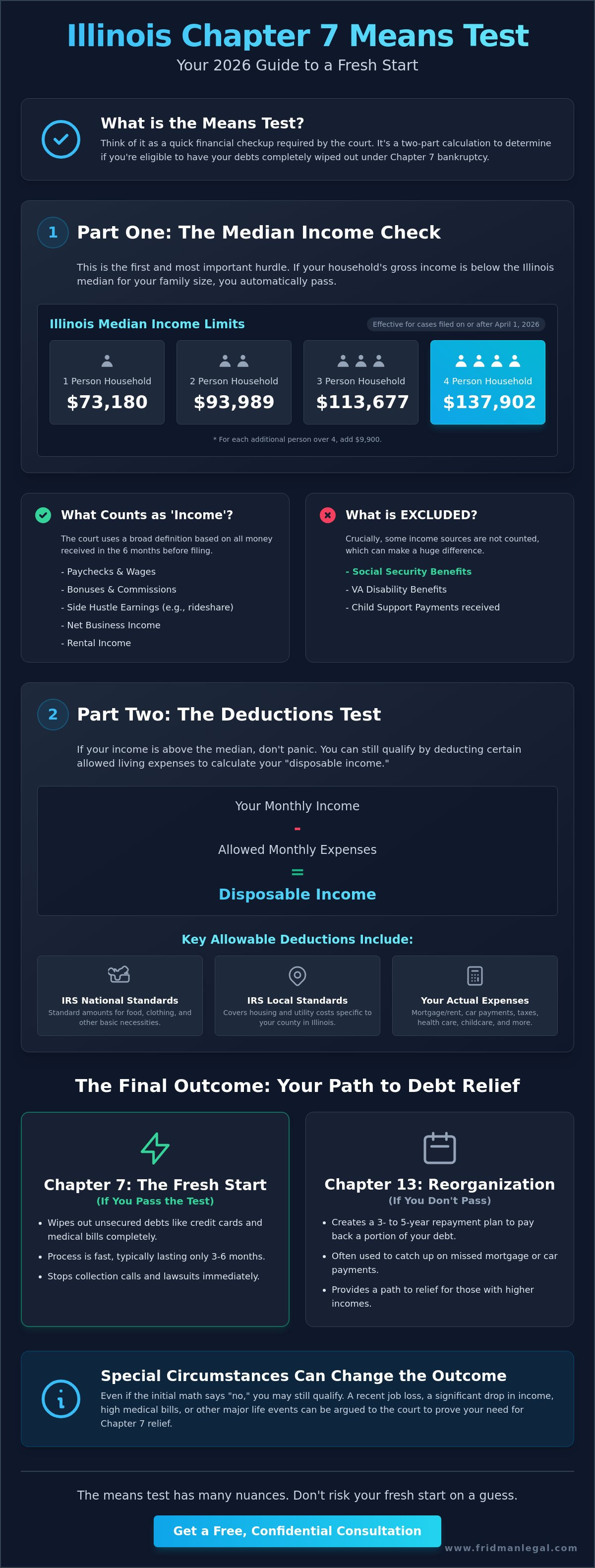
You shouldn't rely on old blog posts from 2024 or 2025. Those figures are now obsolete. The U.S. Trustee Program updates median income limits twice a year to account for inflation and the rising cost of living in Illinois. For cases filed on or after April 1, 2026, the limits have shifted upward to reflect the current economy. For example, the threshold for a one person household is now $73,180, while a four person household is $137,902. Using current 2026 data is vital because even a slight increase in these limits could be the difference between an automatic pass and a more complex legal battle. It's about precision and ensuring your filing is based on the most recent federal standards.
Chapter 7 vs. Chapter 13: What's at stake?
The outcome of this calculation dictates your entire path to debt relief. Chapter 7 is the "fresh start" that most people hope for because it can wipe out unsecured debts like credit cards and medical bills in just a few months. This process is governed by Chapter 7 of Title 11 of the U.S. Code, which sets the strict eligibility rules we're discussing. If the test shows you have enough leftover income to pay back a portion of what you owe, you'll likely be steered toward Chapter 13. That involves a three to five year repayment plan. Understanding the nuances of Chapter 7 bankruptcy Illinois is the best way to protect your future and ensure you don't commit to a payment plan you can't actually afford.
Part One: Comparing Your Income to the Illinois Median
If your gross household income falls below the Illinois median for a family of your size, you've essentially cleared the biggest hurdle before the process truly begins. In this scenario, you automatically pass the test. You don't even have to finish the rest of the complex forms once you establish that your earnings are under the state limit. For cases filed on or after April 1, 2026, the median income for a family of four in Illinois is $137,902. This updated figure reflects recent economic shifts and provides a clearer path for middle-class families to seek relief. Understanding what is the means test in Illinois for 2026 starts with this basic comparison, which serves as a gateway to a total debt discharge.
What counts as 'Income' in the eyes of the court?
The court's definition of income is broader than what you might see on a standard tax return. It isn't just your base paycheck; it includes bonuses, commissions, and even side hustles like driving for a rideshare service or selling items online. Every dollar that came in during the six months prior to your filing date must be accounted for. However, there's a significant exception that serves as a major win for seniors: Social Security benefits are generally excluded from this calculation. If you're a seasonal worker in the Chicago area, we look at your average monthly income over that half-year window, which can help smooth out the spikes in your earnings. You can find the official, raw data tables through the U.S. Trustee Program's Means Testing Information, but interpreting how those numbers apply to your specific living situation is where the real strategy happens.
Defining your household size strategically
Defining your household size strategically is often where the most value is found during a legal review. Most people assume they can only count tax dependents, but the bankruptcy court in Illinois often uses a more flexible "heads in beds" or "economic unit" rule. If you are financially supporting a college student who lives away from home or an elderly parent who resides with you, they might count toward your household size. Since the income limit increases for every additional person in the home, getting this number right is the easiest way to pass the test. For each person beyond a family of four, the 2026 rules allow you to add $11,100 to the median income limit. If you're unsure how to categorize your specific income sources or household members, reaching out for a professional review can clarify your standing immediately and ensure you don't over-report your earnings.
Part Two: The 'Secret' Deductions for Higher Earners
If you're wondering what is the means test in Illinois for 2026 because your salary sits above the median income limits, you're not out of the running for a Chapter 7 discharge. Earning more than the state average simply moves you into the second phase of the calculation. In this stage, we look at your specific expenses to see if you actually have any money left over at the end of the month to pay back creditors. These deductions burn off your disposable income on paper to show you can't afford a repayment plan. It is a technical process, but it's often the key that unlocks a fresh start for middle income families who are drowning in debt despite a good paycheck.
The calculation is a blend of your actual monthly bills and standardized figures set by the IRS. This is where professional legal help becomes essential. If you miss a single allowed deduction, the math might lean toward a "presumption of abuse," which could force you into a five year repayment plan. We make sure every eligible expense is accounted for so you don't leave money on the table or lose your chance at a total discharge.
IRS Local Standards for Cook County
Living in the Chicago suburbs or Cook County comes with a high price tag, and the bankruptcy court recognizes that. The means test allows you to deduct housing and utility costs based on IRS Local Standards for your specific county. Interestingly, these standard amounts might be higher than what you actually spend each month. If your mortgage is lower than the IRS allowance, you may still get to deduct the full standard amount. We also look at transportation standards, which include fixed allowances for car ownership and operating costs. Whether you're commuting into the city or paying off a late model vehicle, these figures are vital for reducing your "disposable" income on paper.
Other critical deductions you might miss
Beyond housing and cars, there are several "actual" expenses that can significantly impact your results. You can find general guidance on these categories through Illinois Legal Aid Online, but the application is often case-specific. Critical deductions include health insurance premiums, mandatory retirement contributions, and all federal and state taxes. You can also deduct charitable contributions, childcare costs, and expenses related to caring for chronically ill or elderly family members. Even education expenses required for your employment can be subtracted. By the time we finish tallying these costs, many "high earners" find that they legally qualify for Chapter 7 bankruptcy because their true disposable income is effectively zero.
What Happens If You 'Fail' the Illinois Means Test?
Failing the means test doesn't mean your case is over. It simply creates what the court calls a "presumption of abuse." This sounds intimidating, but it is actually just a legal hurdle that suggests you might have enough money to pay back some of your debt. It isn't a final judgment or a locked door. A Strategic Bankruptcy Lawyer in Chicago knows how to pivot when the initial math doesn't look perfect. Understanding what is the means test in Illinois for 2026 involves realizing that the court allows for human context. If your income spiked recently but you just lost your job, the test might not reflect your current reality.
The calculation is based on the last six months of income, which can sometimes paint an inaccurate picture of your future. If those numbers don't tell the whole story, we can often rebut the presumption of abuse by presenting a clear, documented explanation of your situation. We look for ways to show the court that your financial state has fundamentally changed since that six-month window closed.
Rebutting the Presumption of Abuse
To move forward with a Chapter 7 despite a "failed" test, you have to demonstrate "special circumstances." In 2026, this often includes a serious medical diagnosis, a permanent change in your employment status, or a call to active military duty. You can't just say things are tough; you need to provide receipts, medical records, or layoff notices. The U.S. Trustee reviews these claims carefully. If we can prove that your income has dropped or your mandatory expenses have skyrocketed, the court may still allow you to proceed with a total debt discharge.
The Chapter 13 Silver Lining
If Chapter 7 truly isn't an option after looking at what is the means test in Illinois for 2026, Chapter 13 serves as a powerful fallback. This isn't a consolation prize. It's a strategic tool that stops foreclosures and ends wage garnishments immediately. In Chapter 13, the means test helps determine your monthly payment in a three to five year plan. It ensures your payment is based on what you can actually afford, not what creditors demand. If the idea of bankruptcy still feels too heavy, a debt settlement lawyer can explore out-of-court negotiations as an alternative. If you're worried about your numbers, request a professional evaluation of your eligibility to find the most secure path forward.
Why a Local Northbrook Attorney Is Your Best Asset
A calculator is a fine starting point, but it's just a tool, not a strategist. When you're trying to figure out what is the means test in Illinois for 2026, it's easy to get buried in spreadsheets and IRS tables. A web tool can't give you legal advice or represent you in front of a Trustee when they have questions about your spending. Fridman Legal brings a deep understanding of the bankruptcy courts in the Northern District of Illinois. We know the specific tendencies of local Trustees and how they view certain deductions, which is something an automated algorithm simply can't replicate. Having an advocate who knows the local landscape provides a level of security that software can't offer.
Timing is everything in this process. Since the test looks at your gross income over the last six months, the date you choose to file can drastically change your results. If you had a high-commission month or a one-time bonus five months ago, waiting just a few weeks might drop your average enough to pass the test automatically. We help you time your filing perfectly to ensure that six-month window works in your favor rather than against you. This human-centric approach means we deal with the math and the technicalities so you can focus on getting your life back on track.
The danger of DIY bankruptcy software
Automated bankruptcy tools are built for the average case, but your life isn't a template. These programs often miss nuanced deductions that a human lawyer would catch, such as specific Cook County cost-of-living adjustments or mandatory retirement contributions. There is a real risk of having your case dismissed because of simple mathematical errors or incorrectly categorized income. O. Allan Fridman's twenty years of experience protects your assets and ensures your filing is accurate from day one. We don't just fill out forms; we build a strategy to protect what you've worked for.
Your path to a fresh start starts here
We believe in transparency and professional integrity, which is why we offer a flat-fee service. You'll know exactly what the costs are upfront, so there are no surprises during your filing. Whether you're in Northbrook or the surrounding suburbs, we provide a personalized consultation to review your unique situation. We can meet in person or handle the details over the phone to make the process as easy as possible for you. Contact Fridman Legal today to see if you qualify and find your path to a debt-free future.
Take Control of Your Financial Future Today
You now have a clearer picture of how to navigate the bankruptcy process this year. The most important thing to remember is that these numbers are just a starting point. While the initial math might seem rigid, your actual financial reality is what truly matters to the court. By correctly defining your household and maximizing every legal deduction, you can often find a path to Chapter 7 that seemed impossible at first glance.
Understanding what is the means test in Illinois for 2026 is about more than just checking a box; it's about building a strategy for your future. With nearly 20 years of Illinois bankruptcy experience and a deep familiarity with Cook and Lake County courts, our team is here to ensure you don't face this alone. We provide flat-fee bankruptcy services so you can move forward with total clarity and no hidden surprises.
If you're ready to stop the stress of debt collectors and finally get the fresh start you deserve, we are ready to help. Schedule a Free Consultation with a Northbrook Bankruptcy Expert today to see exactly where you stand. You don't have to carry this burden by yourself.
Frequently Asked Questions
Is the Illinois means test different for 2026 than in previous years?
Yes, the income thresholds have increased significantly. For filings on or after April 1, 2026, the median income for a single person is $73,180. These figures are updated twice a year by the U.S. Trustee Program to adjust for inflation. Staying current is vital because what is the means test in Illinois for 2026 depends on these latest DOJ standards, which are higher than they were just a year ago.
Can I file for Chapter 7 if my income is over the median?
Yes, you can still qualify by passing the second part of the test. If your income exceeds the median, we look at your disposable income after deducting specific allowed expenses like housing, taxes, and insurance. If these deductions leave you with little to no money at the end of the month, you may still clear the hurdle for Chapter 7 relief. It's about your ability to pay, not just your gross salary.
What happens if I pass the means test but have a lot of equity in my house?
Passing the means test only determines if you can file Chapter 7; it doesn't protect your assets. In Illinois, as of January 1, 2026, the homestead exemption is $50,000 for a single person or $100,000 for a joint filing. If your equity exceeds these limits, a trustee might sell the home to pay creditors. In that case, Chapter 13 might be a safer strategic choice to keep your property.
Does the means test look at my spouse's income if we are filing separately?
Yes, the means test usually considers the entire household income even if only one spouse files. The court wants to see the total economic strength of the home. However, we can apply a marital adjustment deduction for expenses that belong solely to the non-filing spouse, such as their student loans or separate credit card payments. This calculation can help you qualify even with a high-earning partner.
How many months of pay stubs do I need for the Illinois means test?
You need to provide documentation for the six full months of income prior to your filing date. This includes pay stubs, commissions, and any side income. The court uses this data to calculate your current monthly income average. If you file in May, we look at your earnings from November through April to determine your eligibility. Keeping accurate records of every dollar earned is essential for a smooth filing.
Can child support payments help me pass the means test in Illinois?
Yes, child support payments you receive are included as income, but payments you make are a powerful deduction. If you are paying court-ordered child support, that full amount is subtracted from your disposable income. This often helps parents who earn more than the median income qualify for Chapter 7 by lowering their final paper income significantly. It's one of the most reliable deductions available to higher earners.
What is the 'presumption of abuse' in a bankruptcy case?
A presumption of abuse occurs when the math suggests you have enough disposable income to pay back at least a portion of your debts. It doesn't mean you've done anything wrong. It's simply a legal signal that the court might push you toward Chapter 13 instead. We can often overcome this by showing special circumstances like high medical bills or a sudden job loss that the six-month average doesn't show.
What if my income changed significantly in the last month?
A recent drop in income can be a strategic advantage if we time your filing correctly. Because what is the means test in Illinois for 2026 looks at a six-month average, a single month of lower pay might not be enough to pass immediately. However, if your income has permanently decreased, we can often use that as a special circumstance to rebut any presumption of abuse and move forward with your case.

Article by
O. Allan Fridman
O. Allan Fridman has been practicing law since 2001. His practice is unique in that he does not view himself as a litigation attorney or transactional attorney. Rather, he views each area of law as a tool to pursue the best results for his clients. By practicing in both areas of law, he is able to take a 360-degree view of law. This enables the firm to catch potential drawbacks that are readily identifiable.
By practicing in litigation and transactional law and taking a holistic approach in dealing with our clients, he doesn’t put clients in box — rather, as we are all individuals, so too are the legal services we may require.
Whether it is bankruptcy or litigation or transactional, each client brings challenges and does not fit in any one box. Often times, bankruptcy clients end up not filing bankruptcy because we can achieve a better result through litigation or through an out-of-court resolution with the lender, or through a real estate sale. On the other end of the spectrum, a litigation client with multiple issues and lawsuit may fare better in a bankruptcy.
Since 2001, Allan has practiced in states and federal court, and he is a member of the trial bar of the Northern District of Illinois and admitted in the Northern District of Indiana.
We are a debt relief agency. We help people file for bankruptcy relief under the Bankruptcy Code
The materials on this site are for informational purposes only and do not constitute legal advice. Viewing this site or contacting us does not create an attorney–client relationship, and you should not act or refrain from acting based on any information here without seeking professional legal counsel.