

In 2025, the Illinois Attorney General’s office handled 19,763 consumer complaints, and debt issues were right at the top of that list. If you're currently dealing with a phone that won't stop ringing or the constant worry that a single mistake could cost you your home, you aren't alone in feeling overwhelmed. It's completely normal to feel a bit lost when you're trying to figure out the difference between a real solution and a "too good to be true" offer. Most people just want a fresh start, but the pressure of debt makes it hard to focus on avoiding bankruptcy scams in Illinois when every flyer in the mail promises a quick fix.
You deserve a path forward that doesn't involve getting ripped off by predatory schemes or "ghost" preparers who disappear when things get complicated. We're going to show you exactly how to identify legitimate legal help and use the new 2026 Illinois exemption laws to protect assets like your home and car. You'll learn how to spot the red flags of debt settlement traps and find a trustworthy attorney in Northbrook or Chicago who can stop collectors legally. By the end of this guide, you'll have a clear plan to wipe the slate clean while staying far away from legal trouble or accidental fraud.
Key Takeaways
- Learn how scammers use public records to target people in financial distress and what specific warning signs to watch for in your mail.
- Discover why many "debt relief" companies actually lack the power to stop lawsuits or garnishments, unlike a legitimate bankruptcy filing.
- Master a simple five-minute check for avoiding bankruptcy scams in Illinois by verifying any attorney’s record through official state channels.
- Understand the serious legal risks of working with "ghost" petition preparers who won't sign your court documents or represent you.
- See how a transparent, flat-fee approach to Chapter 7 or Chapter 13 can finally stop collector harassment and protect your home.
Spotting the Red Flags: Why Illinois Residents are Targets for Bankruptcy Scams
When you're falling behind on bills, you might expect silence from the world. Instead, your mailbox often explodes with colorful flyers promising a "government-approved" fresh start. This is the reality of avoiding bankruptcy scams in Illinois. It's not a random coincidence; it's a calculated effort by predatory companies to find people at their most vulnerable moment. In the context of the U.S. bankruptcy system, a scam usually involves a non-attorney or a shady "debt relief" firm misrepresenting what they can actually do for you under the law.
Predators use the psychological appeal of a clean slate to lure you into high-fee programs that provide no real legal protection. Residents in high-density areas like Chicago and Northbrook are often targeted because the sheer volume of legal filings makes it easy for scammers to hide in the noise. They know that when you're facing a potential foreclosure or a bank levy, you're looking for a lifeline. They offer a hand, but it's usually attached to a hook designed to drain what little cash you have left.
The "Public Record" Trap
Most people don't realize that their financial struggles are essentially public knowledge. Once a foreclosure is filed in Cook County or Lake County, or a creditor files a lawsuit against you, that information is recorded. Scammers use a system called PACER to monitor these new filings in real time. They scrape your name and address to create a targeted mailing list. This is why you might suddenly receive dozens of mailers a day. It feels like they're watching you because, in a technical sense, they are. You should know that legitimate law firms, like Fridman Law Firm, rarely use these high-pressure, "urgent" mailers that mimic official court documents.
The "Too Good to Be True" Promise
Predators rely on the psychology of desperation. They know you want the phone to stop ringing right now. When a company claims they can "erase all debt for $500" or promises you can "skip the court hearing," they're being dishonest. In bankruptcy law, results are never guaranteed because every case is subject to the review of a trustee and a judge. Any firm that refuses to meet you in person or via a secure video call is a massive red flag. Real legal representation involves a detailed analysis of your specific financial situation, not a one-size-fits-all sales pitch from a call center. If a company guarantees a specific outcome before even looking at your tax returns, it's time to walk away.
The Debt Settlement Trap: Why "Bankruptcy Alternatives" Often Fail
You've likely seen the ads. They promise to cut your debt in half without the "stigma" of bankruptcy. It sounds like a perfect middle ground, but for many people in our state, it's a fast track to a lawsuit. Avoiding bankruptcy scams in Illinois often means looking past these glossy "alternatives" and understanding who is actually on your side. While debt settlement sounds less drastic, it lacks the legal teeth required to actually protect you from aggressive creditors.
The most dangerous part of these programs is the "stop paying" strategy. Most settlement companies tell you to stop paying your creditors and put that money into a private account instead. They claim this gives them leverage to negotiate. In reality, your credit score plummets, interest and late fees pile up, and your creditors get angry. Since these companies have no legal authority, your creditors aren't required to talk to them at all. They might just decide to sue you for the full amount plus their own legal fees while you're still "settling."
Salespeople vs. Attorneys
When you call a debt settlement company, you're usually talking to a salesperson in a call center, not a legal professional. Their goal is to sign you up for a monthly payment plan because that's how they generate commissions. They aren't looking at your long term financial health. It's vital to remember that an attorney has a fiduciary duty to act in your best interest, whereas a settlement clerk is simply a middleman with no legal obligation to you. These companies also hide massive service fees that often eat up the very "savings" they promised you in the first place.
Legal Protection vs. Pinky Promises
A settlement company works on "pinky promises" and hope. A Chapter 7 bankruptcy Illinois filing works on federal law. The moment a bankruptcy is filed, something called the Automatic Stay goes into effect. This is a powerful court order that legally forces every single collector to stop their efforts immediately. It stops wage garnishments, it freezes lawsuits, and it ends the harassing phone calls. A settlement company can't offer you this. If a creditor decides to take your house or garnish your paycheck, a salesperson in a call center can't do anything to stop it. Only a licensed lawyer can use the court system to provide you with an immediate shield. If you want to see how real legal protection works, you can explore your debt relief options with a professional who understands the local court system.
The Danger of "Ghost" Petition Preparers in the Chicago Area
You might run into someone who claims they can handle your entire bankruptcy filing for a fraction of what a law firm charges. These individuals often call themselves "petition preparers." While it sounds like a budget friendly alternative, understanding the risks they carry is a vital part of avoiding bankruptcy scams in Illinois. A ghost preparer is essentially a non-attorney who fills out your court documents but refuses to sign them or identify themselves to the court. This leaves you entirely responsible for every word on those pages, even if they gave you bad advice or made a critical error.
The U.S. Trustee Program referred over 2,200 cases for criminal investigation in 2022, many of which involved bankruptcy fraud. When a ghost preparer makes a mistake, they don't face the consequences. You do. If the court finds that your petition is incomplete or misleading, your case can be dismissed for "bad faith." In some situations, you could even face legal trouble for fraud because you signed the documents under penalty of perjury, while the person who actually wrote them remains invisible to the judge.
The "I’m Just Helping" Scam
Unlicensed preparers often try to blur the lines by saying they're just helping you with the "typing." However, bankruptcy is a complex legal process, not a data entry task. These individuals aren't allowed to give you legal advice. They can't explain how the new 2026 Illinois exemption laws protect your home up to $50,000, and they certainly can't help you navigate the Means Test income limits, such as the $71,304 threshold for a one person household. Many of these preparers charge fees that are surprisingly close to what a real attorney would cost, yet they provide zero legal protection or representation in court.
Identifying a Ghost Preparer
Spotting these predators is easier when you know what to look for. A legitimate professional will always be transparent about their role. You should consider it a massive red flag if a preparer asks you to sign blank forms or tells you to "leave the rest to them." This is a common tactic used to hide their involvement or to insert information you haven't verified. Another dangerous sign is if they suggest you hide assets, like cash in a savings account, from the court. Real legal relief depends on total transparency. You can see what a professional, transparent process looks like by visiting our bankruptcy services page. Working with a licensed attorney ensures that your paperwork is accurate and that your rights are actually being defended by someone who is legally allowed to do so.
- Refusal to sign: If they won't put their name on the "Preparer" line of the petition, walk away.
- High pressure: They might push you to file quickly before you've had a chance to review the details.
- Asset "advice": They might encourage you to move money or property to "save" it, which is often a crime.
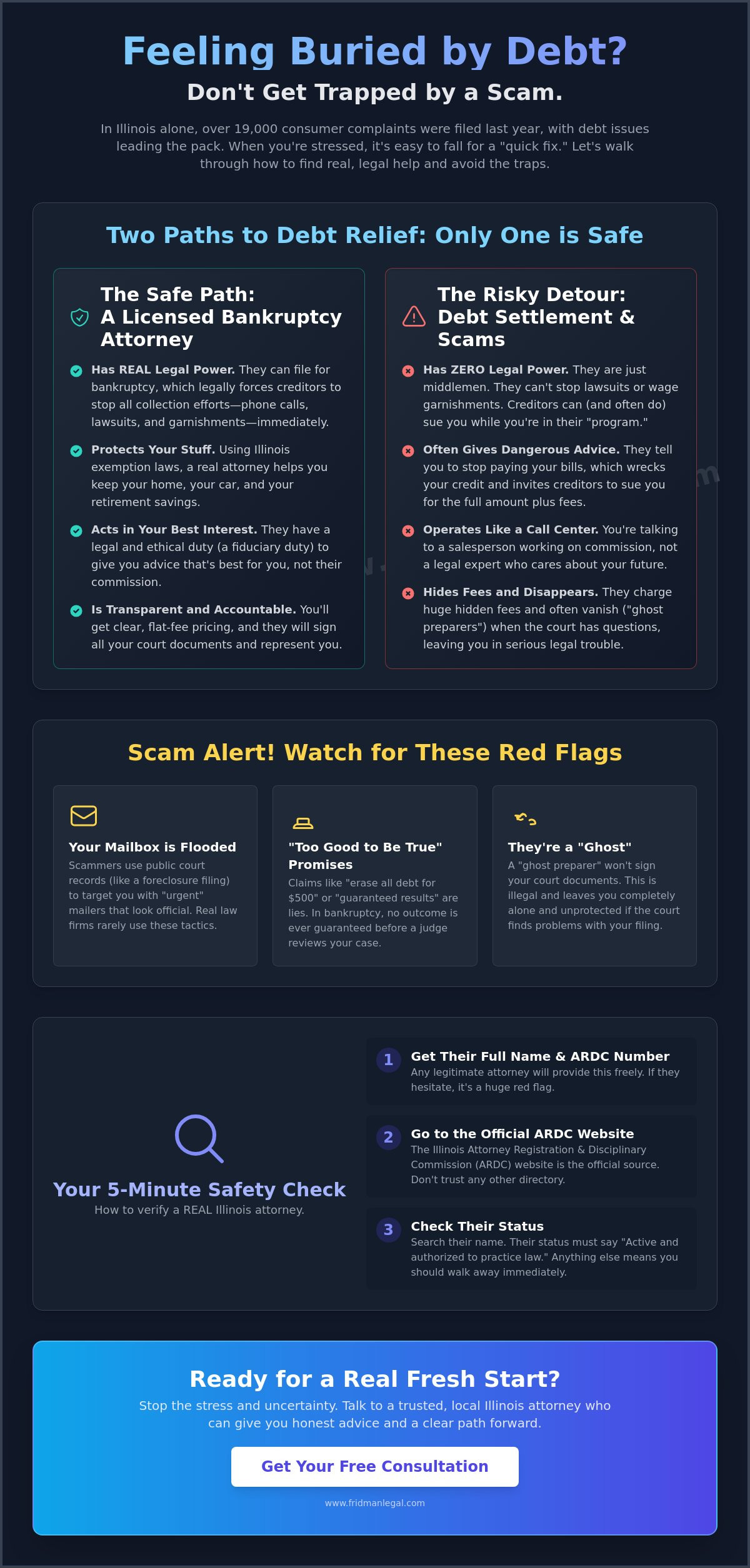
How to Verify a Legitimate Illinois Bankruptcy Attorney
You shouldn't have to guess whether the person handling your financial future is actually qualified to do so. Avoiding bankruptcy scams in Illinois is much easier when you realize that every legitimate lawyer in the state is part of a public, searchable database. It takes less than five minutes to verify someone's credentials, and that small investment of time can save you thousands of dollars and months of legal headaches.
The ARDC Search: Your Best Defense
The first thing you should do is visit the Illinois Attorney Registration and Disciplinary Commission website at iardc.org. Every licensed attorney in the state must be registered here. When you search for a name, you're looking for two specific things. First, their status must say "Authorized to Practice Law." If it says anything else, stop the conversation immediately. Second, check if they have malpractice insurance. While not every lawyer is required to have it, a firm that carries insurance shows they take their professional liability seriously. You should be wary of any "law firm" that refuses to give you the name of a specific lead attorney. If they're hiding behind a generic brand name, they might be a lead generation site or a scam operation.
A physical office in Northbrook or Chicago also provides a layer of accountability that a random website cannot match. Scammers love to operate out of P.O. boxes or virtual offices because it makes them harder to find when things go wrong. A local office means your attorney is part of the local legal community and is familiar with the specific judges and trustees in the Northern District of Illinois. Before you sign anything, ask for a written retainer agreement. This document should clearly explain every fee and cost associated with your case. If the fee structure feels vague or they won't put it in writing, it's a major red flag.
The Consultation Test
Pay close attention to who you speak with during your initial meeting. Are you talking to an actual attorney, or were you passed off to a "case manager" or "enrollment specialist"? A case manager is often just a salesperson in disguise. A real legal consultation should feel like an educational meeting, not a high pressure sales pitch. A qualified lawyer will take the time to explain the specific risks and benefits of a Chapter 11 bankruptcy filing or a Chapter 13 repayment plan based on your unique goals. They won't just push you toward the quickest option; they'll help you understand the long term impact on your credit and assets. If you're ready to speak with a professional who prioritizes transparency, contact Fridman Law Firm to discuss your situation directly with an experienced attorney.
Safe Debt Relief: The Fridman Legal Approach in Northbrook
Finding a way out of debt shouldn't feel like another gamble. Avoiding bankruptcy scams in Illinois begins with a commitment to absolute transparency, which is the cornerstone of how Allan Fridman approaches every case. We believe that professional integrity is the only way to build the trust necessary for a successful legal outcome. You won't find high-pressure sales tactics or vague promises here. Instead, we provide results-driven solutions tailored to the specific financial realities of residents in Cook and Lake County. Our goal is to ensure you understand every step of the process before a single document is filed with the court.
One of the most significant red flags in the "debt relief" industry is a lack of clarity regarding costs. We eliminate this concern by offering flat-fee bankruptcy services for both Chapter 7 and Chapter 13 filings. This means you know exactly what your legal representation costs from the very beginning. You aren't just paying for paperwork; you're paying for a strategic partner who understands the nuances of the local court systems in Chicago and the surrounding suburbs. This local expertise allows us to anticipate the concerns of specific trustees and judges, ensuring your case moves forward with minimal friction.
No Gimmicks, Just Legal Representation
We prioritize administrative accuracy and professional presence above all else. Unlike the "ghost" preparers mentioned earlier, we stand behind every line of your petition. We handle the complexities of the filing and personally attend the mandatory meeting of creditors with you. If your situation is better served through negotiation rather than a court filing, having a licensed debt settlement lawyer ensures your interests are protected by a professional with a fiduciary duty to you. Having a physical office in Northbrook allows us to provide a level of personal service that call centers simply cannot replicate. You can meet your attorney in person, review your documents together, and get direct answers to your most pressing questions.
Taking the First Step Safely
Your first interaction with our team is an objective evaluation of your financial health. We take the time to navigate the Illinois Means Test with precision, checking your income against the current 2026 thresholds, such as the $110,712 limit for a three-person household. We don't cut corners to force a case through the system. Instead, we use the updated 2026 Illinois exemption laws to protect as much of your property as possible, including the increased $50,000 homestead exemption for individuals. We focus on your long-term stability so you can rebuild your life on a solid foundation. If you are ready for a legitimate evaluation of your options, you can contact us directly to begin the process with a professional you can trust.
Take the Next Step Toward Genuine Debt Relief
Reclaiming your financial life is a significant milestone, but it requires a careful approach to ensure you aren't trading one crisis for another. We've discussed the importance of verifying every professional you work with through the ARDC and staying clear of "ghost" preparers who refuse to sign your documents. Avoiding bankruptcy scams in Illinois essentially comes down to choosing transparency over high pressure sales pitches. Real protection only comes from a licensed attorney who has a legal duty to protect your assets and your future.
At Fridman Law Firm, we've spent nearly 20 years providing this exact level of dedicated service to the community. From our Northbrook office, we offer the local accountability you need and the flat fee transparency you deserve for Chapter 7 and Chapter 13 filings. You don't have to navigate this complex system alone or fear that you're being taken advantage of by predatory schemes. When you're ready for a path that is both legal and secure, we're here to help you move forward. Talk to a real Illinois bankruptcy attorney today and start your journey toward a truly clean slate with confidence.
Frequently Asked Questions
Is it a scam if a company says they can stop my foreclosure for a fee?
It is almost certainly a scam if a non-lawyer company promises to stop your foreclosure in exchange for an upfront fee. Legitimate foreclosure defense requires specific legal filings and court appearances that only a licensed attorney can perform. These predators often take your money and then stop answering your calls, leaving you in a far worse position with your lender than when you started.
How can I tell if a debt relief mailer is from a real law firm or a scammer?
You can usually spot a scam mailer by its lack of a specific attorney's name or a physical Illinois office address. Scammers often use official sounding names like "The Settlement Center" to trick you into thinking they're a government agency. A real law firm will be transparent about who they are and won't use high pressure tactics to get you to call.
Can a non-lawyer legally file my bankruptcy petition in Illinois?
No, a non-lawyer cannot legally represent you or file your bankruptcy petition in any Illinois court. While "petition preparers" are technically allowed to type documents you provide, they aren't allowed to give legal advice or sign the paperwork as your representative. Avoiding bankruptcy scams in Illinois means realizing that anyone who isn't a licensed lawyer is essentially just a typing service with no legal authority.
What happens if I accidentally file a petition with a scammer and it has errors?
The court may dismiss your case for bad faith or even charge you with fraud if your petition has significant errors. Since you sign the documents under penalty of perjury, you are the one held legally responsible for any mistakes a scammer makes. This can lead to a permanent ban from discharging those specific debts and could even result in criminal investigations by the U.S. Trustee.
Should I pay a debt relief company to negotiate my debts instead of filing bankruptcy?
You should be extremely careful because debt relief companies have no legal power to stop a creditor from suing you or garnishing your wages. Unlike a formal bankruptcy filing, these companies rely on the willingness of a creditor to negotiate. Most people find that they end up with more fees and a ruined credit score without ever actually resolving their debt balances.
How do I report a bankruptcy scam or an unlicensed lawyer in Illinois?
You should report any suspicious activity to the Illinois Attorney Registration and Disciplinary Commission or the Illinois Attorney General’s office. In 2025 alone, the Attorney General received nearly 2,000 complaints specifically about consumer debt issues. Reporting these predators helps protect other residents in Northbrook and Chicago from falling into the same trap and helps the state take legal action against scammers.
What is the "Automatic Stay" and can a scammer provide it?
The Automatic Stay is a federal court order that legally forces all debt collection activities to stop the moment you file for bankruptcy. A scammer or debt settlement company cannot provide this protection because they don't have the authority of the federal court system. Avoiding bankruptcy scams in Illinois requires understanding that only a legitimate court filing can legally freeze lawsuits, repossessions, and wage garnishments.
Why do scammers ask for my social security number and bank info so early?
Scammers ask for your social security number and bank details early so they can commit identity theft or drain your remaining accounts before you realize it's a fraud. A real law firm will only ask for this information through secure, formal channels after you've had a consultation and signed a written retainer agreement. If someone asks for your sensitive data over the phone before you've even met them, hang up.

Article by
O. Allan Fridman
O. Allan Fridman has been practicing law since 2001. His practice is unique in that he does not view himself as a litigation attorney or transactional attorney. Rather, he views each area of law as a tool to pursue the best results for his clients. By practicing in both areas of law, he is able to take a 360-degree view of law. This enables the firm to catch potential drawbacks that are readily identifiable.
By practicing in litigation and transactional law and taking a holistic approach in dealing with our clients, he doesn’t put clients in box — rather, as we are all individuals, so too are the legal services we may require.
Whether it is bankruptcy or litigation or transactional, each client brings challenges and does not fit in any one box. Often times, bankruptcy clients end up not filing bankruptcy because we can achieve a better result through litigation or through an out-of-court resolution with the lender, or through a real estate sale. On the other end of the spectrum, a litigation client with multiple issues and lawsuit may fare better in a bankruptcy.
Since 2001, Allan has practiced in states and federal court, and he is a member of the trial bar of the Northern District of Illinois and admitted in the Northern District of Indiana.
We are a debt relief agency. We help people file for bankruptcy relief under the Bankruptcy Code
The materials on this site are for informational purposes only and do not constitute legal advice. Viewing this site or contacting us does not create an attorney–client relationship, and you should not act or refrain from acting based on any information here without seeking professional legal counsel.