

What if filing for bankruptcy was actually the most effective way to ensure you never lose your family home? For many families in the Chicago suburbs, the fear of losing everything to debt feels like a constant shadow. You might worry that your income in Cook or Lake County is too high for the Means Test, or that the court will take your car to pay off creditors. If you're tired of the endless collector calls and the threat of wage garnishment, finding a chapter 7 bankruptcy lawyer chicago suburbs is the first step toward reclaiming your peace of mind. It isn't about giving up; it's about using the law to protect your future.
You likely believe that your suburban home is your most important asset, and you're right to want to protect it. I'll show you how the updated 2026 Illinois exemptions allow you to wipe out overwhelming debt while keeping your house and your vehicle. We will look at the specific income limits for 2026, such as the $137,902 threshold for a four person household, and how the new $50,000 homestead exemption works for you. This article explains exactly how to navigate the filing process to achieve a total debt discharge and a genuine fresh start.
Key Takeaways
- Understand how Chapter 7 works as a legal reset to eliminate credit card debt and medical bills without losing your peace of mind.
- Learn how the 2026 Illinois Means Test applies to your household income and why partnering with a chapter 7 bankruptcy lawyer chicago suburbs is crucial for qualifying.
- Discover the specific 2026 exemptions that let you protect up to $50,000 in home equity and keep your vehicle while discharging debt.
- Get a clear roadmap of the filing process, from your first document gathering to completing the mandatory credit counseling courses.
- See how a transparent flat-fee model and decades of local experience can remove the stress of hidden legal costs during your financial recovery.
What is Chapter 7 Bankruptcy and How Does it Work in the Chicago Suburbs?
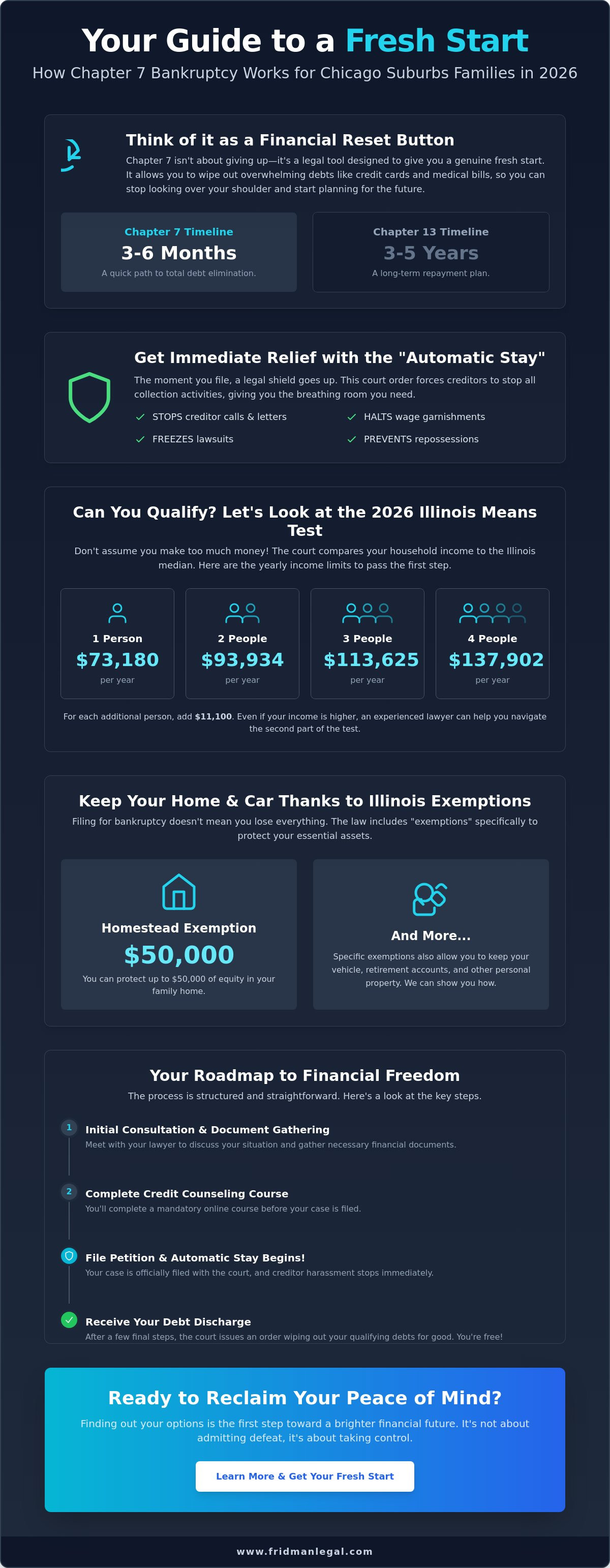
Think of Chapter 7 bankruptcy as a legal reset button for your finances. While the court technically calls it a liquidation bankruptcy, for most people living in the Chicago suburbs, it's simply the fastest way to eliminate overwhelming unsecured debt. When you file, the law allows you to wipe out obligations that have been weighing you down for years. This isn't about losing your dignity; it's about a "Fresh Start." In plain English, this means that once your case is finished, you no longer legally owe the money that was discharged. You can finally stop looking over your shoulder and start planning for the future again.
The process is governed by Chapter 7 of Title 11 of the U.S. Code, which provides a structured way for individuals to seek relief. One of the most powerful parts of this process is the "Automatic Stay." The moment your case is filed, a legal shield goes up. This order immediately stops debt collectors in their tracks. They can't call you, they can't send threatening letters, and they must halt any active wage garnishments or lawsuits. It provides immediate breathing room while your bankruptcy case moves through the court system.
The Reality of Debt in the Chicago Suburbs
Living in areas like Northbrook or Glenview comes with a high price tag. Even high-earning suburbanites often find themselves struggling when a medical emergency or a sudden job change occurs. The cost of maintaining a household in Cook or Lake County can make it nearly impossible to catch up once you've fallen behind. It's important to distinguish between your debts. Unsecured debt, like credit cards, medical bills, and personal loans, is what Chapter 7 typically erases. Secured debt, like your mortgage or car loan, involves assets you likely want to keep, which requires a different strategic approach during the filing.
Why Chapter 7 is the Most Common Choice
Efficiency is a major reason why many families choose this path. The entire process usually takes only three to six months from the day you file until you receive your discharge papers. Unlike Chapter 13, which requires you to commit to a three to five year repayment plan, Chapter 7 is designed for speed and total debt elimination. Chapter 7 is a legal tool for total debt forgiveness. If you're feeling stuck in a cycle of interest and late fees, a chapter 7 bankruptcy lawyer chicago suburbs can help you determine if this path fits your specific financial situation and goals for 2026.
Qualifying for Relief: The Illinois Means Test and Suburban Income
Many people in the Chicago suburbs assume they make too much money to file for Chapter 7. This is a common misconception. The court uses a calculation called the "Means Test" to decide if your income is low enough to qualify for total debt discharge. If you live in Cook or Lake County, where salaries are often higher than the national average, the test accounts for your specific geographic reality. A chapter 7 bankruptcy lawyer chicago suburbs can help you navigate these numbers so you don't disqualify yourself prematurely. The goal of this test isn't to block you from relief; it's to ensure that Chapter 7 is the appropriate tool for your financial situation.
If you're currently facing constant calls from creditors or the threat of a lawsuit, understanding these qualifications is the first step toward safety. The math can be complex, but it's designed to be fair. It looks at your average income over the six months before you file. Even if you've recently started a high paying job, you might still qualify if your previous months were lean. The system is built to provide a way out for those who are genuinely overwhelmed by debt, regardless of their zip code.
Median Income Limits in Illinois
The first step of the Means Test compares your gross household income against the median income for a family of your size in Illinois. As of April 1, 2026, the limits have been adjusted to reflect current economic conditions. For a single person household, the limit is $73,180. For a household of two, it's $93,934, and for a household of three, it's $113,625. A household of four has a limit of $137,902. For every person you add beyond that, you can add another $11,100 to the total. You can find more details on the Chapter 7 Bankruptcy Basics page provided by the federal courts. If your income falls below these amounts, you typically qualify for Chapter 7 without further calculations.
Deducting Suburban Expenses
This is where the high cost of living in the Chicago suburbs actually works in your favor. If you earn more than the median, we move to the second part of the test. The law allows you to deduct specific "allowable expenses" from your gross income. If you have a high mortgage payment or significant property taxes in a place like Northbrook, those costs reduce your "disposable income" in the eyes of the court. You can also deduct health insurance premiums, commuting costs, and even some charitable contributions. For a deeper look at how this applies to specific neighborhoods, you might find our guide on Chapter 7 Bankruptcy in Northbrook, IL helpful. If your disposable income is low enough after these deductions, you can still file for Chapter 7 despite a high salary. If you still don't qualify, we would then look at a Chapter 13 filing as a strategic alternative to manage your debt. If you aren't sure where you stand, it's worth taking a moment to consult with a professional to run the numbers accurately.
Protecting Your Suburban Assets: Can You Keep Your House and Car?
The most common fear I hear from families in the Chicago suburbs is that filing for bankruptcy means losing the family home. It's an understandable worry. You've worked hard for your slice of the suburbs, and the thought of a court taking your property is terrifying. However, the reality of Chapter 7 is often the exact opposite. The law includes specific "exemptions" that act as a legal shield for your assets. Working with a chapter 7 bankruptcy lawyer chicago suburbs ensures that your property is categorized correctly to maximize these protections. Most people who file for Chapter 7 in Illinois find that they don't actually lose any of their personal property.
Exemptions are the rules that define which assets the court can't touch. While the Illinois Means Test determines your eligibility to file, these exemptions determine what you get to keep. As of January 1, 2026, Illinois has significantly increased several of these protections, making it easier for suburban homeowners to seek relief without sacrificing their stability.
The Illinois Homestead Exemption Explained
The homestead exemption is your primary defense for your house. For cases filed in 2026, an individual can protect up to $50,000 of equity in their primary residence. If you're a married couple filing jointly, that protection doubles to $100,000. Equity is the difference between what your home is worth and what you still owe on the mortgage. If your equity is below these limits, the bankruptcy trustee cannot sell your home to pay off your creditors. Most Chapter 7 filers in Illinois keep their primary residence.
Keeping Your Vehicle and Personal Belongings
Your daily commute is essential for suburban life, and the law recognizes that. The motor vehicle exemption has increased to $3,600 of equity in one car. If your car is worth less than the loan or has less than $3,600 in equity, it's generally safe. You also have a "wildcard" exemption of $4,000, which you can apply to any personal property, such as money in a savings account or jewelry. If you use tools for your job, you can protect an additional $2,250 under the "tools of the trade" exemption.
It's also vital to remember that retirement accounts like 401ks and IRAs are almost always fully protected under federal law. When we look at your suburban household, we distinguish between luxuries and necessities. While a second vacation home might be at risk, your clothing, household furniture, and retirement savings are typically off limits to the court. This structure is designed to give you a true fresh start, not to leave you with nothing.
The Step-by-Step Filing Process in the Chicago Suburbs
The path to a fresh start follows a specific legal sequence that is far less intimidating than most people imagine. It begins with a focused period of data gathering. You'll need to pull together your most recent pay stubs, tax returns from the last two years, and a comprehensive list of every bill you owe. While this feels like a lot of homework, it's the foundation of a successful case. When you sit down with a chapter 7 bankruptcy lawyer chicago suburbs, we'll use these documents to build your petition and ensure every exemption is applied correctly. Before we can officially file, you'll also complete a mandatory credit counseling course. It's a straightforward session, usually done online or over the phone, designed to ensure you've explored all your financial options.
Once your paperwork is finalized, your chapter 7 bankruptcy lawyer chicago suburbs will file your petition electronically with the court. The moment that "submit" button is clicked, the automatic stay takes effect, providing you with immediate legal protection. About a month after filing, you'll attend what's known as the 341 Meeting of Creditors. Despite the formal name, creditors rarely actually attend these sessions. It's typically a brief, ten minute conversation with a court appointed trustee who verifies your identity and asks a few standard questions about your assets and the accuracy of your filing documents.
Local Suburban Bankruptcy Courts
All bankruptcy cases in our region are handled by the United States Bankruptcy Court for the Northern District of Illinois. If you live in the immediate suburbs of Cook or Lake County, your case will fall under the Eastern Division in Chicago. For those further out in the far northwest suburbs, you might fall under the Rockford division. In 2026, many of these 341 meetings are still conducted remotely via phone or video conference. This means "going to court" often happens from the comfort of your own home, making the experience much more informal and less stressful than a traditional trial.
Life After Discharge
The final step in your journey is the discharge decree. This is the legal order that officially wipes out your qualifying debt. Once you receive this document, you're no longer legally obligated to pay those creditors. From here, the focus shifts to recovery. Many clients are surprised at how quickly they can start rebuilding their credit scores by managing new bills carefully and using credit strategically. For a deeper dive into how this legal reset works, you can read our guide on being a Strategic Bankruptcy Lawyer in Chicago. If you're ready to see how this process applies to your specific financial situation, reach out to our office to start the conversation.
Why Choose Fridman Legal for Your Suburban Chapter 7 Case?
Choosing the right legal partner is about more than just finding someone who can fill out forms. It's about finding a chapter 7 bankruptcy lawyer chicago suburbs who actually understands the nuances of the local court system and the unique pressures of suburban life. O. Allan Fridman brings over 20 years of experience to every case, providing a level of insight that only comes from decades of practice in Cook and Lake County. One of the biggest stressors in legal matters is the unknown cost. We address this directly with a flat-fee model. This means you won't deal with hidden costs or surprise hourly bills. You'll know exactly what to expect from the start, allowing you to focus on your financial recovery instead of worrying about the clock.
Our approach to bankruptcy services is built on a human-centric philosophy. We know that debt isn't just a numbers problem; it's a life problem. We use clear, conversational language to explain your options because you deserve to feel empowered, not confused. While the legal environment is complex, your relationship with your attorney shouldn't be. We prioritize professional integrity and precision, ensuring that your interests are defended with the quiet confidence that comes from years of successful advocacy in the Chicago suburbs.
A Personalized, Boutique Experience
At Fridman Legal, you aren't just another case number in a database. Unlike large city firms where you might only ever speak to a paralegal, here you work directly with a principal attorney. This boutique approach ensures that every detail of your petition is handled with professional precision. Our office in Northbrook serves as a convenient hub for clients across the Chicago suburbs, providing a discreet and professional environment to discuss your future. Having a local advocate means your strategy is tailored to the specific dynamics of the suburban market, from property valuations to local trustee expectations.
Ready to Take the First Step?
If you're still feeling unsure about the Means Test or worried about your specific assets, a quick conversation can often clear up the confusion. There's no pressure to commit; sometimes just hearing how the law applies to your specific income and household size provides the relief you need to sleep better at night. We're here to help you navigate the 2026 regulations with confidence and clarity. Contact us today to schedule your consultation and let's start mapping out your path to a fresh start.
Secure Your Financial Future in the Chicago Suburbs
Navigating debt shouldn't mean sacrificing the life you've built in the suburbs. The 2026 Illinois exemptions are specifically designed to help you keep your home and your car while wiping out the unsecured debt that's holding you back. Whether you're worried about the Means Test or just need to stop the constant collector calls, the right legal strategy makes all the difference. You don't have to guess about your eligibility when clear, professional answers are available.
With over 20 years of local experience and a transparent flat-fee pricing model, our Northbrook-based firm is here to guide you through every step of the process. Working with a dedicated chapter 7 bankruptcy lawyer chicago suburbs ensures that your assets are protected and your filing is handled with the precision it requires. It's time to move past the stress and start your next chapter with confidence. Schedule a Free, Conversational Consultation with Fridman Legal today to explore your options. You've worked hard for your home; let's make sure you get to keep it.
Frequently Asked Questions
Can I file for Chapter 7 bankruptcy and keep my house in the Chicago suburbs?
Yes, you can keep your home as long as your equity stays within the legal limits. As of January 1, 2026, the Illinois homestead exemption protects up to $50,000 of equity for an individual or $100,000 for a married couple. If your home's value minus your mortgage balance is less than these amounts, the court won't touch your property. This allows most suburban homeowners to eliminate their debt without losing their primary residence.
What is the income limit for Chapter 7 bankruptcy in Illinois in 2026?
The income limits are based on your household size and were updated for cases filed on or after April 1, 2026. For a single person, the limit is $73,180, while a household of four has a limit of $137,902. If your gross income is higher than these figures, a chapter 7 bankruptcy lawyer chicago suburbs can help you apply specific deductions for suburban expenses like high property taxes or health insurance to see if you still qualify through the Means Test.
How much does a Chapter 7 bankruptcy lawyer cost in Chicago?
The total cost involves a court filing fee of $338 plus the legal fees charged by your attorney. Legal fees vary depending on how complex your financial situation is, but many boutique firms offer flat-fee pricing to avoid any surprises. You should always ask for a clear fee agreement during your first meeting so you know exactly what the investment will be to clear your debt.
Will my employer find out if I file for bankruptcy in Northbrook?
Employers are almost never notified of a Chapter 7 filing unless they are also one of your creditors. While bankruptcy is a matter of public record, the court doesn't send a notice to your workplace. Unless you have a specific wage garnishment that needs to be stopped, your employer will likely never know you filed unless you choose to share that information with them.
How long does the Chapter 7 process take from start to finish?
Most Chapter 7 cases move through the court system in three to six months. The clock starts the day your lawyer electronically submits your petition. After about thirty days, you'll have a brief meeting with the trustee. If everything is in order, you'll receive your final discharge decree a few months later, officially erasing your qualifying debts.
Can I wipe out my medical bills with Chapter 7 bankruptcy?
Yes, medical bills are classified as unsecured debt and are completely erasable through the Chapter 7 process. This includes everything from surgeon fees to hospital stays and prescription costs. For many families in the suburbs, medical debt is the primary driver for filing, and Chapter 7 provides a direct way to eliminate those balances permanently.
What happens to my credit score after a Chapter 7 discharge?
Your credit score will take an initial hit, but it's often the first step toward a much higher score in the long run. By wiping out your debt, you improve your debt to income ratio, which is a major factor in credit scoring. Many people are able to start rebuilding their credit immediately after their discharge by using new credit lines responsibly and paying every bill on time.
Do I have to go to a courthouse in downtown Chicago to file?
You likely won't need to visit a courthouse in person. In 2026, almost all bankruptcy documents are filed electronically by your chapter 7 bankruptcy lawyer chicago suburbs. Even the mandatory Meeting of Creditors is typically handled via a phone call or video conference. This means you can complete most of the legal process from your home or office in the suburbs without the stress of a commute downtown.

Article by
O. Allan Fridman
O. Allan Fridman has been practicing law since 2001. His practice is unique in that he does not view himself as a litigation attorney or transactional attorney. Rather, he views each area of law as a tool to pursue the best results for his clients. By practicing in both areas of law, he is able to take a 360-degree view of law. This enables the firm to catch potential drawbacks that are readily identifiable.
By practicing in litigation and transactional law and taking a holistic approach in dealing with our clients, he doesn’t put clients in box — rather, as we are all individuals, so too are the legal services we may require.
Whether it is bankruptcy or litigation or transactional, each client brings challenges and does not fit in any one box. Often times, bankruptcy clients end up not filing bankruptcy because we can achieve a better result through litigation or through an out-of-court resolution with the lender, or through a real estate sale. On the other end of the spectrum, a litigation client with multiple issues and lawsuit may fare better in a bankruptcy.
Since 2001, Allan has practiced in states and federal court, and he is a member of the trial bar of the Northern District of Illinois and admitted in the Northern District of Indiana.
We are a debt relief agency. We help people file for bankruptcy relief under the Bankruptcy Code
The materials on this site are for informational purposes only and do not constitute legal advice. Viewing this site or contacting us does not create an attorney–client relationship, and you should not act or refrain from acting based on any information here without seeking professional legal counsel.