

You're sitting at your kitchen table in Cook County, staring at a stack of final notices while your phone vibrates with yet another debt collector's call. It's a heavy feeling, especially when the fear of wage garnishment or losing your home starts to feel like an inevitable reality. You might feel like bankruptcy is the only exit, but that's a common misconception that ignores the powerful legal tools available to you in Illinois right now.
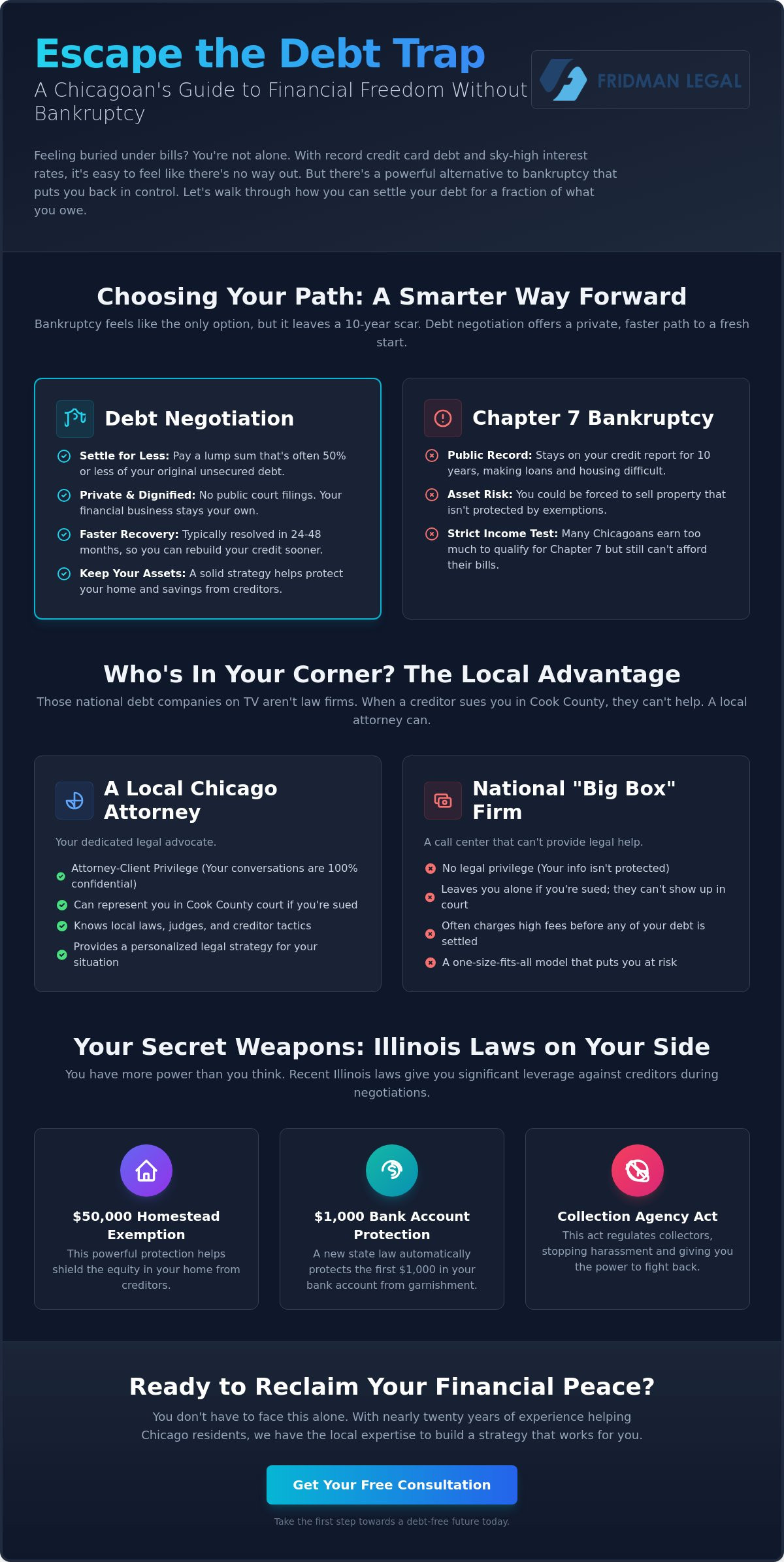
With the 2026 updates to state law, such as the increased $50,000 homestead exemption and the new $1,000 automatic bank account protection, you actually hold significant leverage over your creditors. I'll show you how to leverage debt negotiation services Chicago residents can use to settle their bills for much less than they owe while keeping their assets safe. We'll break down the difference between settlement and consolidation, explain how to stop the harassment, and outline a clear legal strategy to reclaim your financial peace of mind without filing for Chapter 7.
Key Takeaways
- Learn how to settle your debts for a fraction of what you owe by using a targeted legal strategy that avoids the lasting impact of a bankruptcy filing.
- Discover why choosing local debt negotiation services Chicago residents trust provides better protection than national companies that often hide fees and lack local court knowledge.
- Find out how specific Illinois laws like the Collection Agency Act stop collector harassment and give you the upper hand during settlement talks.
- Get a clear, sustainable plan for auditing your unsecured debts and building a settlement fund that actually works with your monthly budget.
- See how nearly twenty years of local experience in the Chicago legal market can help you resolve financial distress with professional privacy and precision.
Understanding Debt Negotiation Services in Chicago: Is It Right for You?
Choosing how to handle overwhelming debt is rarely a simple decision. By mid-2026, the financial pressure on many households has reached a breaking point. With national credit card debt hitting a record $1.35 trillion and average APRs stuck at a staggering 21.52%, many Chicagoans find that their monthly payments barely cover the interest. If you're in this position, you've likely realized that minimum payments are no longer a viable strategy. This is where professional debt negotiation services Chicago residents rely on can offer a strategic exit that avoids the long-term shadow of a bankruptcy court.
Debt negotiation isn't a magic trick; it's a calculated legal settlement. It involves a proactive choice to resolve your obligations for less than the full balance. Unlike bankruptcy, which is a public court process, negotiation happens behind the scenes. It allows you to maintain a level of privacy while still achieving the financial reset you need to move forward.
What exactly is debt negotiation?
In legal circles, we often refer to this process as "haircutting" the debt. You're essentially asking a creditor to accept a one-time, lump-sum payment to satisfy the entire balance. Understanding Debt Negotiation is vital because it only applies to unsecured debts. This includes things like credit card balances, medical bills, and certain personal loans. It's fundamentally different from a debt management plan, where you still pay back every penny plus interest. Here, the goal is to cut the principal balance itself, sometimes by half or more, depending on the creditor’s willingness to avoid the risk of you filing for bankruptcy instead.
Why Chicagoans are choosing negotiation over bankruptcy in 2026
The 2026 Chicago real estate market remains highly competitive. If you're planning to buy a home or move into a new commercial space, a Chapter 7 filing on your record for ten years can be a major roadblock. Negotiation allows you to resolve the debt faster, often within 24 to 48 months, and start rebuilding your credit profile much sooner.
Additionally, many professionals in Cook County find they don't pass the "Means Test" for Chapter 7 because their income is too high, yet they still don't have enough cash flow to survive. Negotiation provides a middle ground. It offers the emotional relief of knowing your debt is being handled by a professional without the rigid, years-long oversight of a Chapter 13 trustee. It's about taking control of the narrative rather than letting a court dictate your financial life.
While the DIY approach exists, it's often a lopsided fight. Creditors have entire departments dedicated to collections. Having a local attorney who understands the Chicago legal landscape ensures that your settlement is legally binding and that you aren't being bullied into a deal that doesn't actually solve your problem.
Why a Chicago Debt Attorney Beats a National Consolidation Company
Those late-night commercials make it sound so easy, don't they? National companies promise to wipe away your debt with one low monthly payment. But there's a world of difference between a call center in another state and a local attorney who knows the Cook County court system inside and out. When you're looking for the kind of debt negotiation services Chicago residents actually need, the name on the letterhead is your first line of defense.
These national firms usually focus on volume, not a personal strategy. Since they aren't law firms, they can't offer you attorney-client privilege. That's a huge deal. Anything you tell a salesperson at a national company isn't confidential. If things get messy, those records aren't protected. Their fees are often just as problematic. You might find them taking a huge chunk of your savings or charging monthly admin fees before they've even picked up the phone to call a creditor.
The hidden risks of Big Debt settlement firms
Most national firms tell you the same thing: just stop paying your bills. While that's a tactic to build leverage, it often triggers a lawsuit. If a bank sues you in a Chicago courtroom, that national firm can't show up to help you. They're not licensed in Illinois. You're left on your own against wage garnishments and frozen accounts. It's a dangerous lack of accountability that leaves you exposed when a process server shows up. These firms are basically practitioners without a license who vanish when the legal heat turns up.
The power of legal representation in Cook County
Creditors pay attention when a local law firm steps in. At Fridman Legal, we don't just push paper; we prepare for litigation. Every case is handled as if it's going to court. When big banks see a firm with nearly twenty years of experience in the Chicago market, they realize they can't just bully you. They know we understand how to negotiate with a debt collector using the latest 2026 Illinois bank exemptions.
We've spent years across from the opposing counsel who represent these banks in Northbrook and the surrounding suburbs. We know their settlement limits. If you want a strategy built on legal muscle rather than a phone script, it's worth seeing how professional debt negotiation can actually protect your assets.
Illinois Laws That Give You Leverage in Debt Settlements
Leverage in a negotiation comes from understanding what the other side stands to lose. In Cook County, creditors are well aware of the strict protections Illinois law provides to consumers. Using debt negotiation services Chicago professionals offer means you're tapping into these specific statutes to force a favorable outcome. One of the most potent tools in your arsenal is the Debt Settlement Consumer Protection Act, which ensures that companies helping you settle debt follow rigorous licensing and fee disclosure rules. This prevents the predatory "upfront fee" structures that used to plague the industry.
Beyond that, the statute of limitations on debt in Illinois serves as a hard deadline. For most written contracts, creditors have a specific window to sue. If they miss it, the debt becomes legally uncollectible in court. Additionally, for consumer debt judgments entered on or after January 1, 2026, the law now limits enforceability to 15 years with no option for revival. Knowing these dates can completely change the tone of a negotiation, as a creditor's "threat" to sue loses its teeth if the clock has already run out.
Fair Debt Collection Practices in Illinois
The Illinois Collection Agency Act and the Consumer Fraud Act set clear boundaries on collector behavior. They can't threaten you with actions they aren't legally allowed to take, such as claiming they'll have you arrested. When you hire an attorney, the dynamic shifts instantly. Under the law, once a collector knows you're represented, they're generally prohibited from contacting you directly. It stops the clock on the constant phone calls and letters, funneling all communication through your legal counsel. This isn't just about peace of mind; it's a tactical move. It's also important to remember that debt buyers who purchase old accounts for pennies on the dollar often have far more flexibility to settle than the original creditor who first issued the credit line.
Using the threat of bankruptcy as a negotiation tool
Creditors are businesses, and they're driven by risk assessment. They know that if you file for Chapter 7 bankruptcy in Illinois, they'll likely receive zero cents on the dollar. This makes a settlement offer of 30 or 40 percent look like a win to them. It's a bird-in-the-hand scenario where they'd rather take a guaranteed payment now than risk losing everything in a total discharge.
A strategic settlement window often opens right before a bankruptcy petition is filed. By demonstrating that you're prepared to take the bankruptcy route if a reasonable settlement isn't reached, you create a sense of urgency. With the 2026 increase in the Illinois homestead exemption to $50,000 and the automatic $1,000 bank account protection, creditors realize that even if they sue you, there's less collectible property for them to seize. This reality often brings them to the table much faster than they would have come just a few years ago.
The Step-by-Step Path to Settling Your Debt in the Windy City
Resolving a mountain of debt isn't something that happens overnight. It's a methodical process that requires a clear head and a solid strategy. When you engage debt negotiation services Chicago experts provide, the first step is always a deep dive into your finances. We start with a comprehensive audit of every unsecured debt you own, from high-interest credit cards to those lingering medical bills from a Cook County hospital visit. We also look at your current income to determine what's actually sustainable. There's no point in making an offer you can't follow through on; we need to build a "settlement fund" that works within your real-world budget.
If you're already facing a pending lawsuit in the Daley Center or have received formal notices from a creditor's law firm, the next step is immediate legal action. We draft a formal response to these filings. This isn't just about paperwork; it's about signaling to the bank's legal team that you're represented by counsel. Once that's done, the actual negotiation begins. This is where your attorney speaks directly to the bank’s lawyers, using the leverage of Illinois law and the potential for a bankruptcy filing to drive the balance down as far as possible.
Assessing your financial landscape
Gathering your most recent statements is the first hurdle. We need to identify which debts are "settlement-ready." Generally, accounts that are already a few months past due offer the most room for negotiation. We'll prioritize high-interest credit cards first because they're the ones draining your bank account the fastest. Be completely honest with your lawyer during this stage. If there's an old, stagnant debt you've ignored for years, we need to know. A bulletproof strategy is built on facts, not surprises.
The art of the settlement offer
Negotiation is a conversation, not a demand. The first offer we send is rarely the one the bank accepts, and that's by design. Timing plays a huge role here. Often, we'll aim for the end of a business quarter when banks are more motivated to clear "bad debt" off their books to satisfy their shareholders. This is when you can see the deepest discounts on your principal balance.
Once we reach an agreement, we don't just take their word for it. We finalize everything in writing with a "Release of Liability" document. This ensures that once the settlement is paid, the debt is legally satisfied and the creditor can't come back for more later. We also make sure the account is marked correctly for the credit bureaus so you can begin the rebuilding process. If you're ready to see how these steps apply to your specific situation, you can request a professional case review to get started on your path to financial peace.
How Fridman Legal Navigates Chicago Debt Relief for You
When you're dealing with the weight of unmanageable debt, you don't just need a service provider; you need a dedicated advocate who knows the local landscape. O. Allan Fridman has spent nearly twenty years in the Chicago legal market, building a reputation for precision and professional integrity. We understand that every financial crisis is deeply personal, which is why our approach to debt negotiation services Chicago residents rely on is built around results and, more importantly, your peace of mind. We aren't a high-volume call center. We're a local firm that prioritizes strategic, personalized solutions for every client who walks through our door.
Our Northbrook office offers a convenient location for our suburban clients, while our modern digital consultation options ensure that those living in the heart of the city can access high-level legal support without the commute. We take a holistic view of your situation. While our primary goal is often to settle your debts for a fraction of what you owe, we're also fully prepared to pivot. If a creditor refuses to be reasonable, we have the expertise to transition your case into bankruptcy protection, ensuring you're never left without a legal shield. This dual capability is something national settlement firms simply cannot offer.
A customized approach to your financial freedom
At Fridman Legal, we don't believe in "one-size-fits-all" templates. Every creditor has different settlement thresholds, and every client has a unique budget. We take the time to build a strategy that actually fits your life. Our initial consultations are a judgment-free zone where we lay all the options on the table. We want you to understand the "why" behind every move we make. If you're ready to stop the stress and start a real conversation about your future, you can reach out through our contact page for a private strategy session.
Why local expertise matters in Northbrook and beyond
There's a distinct advantage to having a lawyer who has spent decades in Cook County courtrooms. We know the judges, we know the opposing counsel, and we know exactly how local court procedures can be used to your advantage. This local insight is often what makes the difference between a mediocre settlement and a great one.
Our firm’s broader expertise in real estate law also means we're uniquely positioned to protect your most valuable asset: your home. We understand how debt issues can intersect with property rights, and we work tirelessly to ensure your residence remains secure throughout the negotiation process. Taking the first step toward financial recovery is often the hardest part, but you don't have to do it alone. Let’s work together to close this chapter and build a more stable financial future for you and your family.
Take the First Step Toward Your Financial Reset
You've seen how the 2026 updates to Illinois law, from increased homestead exemptions to automatic bank account protections, have shifted the balance of power back into your hands. Settling your debt isn't just about making a phone call; it's about a strategic legal defense that national call centers simply can't provide. By utilizing the debt negotiation services Chicago families trust, you can stop collector harassment and resolve your obligations for a fraction of the balance without the long-term stigma of bankruptcy.
At Fridman Legal, you aren't just another case file. Principal attorney O. Allan Fridman brings nearly 20 years of local Illinois legal experience to your side, offering the personalized attention you need during a stressful time. Our specialized expertise in both debt settlement and bankruptcy means we always have a "Plan B" ready to protect your assets. It's time to stop staring at past-due notices and start building a debt-free future.
Talk to a Chicago Debt Lawyer Today and reclaim the peace of mind you deserve.
Frequently Asked Questions
Is debt negotiation better for my credit than bankruptcy in Chicago?
In most cases, yes, because a settlement doesn't carry the ten-year weight of a bankruptcy filing on your record. While your score will take a temporary hit during the process, resolving the debt shows you've satisfied the obligation. This often makes it much easier to qualify for a mortgage or a car loan in the Chicago area within just a couple of years, rather than waiting a decade for a Chapter 7 discharge to fall off.
Can a debt collector still sue me if I am in the middle of negotiations?
A collector can still file a lawsuit in Cook County even if we're currently talking to them. Negotiation doesn't provide the same immediate "automatic stay" that you get when you file for bankruptcy. However, if a lawsuit is filed, having a lawyer already on your side means you have an immediate defense. Often, the start of litigation actually creates a new opportunity to settle because the creditor wants to avoid the high cost of a trial.
How much do debt negotiation services cost at a Chicago law firm?
When you're evaluating debt negotiation services Chicago firms offer, costs are typically based on the complexity of your debt and the total amount you owe. We don't use the predatory upfront fee models that national call centers often rely on. Instead, we provide a transparent fee structure during your initial strategy session. This ensures you know exactly what the investment in your financial freedom will be before any work begins.
Will I have to pay taxes on the portion of the debt that is forgiven?
The IRS generally considers forgiven debt over $600 as taxable income, and you'll likely receive a 1099-C form. This means the "savings" from your settlement could be taxed at your normal income rate. However, there's a common exception called the "insolvency" rule. If your total debts were higher than the value of everything you owned at the time of the settlement, you might be able to avoid paying those taxes entirely.
How long does the debt settlement process typically take in Illinois?
Most clients finish their settlement plans within 24 to 48 months. The timeline really depends on how quickly you can build your settlement fund. If you have a lump sum of cash ready to go, we can often resolve individual accounts in as little as 90 days. We focus on a sustainable pace that clears your balances without putting an impossible strain on your monthly household budget.
What happens if a creditor refuses to negotiate with my lawyer?
If a creditor won't budge, we use our broader legal expertise to pivot your strategy. Since our firm handles both debt settlement and bankruptcy filings, we can move to Chapter 7 or Chapter 13 if it's the best way to protect your assets. Creditors know this, and the credible threat of a bankruptcy discharge is often the very thing that forces them to accept a settlement offer they previously rejected.
Can Fridman Legal help with business debt negotiation or just personal debt?
We handle both personal and business debt relief. Whether you're a consumer overwhelmed by credit cards or a Chicago business owner dealing with commercial lease disputes or vendor debts, we have the experience to help. Our firm provides civil litigation representation and Chapter 11 support, ensuring that your business interests are protected just as vigorously as your personal finances.
If your commercial interests extend beyond the Midwest, you can discover Matthew Fornaro, P.A. for specialized business law services in the South Florida area, ensuring your company is protected across different jurisdictions.
Do I need to stop making payments on my credit cards to start negotiating?
Banks almost never negotiate on accounts that are current and in good standing. They need to see evidence of financial distress before they'll agree to accept less than the full balance. Stopping payments is a strategic decision that creates the necessary leverage for a settlement, but it's a move you should only make after consulting with your attorney. We'll help you weigh the credit impact against the potential savings to ensure it's the right choice for you.

Article by
O. Allan Fridman
O. Allan Fridman has been practicing law since 2001. His practice is unique in that he does not view himself as a litigation attorney or transactional attorney. Rather, he views each area of law as a tool to pursue the best results for his clients. By practicing in both areas of law, he is able to take a 360-degree view of law. This enables the firm to catch potential drawbacks that are readily identifiable.
By practicing in litigation and transactional law and taking a holistic approach in dealing with our clients, he doesn’t put clients in box — rather, as we are all individuals, so too are the legal services we may require.
Whether it is bankruptcy or litigation or transactional, each client brings challenges and does not fit in any one box. Often times, bankruptcy clients end up not filing bankruptcy because we can achieve a better result through litigation or through an out-of-court resolution with the lender, or through a real estate sale. On the other end of the spectrum, a litigation client with multiple issues and lawsuit may fare better in a bankruptcy.
Since 2001, Allan has practiced in states and federal court, and he is a member of the trial bar of the Northern District of Illinois and admitted in the Northern District of Indiana.
We are a debt relief agency. We help people file for bankruptcy relief under the Bankruptcy Code
The materials on this site are for informational purposes only and do not constitute legal advice. Viewing this site or contacting us does not create an attorney–client relationship, and you should not act or refrain from acting based on any information here without seeking professional legal counsel.