

The most daunting part of your bankruptcy filing might actually be the most comfortable. You're probably picturing a stern judge, a public gallery, and the heavy weight of a wood-paneled courtroom as you answer for your financial history. It's a common fear that keeps many people from seeking the relief they deserve, but the reality in 2026 is far more private. Many of our clients come to us asking, "do I have to go to court to file for bankruptcy?" and they're often relieved to learn that the answer is almost always no. We know how much weight the social stigma of debt carries, and we're here to ensure your transition to a fresh start is as discreet and professional as possible.
In this guide, you'll learn why filing for bankruptcy in Illinois rarely requires you to step foot in a physical courthouse and how virtual meetings have streamlined the entire process. We'll break down what really happens during a 341 meeting of creditors, how to navigate remote hearings from your own home, and what the updated 2026 exemption limits mean for your assets. You'll gain a clear understanding of the logistics involved so you can move forward with confidence and peace of mind.
Key Takeaways
- If you're asking "do I have to go to court to file for bankruptcy," you'll be relieved to know that the 2026 process is almost entirely digital and remote.
- Understand the "341 Meeting"—a brief, 10-minute conversation with a trustee that replaces the intimidating courtroom experience you might be imagining.
- Discover how Zoom and telephone hearings have become the standard in Illinois, offering a level of privacy and convenience that protects you from public scrutiny.
- Identify the rare exceptions, such as reaffirmation hearings for vehicle loans, where a brief interaction with a judge might still be required.
- Learn how a flat-fee legal partner acts as your professional shield, managing the complex jargon and paperwork so you can focus on your fresh start.
Filing vs. Appearing: The Reality of Starting Your Case
Many people delay seeking the financial relief they need because they're worried about a public spectacle. When you ask, "do I have to go to court to file for bankruptcy," it's vital to understand that the act of "filing" and the act of "appearing" are two completely different things. In the modern Illinois legal system of 2026, filing is a purely administrative, digital event. It doesn't involve a courtroom, a judge, or even a trip to a government building. The process is designed to be efficient and, for the most part, entirely private.
The Role of Electronic Filing in 2026
The Northern District of Illinois uses a sophisticated system called CM/ECF, which stands for Case Management/Electronic Case Files. This platform allows authorized attorneys to submit your entire petition, schedules, and financial disclosures with a few clicks. Because Fridman Legal handles this digital submission process for you, the start of your case is essentially invisible to the outside world. You aren't standing in a line at a clerk's window; instead, your case is officially opened the moment we hit "submit" from our office. This electronic infrastructure ensures that your paperwork is processed accurately and instantly, removing the need for any physical presence at the courthouse during the initiation phase.
What Happens the Moment You File?
The legal framework of Bankruptcy in the United States provides an immediate shield known as the Automatic Stay. This isn't something you have to wait for a judge to sign off on later. It's an injunction that goes into effect the millisecond your case is electronically filed. It serves as a legal wall between you and your creditors, providing immediate wage garnishment protection and putting a dead stop to collection calls, letters, pending lawsuits, and foreclosure proceedings.
It's important to realize that no judge is present when your case begins. The system is built on data and statutory requirements, not courtroom drama. If you've been wondering, "do I have to go to court to file for bankruptcy" just to get creditors off your back, the answer is a resounding no. Your protection is rooted in the law itself. You get the benefits of the court's protection without having to enter the building. This immediate relief allows you to breathe again while we handle the technical logistics of your case in the background.
The Meeting of Creditors: Your Only Mandatory "Court" Date
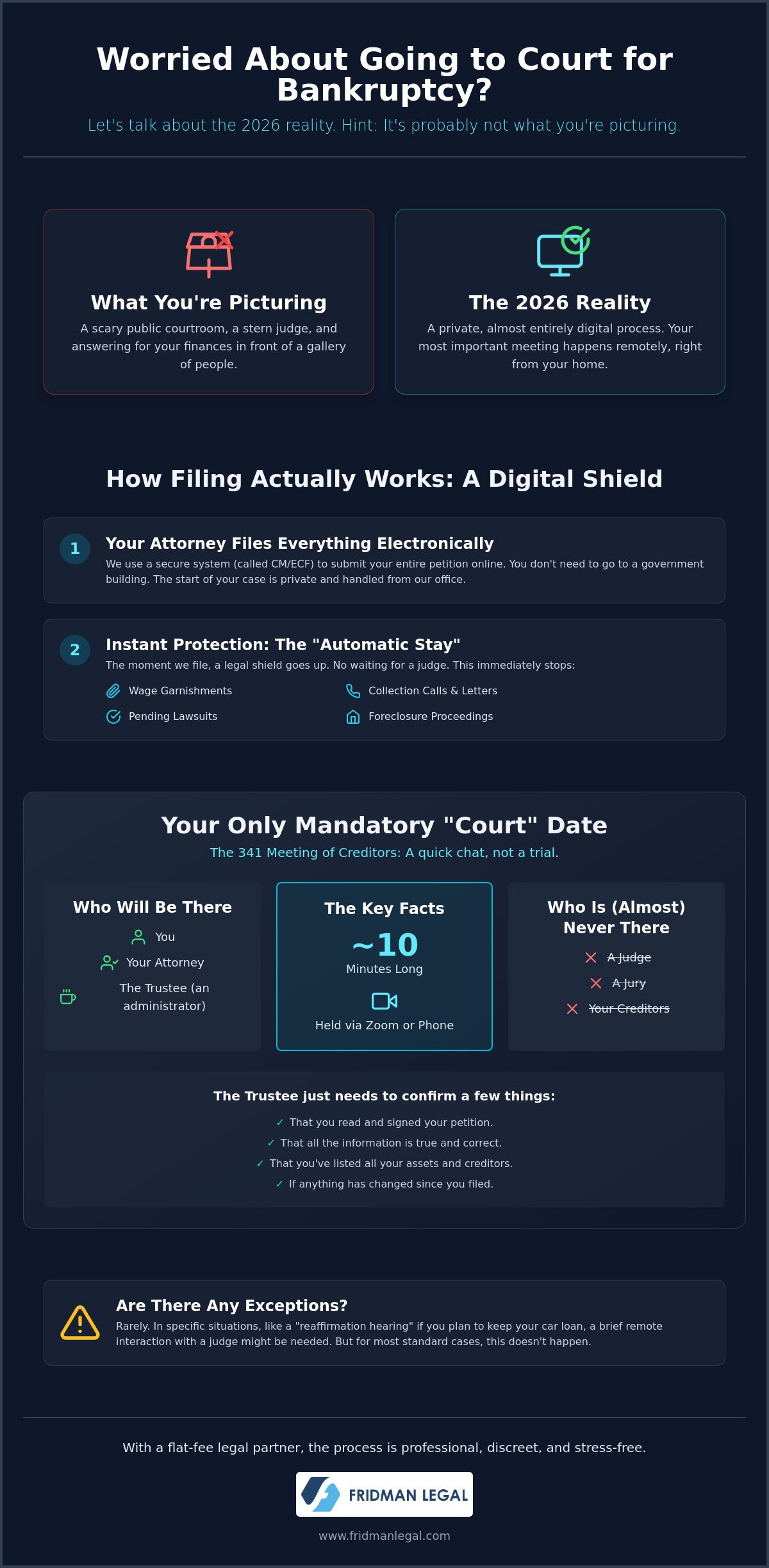
If you've been losing sleep asking yourself, "do I have to go to court to file for bankruptcy," you can finally rest. The only mandatory appointment in a standard Chapter 7 or Chapter 13 case is the Meeting of Creditors, often called the 341 meeting. Despite the official name, this isn't a trial. There's no judge, no jury, and usually no one else in the room except you, your attorney, and the trustee. In the Northern District of Illinois, these meetings are remarkably efficient, often lasting less than 10 minutes from start to finish. According to the official Bankruptcy Basics guide, this meeting is designed to allow the trustee to verify your identity and the information in your petition under oath.
Who is the Bankruptcy Trustee?
Think of the trustee as a neutral administrator rather than a prosecutor. Their primary objective is to ensure your paperwork is accurate and that you've been transparent about your assets. They aren't there to lecture you or make you feel guilty about your financial situation. When you work with a bankruptcy lawyer in Chicago, we'll walk through the specific questions you'll face so there are no surprises on the day of your meeting. The trustee will typically ask a standard set of questions, such as:
- Did you read and sign the bankruptcy petition and related schedules?
- Is all the information in those documents true and correct to the best of your knowledge?
- Did you list all of your assets and all of your creditors?
- Have any changes occurred in your financial situation since the date you filed?
Will My Creditors Be There?
This is perhaps the biggest source of anxiety for our clients, yet it's the least likely thing to happen. The reality is that creditors almost never attend consumer bankruptcy meetings. For a credit card company or a medical provider, the cost of sending an attorney to a 10-minute meeting in Cook County far outweighs any potential benefit. Unless there's a specific allegation of fraud or a complex dispute over collateral, you'll likely never see a creditor at this stage. If one does happen to appear, your attorney is there to act as your shield and handle the legal dialogue on your behalf. Receiving personalized support during this phase ensures you don't have to face even the smallest possibility of confrontation alone.
By the time you reach this meeting, the most difficult work of preparing the petition is already behind you. It's a procedural step, a confirmation of the facts we've already established together. Knowing that this is a brief, administrative conversation rather than a high-stakes courtroom battle can significantly lower the stress of the entire process.
Courthouse vs. Zoom: Is Bankruptcy Still Virtual in 2026?
One of the biggest concerns for our clients in Northbrook and Chicago involves the physical logistics of their case. If you're asking, "do I have to go to court to file for bankruptcy" because you're worried about navigating city traffic or finding expensive parking near the Loop, you can finally breathe a sigh of relief. As of 2026, the Northern District of Illinois has firmly embraced remote technology for the vast majority of consumer bankruptcy proceedings. This shift isn't just a temporary measure; it's a permanent standard that prioritizes efficiency and accessibility for everyone involved.
Attending your Section 341 Meeting of Creditors from your living room or a private office removes the psychological weight of the courthouse environment. It allows you to focus on the trustee's questions without the distraction of a busy federal building. This modern approach ensures that your fresh start begins in a space where you feel safe and in control, rather than in a crowded public gallery. Many people still wonder, "do I have to go to court to file for bankruptcy" in person if a creditor requests it, but even those rare instances are often handled through the same virtual platforms.
The Northern District of Illinois Procedures
The Everett McKinley Dirksen United States Courthouse is a landmark of the Chicago skyline, but for most Chapter 7 and Chapter 13 filers, it's a building they may never need to enter. While the courthouse remains the hub for complex litigation, the remote hearing protocol for 2026 mandates that nearly all initial meetings of creditors are held via Zoom or telephone. Under the updated Illinois Supreme Court Rule 45, the court system has standardized these remote options to ensure that legal relief remains accessible. We've seen this transition significantly reduce the anxiety our clients feel, as the experience is now a structured video call rather than a daunting public appearance.
Preparing Your "Virtual Courtroom" at Home
Even though the meeting happens through a screen, it's still a formal legal proceeding that requires your full attention. You'll need a quiet, private space where you won't be interrupted by family members or pets. The trustee will require you to hold your original government-issued photo ID and Social Security card up to the camera to verify your identity. It's a quick process, but having these documents ready is essential for a smooth meeting. We also recommend testing your camera and microphone in advance to avoid any last-minute technical glitches.
We don't expect you to navigate this technology alone. At Fridman Legal, we conduct mock meetings with our clients before the actual date. We'll test your connection and walk through the typical questions one more time. Our goal is to ensure you're comfortable with the platform so that when the trustee joins the call, you can speak with confidence and clarity. This preparation turns a potentially stressful event into a routine, manageable task that you can complete from the comfort of your home.
Rare Scenarios: When You Might Actually See a Judge
While we've established that the typical process is administrative and remote, there are specific outliers where a judge might need to weigh in. If you're still wondering, "do I have to go to court to file for bankruptcy" because your situation feels complicated, it's helpful to know that roughly 95% of consumer cases in Illinois are completed without ever seeing a judge. The court system is designed to run on autopilot unless a specific dispute arises or a statutory requirement triggers a review. In these rare instances, the goal isn't to put you on trial; it's to ensure the law is being applied fairly to both you and your creditors.
Disputes and Adversary Proceedings
An adversary proceeding is essentially a lawsuit that happens within your bankruptcy case. These are quite rare in standard consumer filings, but they can be triggered by specific red flags. For example, if a creditor alleges that you engaged in "luxury spending" or took out significant cash advances just weeks before your filing, they might file a complaint to challenge the discharge of that specific debt. This is exactly why careful planning is so vital. When we handle Chapter 7 bankruptcy in Illinois, we perform a deep dive into your recent financial history to identify and resolve these issues before the petition is even filed. By being proactive, we can usually prevent these disputes from ever reaching a judge's desk.
Reaffirmation Agreements
The most common reason a consumer might have a brief interaction with a judge involves a reaffirmation agreement. If you want to keep your car or your home and continue making payments on the loan, you may need to sign a contract stating you'll remain legally responsible for that debt after your bankruptcy is over. In some cases, especially if your budget is tight, the law requires a judge to review the agreement. They want to make sure that keeping the car isn't going to cause you "undue hardship." These hearings are typically pro forma and non-adversarial; the judge is simply acting as a safeguard to ensure you aren't setting yourself up for financial failure again. Even then, these hearings are frequently conducted via Zoom in the Northern District of Illinois.
It's also possible for a judge to get involved if a Trustee objects to one of your property exemptions. If there's a disagreement over the value of your home or a specific asset, and we can't reach a settlement with the Trustee, a judge will make the final call. However, with nearly 20 years of experience navigating these local procedures, we've found that most of these technicalities are resolved through negotiation rather than litigation. If you want to ensure your case is handled with this level of precision, you can contact us to discuss your specific situation and see how we can protect your interests.
Making the Process Stress-Free with Fridman Legal
Navigating the federal legal system shouldn't feel like a solo mission into hostile territory. When you ask, "do I have to go to court to file for bankruptcy," the answer depends heavily on how you choose to approach the case. If you attempt to handle the filing alone, you're much more likely to end up in front of a judge explaining a technical error or a missed deadline. With professional representation, the entire process stays behind the scenes where it belongs. O. Allan Fridman acts as your spokesperson and shield, ensuring that the legal machinery works for you rather than against you. Our goal is to provide a buffer between you and the complexity of the law so you can focus on your recovery.
The Danger of Filing Without an Attorney
Filing "pro se," or without an attorney, is the most common reason people find themselves in actual courtroom trouble. The bankruptcy court is a rigid environment, and the clerks are legally prohibited from giving you any advice if you get stuck. Simple mistakes in your digital paperwork often lead to mandatory "order to show cause" hearings. This is a formal demand from the court requiring you to appear in person and explain why your case shouldn't be dismissed. These are the very courtroom visits we work so hard to avoid. Professional representation isn't just about filling out forms; it's an investment in ensuring you never have to face a judge because of a clerical oversight.
Personalized Support in Northbrook and Chicago
With nearly 20 years of experience in Illinois bankruptcy law, Allan Fridman understands the specific nuances of local trustees and the expectations of the Northern District. We don't just process cases; we provide a human-first approach that prioritizes your peace of mind. Our flat-fee bankruptcy services in Northbrook are designed to eliminate the fear of hidden costs or escalating legal bills. This predictable pricing model allows you to plan your financial future with certainty while we manage the heavy lifting of the legal process.
We've spent two decades refining a process that is as discreet as it is effective. By the time your virtual meeting arrives, we've already anticipated the trustee's questions and secured your exemptions. You won't be navigating this journey alone or wondering what comes next. If you're ready to leave the stress of debt behind and want to ensure the process is handled with professional precision, contact Fridman Legal today to start your fresh start. We'll map out your specific journey and ensure you get the relief you need without the courtroom drama you fear.
Take the First Step Toward Your Financial Fresh Start
The fear of a public courtroom shouldn't stand between you and the debt relief you deserve. As we've explored, the modern legal process in Illinois is built for efficiency and privacy. You've learned that the answer to do I have to go to court to file for bankruptcy is almost always a relieved no, thanks to the permanent shift toward virtual hearings and digital filing. By understanding that the 341 meeting is just a brief, remote conversation rather than a trial, you can approach your case with a real sense of calm.
With nearly 20 years of experience in Illinois bankruptcy law, Allan Fridman provides the steady hand and local expertise you need to navigate these procedures. Our Northbrook-based firm offers flat-fee Chapter 7 filings, giving you total transparency and removing financial surprises from the equation. We handle the technical complexities and act as your professional shield so that your experience is as stress-free as possible.
Don't let uncertainty delay your recovery any longer. You can Schedule a Consultation with Allan Fridman today to discuss your unique situation. We're here to help you turn the page and begin your future with a clean slate.
Common Questions About the Bankruptcy Process
Do I have to dress up for a Zoom bankruptcy meeting?
You should aim for business casual attire during your virtual meeting. While you don't need to wear a formal suit or a tie, dressing professionally shows respect for the legal proceeding and the trustee's time. A simple collared shirt or a neat blouse is usually perfect. Since the meeting is conducted from the chest up, just ensure your background is tidy and your appearance is presentable.
Will my neighbors find out I filed for bankruptcy?
It's highly unlikely that your neighbors or friends will ever know unless you choose to tell them. While bankruptcy is technically a matter of public record, it isn't published in local newspapers or broadcast to the community. Most people who aren't your creditors have no reason to search the federal court database. The shift to remote hearings has made the process even more private, helping answer the common worry: do I have to go to court to file for bankruptcy in front of people I know?
Can I file for bankruptcy without ever going to an office?
Yes, you can complete the entire process without visiting a physical office. In 2026, we handle consultations via phone or video call, and all necessary documents are signed and submitted electronically. This modern approach is designed for your convenience, allowing you to secure a fresh start from your home in Northbrook or anywhere else in Illinois. We've refined this digital workflow to ensure it's just as personal as an in-office visit.
What happens if I miss my scheduled 341 meeting?
Missing your meeting without a valid reason can lead to the immediate dismissal of your case. If an emergency arises, it's critical to notify us immediately so we can request a continuance from the trustee. Trustees are generally reasonable about rescheduling for legitimate conflicts, but a no-show without notice signals a lack of cooperation to the court. We track all deadlines closely to ensure this doesn't happen to our clients.
How much does it cost to have a lawyer represent me at the meeting?
At Fridman Legal, the cost of representation at your meeting is included in our flat-fee structure. We don't believe in surprising you with extra line items or appearance fees for the mandatory 341 meeting. When you hire us, you're paying for a comprehensive service that covers everything from the initial petition filing to the final discharge. This model helps reduce your financial anxiety by providing a clear, upfront cost for the entire legal journey.
Is the meeting of creditors recorded or public?
The meeting is recorded by the trustee, but it isn't a public spectacle. In a Zoom environment, other people with cases scheduled during the same hour will be on the call and can hear your testimony. However, these recordings aren't posted online for the general public to see. It's a standard administrative procedure focused on verifying your assets and income rather than exposing your personal life.
Do I need to bring a witness to my bankruptcy hearing?
No, you don't need to bring witnesses to a standard meeting of creditors. The trustee only needs to speak with you, as you are the one testifying to the accuracy of your financial documents. The only witness you'll need is your original government-issued ID and Social Security card, which you'll show to the camera to verify your identity. Your attorney will be there to provide guidance, but no one else needs to testify on your behalf.

Article by
O. Allan Fridman
O. Allan Fridman has been practicing law since 2001. His practice is unique in that he does not view himself as a litigation attorney or transactional attorney. Rather, he views each area of law as a tool to pursue the best results for his clients. By practicing in both areas of law, he is able to take a 360-degree view of law. This enables the firm to catch potential drawbacks that are readily identifiable.
By practicing in litigation and transactional law and taking a holistic approach in dealing with our clients, he doesn’t put clients in box — rather, as we are all individuals, so too are the legal services we may require.
Whether it is bankruptcy or litigation or transactional, each client brings challenges and does not fit in any one box. Often times, bankruptcy clients end up not filing bankruptcy because we can achieve a better result through litigation or through an out-of-court resolution with the lender, or through a real estate sale. On the other end of the spectrum, a litigation client with multiple issues and lawsuit may fare better in a bankruptcy.
Since 2001, Allan has practiced in states and federal court, and he is a member of the trial bar of the Northern District of Illinois and admitted in the Northern District of Indiana.
We are a debt relief agency. We help people file for bankruptcy relief under the Bankruptcy Code
The materials on this site are for informational purposes only and do not constitute legal advice. Viewing this site or contacting us does not create an attorney–client relationship, and you should not act or refrain from acting based on any information here without seeking professional legal counsel.