

Imagine sitting across the dinner table in your Northbrook home, watching your partner talk about future plans while you're mentally tallying up the past-due notices hidden in a drawer. You want to be honest, but the words feel heavy because of the shame and fear that often accompany financial hardship. It is a common situation, yet learning how to talk to your spouse about filing bankruptcy is one of the most stressful hurdles you'll face. You might worry about their reaction or how a filing could impact their credit, but keeping these secrets only adds to the pressure.
It's natural to feel like a financial setback is a personal failure, but it's actually a legal reality that many families encounter. You aren't alone in this, and you don't have to carry the weight by yourself. This guide will help you approach the conversation with calm and professional clarity so you can move toward a fresh start together. We'll cover how to explain the benefits of the automatic stay, address fears about keeping your property, and outline a shared strategy for debt relief that protects your family's long-term stability.
Key Takeaways
- Reframe bankruptcy as a strategic financial tool that can actually reduce marital tension rather than a sign of personal failure.
- Learn how to organize your financial records and prepare your talking points so you know exactly how to talk to your spouse about filing bankruptcy without the extra stress.
- Understand how legal protections like the automatic stay and the Illinois Homestead Exemption work to keep your home and car safe during the process.
- Discover the practical differences between Chapter 7 and Chapter 13 filings to see which debt relief plan offers your family the best fresh start.
- See why bringing in a professional for a joint consultation can turn a difficult discussion into a clear, actionable plan for your future.
Why talking to your spouse about bankruptcy feels so terrifying (but is totally worth it)
Money is the primary source of friction in most marriages. When debt begins to spiral, the silence between partners usually grows thicker. You might feel like you've failed your family, but bankruptcy is actually a sophisticated tool designed for recovery rather than a mark of shame. Under U.S. bankruptcy laws, the system is built to provide a "fresh start" to those who need it. If you're looking at 2026 as the year you finally regain your footing, starting this dialogue now is the first step toward that stability. Bankruptcy isn't a dead end; it's a financial reset button that allows you to breathe again.
Breaking the silence on 'secret debt'
It's incredibly common for one spouse to manage the household finances and, in an attempt to protect the other, hide the true extent of the debt. You might have credit card statements hidden in a drawer or personal loans that haven't been mentioned. While the shame of "secret debt" feels heavy, these hidden numbers are what lead to sudden legal crises like wage garnishment. Learning how to talk to your spouse about filing bankruptcy means turning an "I" problem into a "we" problem. Honesty prevents your partner from being blindsided by a process server or a frozen bank account. Once everything is on the table, you can stop being adversaries with your creditors and start being a team with a shared plan.
The high cost of waiting to talk
Delaying this conversation doesn't just prolong the emotional stress. It can actually cost you assets that could have been saved with better timing. Many people wait until a foreclosure notice arrives or a car is about to be repossessed before they finally bring up the topic. By that point, some of the most effective legal protections are harder to implement. Your creditors don't care about your marital harmony, but the law provides a powerful shield called the "automatic stay." This legal order goes into effect the moment you file. It instantly stops collector harassment, lawsuits, and even certain foreclosure actions. Talking today ensures you have the time to use these rules to protect your Northbrook home and your family's future peace of mind.
Silence allows debt to grow. A calm, professional approach to the situation stops the cycle of interest and penalties. When you decide to face the numbers together, you're choosing the long-term health of your marriage over the short-term fear of a difficult talk.
Pre-talk prep: Getting your ducks in a row before sitting down
Walking into a conversation about debt without the facts is like trying to navigate a storm without a compass. You don't need a formal forensic audit, but you do need clarity. Before you figure out how to talk to your spouse about filing bankruptcy, take an evening to gather the basic numbers. List out your credit card balances, medical bills, and any personal loans. It's helpful to distinguish between joint accounts, where you're both legally responsible, and individual debts that only one of you signed for. Having this data ready prevents the conversation from stalling on "I don't know" and keeps the focus on finding a solution.
You should also have a baseline understanding of your options. While a professional will handle the heavy lifting, knowing that official bankruptcy information categorizes filings into different "chapters" helps you explain the path forward. Chapter 7 is a relatively fast process that wipes out most unsecured debt; Chapter 13 involves a structured repayment plan over three to five years. If you're feeling overwhelmed by the technical details, reviewing a strategic overview of debt relief options can help you feel more grounded before you speak with your partner.
Know your Illinois basics
Fear often stems from the unknown, particularly the fear of losing your home. In Illinois, the law is designed to be supportive. For instance, the homestead exemption allows individuals to protect $31,575 of equity in a principal residence, and married couples filing jointly can often double that amount. Similarly, the motor vehicle exemption protects up to $5,025 in car equity. You might find that Chapter 7 bankruptcy in Illinois is the most efficient way to secure your assets while eliminating debt. Most importantly, if the debt is entirely in your name, your spouse might not even need to file with you, which can preserve their credit score.
Picking the right time and place
Timing is just as important as the data you bring. Avoid starting this discussion right before bed, during a hectic work week, or when the kids are in the room. A quiet, neutral space like the kitchen table works best. Approach the talk with a "no-blame" policy. This isn't about who spent what; it's about how you both move forward. By choosing a calm environment, you signal that you're treating this as a serious, professional decision for the family's future. You're not just presenting a problem; you're presenting a prepared, legal strategy to reclaim your lives.
The 'Kitchen Table' conversation: A guide to the actual discussion
When you finally sit down to talk, start with the outcome you both want. Instead of leading with a spreadsheet of debt, lead with the desire for peace. You might say something like, "I want us to be able to breathe again and stop worrying about every phone call." This frames the situation as a shared goal for your future rather than a confession of failure. Lay out the facts plainly without getting defensive. If you've been managing the bills alone, your spouse might feel blindsided; give them the space to feel angry or scared without trying to "fix" their emotions immediately. Listening more than you talk is often the most productive thing you can do in these first few minutes.
It helps to keep the focus on "we" language. This isn't just your debt or their debt; it's a family challenge that requires a unified strategy. You're making a business decision for your household, and like any business, sometimes you need to use the legal tools available to restructure. Understanding how to talk to your spouse about filing bankruptcy involves moving away from moral judgments and toward practical solutions that protect your Northbrook home and your long-term stability.
Sample scripts to get you started
Finding the right words is often the hardest part. If you have been hiding the extent of the debt, honesty is the only way forward. Try a script like this: "I've been trying to handle our finances alone because I didn't want to worry you, but I've realized the interest and balances have reached a point where we need professional help." If you're ready to propose the filing, you could say: "I’ve looked into our options, and bankruptcy is a tool that would allow us to protect our assets while wiping out the debt that's holding us back." Remember, bankruptcy is a strategic move, not a personal reflection on your character.
Handling the 'What about our credit?' question
One of the first things your partner will likely worry about is their credit score. It's helpful to point out that if you're already struggling with high balances or late payments, your credit is probably already taking a hit. Bankruptcy is actually the fastest way to stop the damage and start rebuilding. By the time 2026 rolls around, many people who file today see their scores begin to recover or even exceed their pre-filing levels because the debt-to-income ratio has improved so significantly. You aren't just ending a period of debt; you're starting the clock on a brand-new credit history. If you're looking for a way to get these answers from a professional, a joint consultation can provide the objective facts your spouse needs to feel secure.
Addressing the big fears: The house, the car, and the future
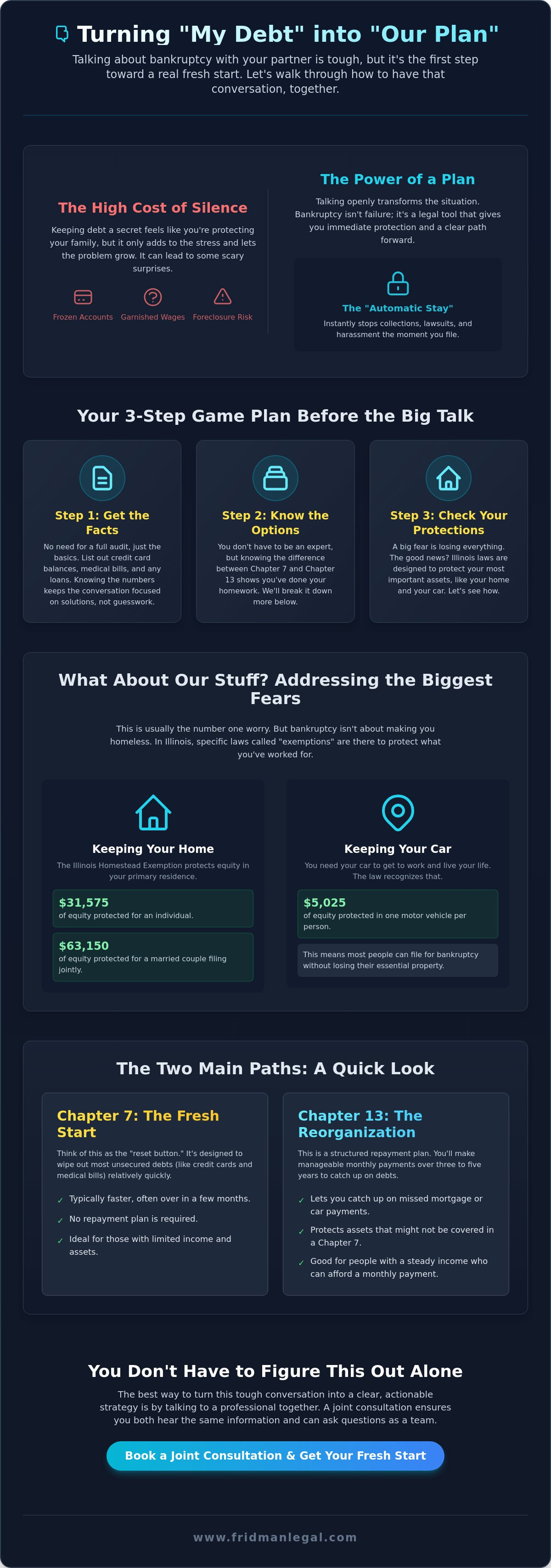
The most common fear that halts the conversation before it starts is the idea of losing the family home or the car. When you're figuring out how to talk to your spouse about filing bankruptcy, you need to lead with the specific protections Illinois provides. Our state laws include a homestead exemption that allows you to protect $31,575 of equity in your primary residence. If you file jointly, that protection can double to $63,150. For many families in Northbrook, this means their home remains untouched by the proceedings. You aren't just filing paperwork; you're using a legal shield designed to keep your family's foundation intact.
The immediate relief comes from the automatic stay. This isn't just a legal term; it's a hard stop on all collection activities. The moment your case is filed, the law prevents creditors from calling you, suing you, or moving forward with a foreclosure. It provides the breathing room necessary to evaluate your next move without the constant threat of repossession. In some cases, a broader financial strategy might involve a transition, where real estate lawyers for closing help you navigate a strategic sale or purchase as part of your fresh start. The goal is always long term stability.
Imagine your life twelve months from now. The constant weight of debt is gone. Your credit score is likely already beginning to climb because your debt-to-income ratio has been corrected. You're no longer hiding mail or avoiding the phone. By taking this step today, you're ensuring that by 2027, your family's financial discussions will be about growth and investments rather than survival and past-due notices.
Will the neighbors find out?
There's a common worry that filing will become the talk of the neighborhood. While bankruptcy is a matter of public record, it isn't published in the local papers or broadcast to your social circle. Unless someone is actively searching federal court databases, they won't know. Successful business owners use these same legal tools to restructure every day. It's a professional financial correction, not a public announcement of your private life.
Can I file without my spouse?
You don't always have to file together. If the debt is entirely in your name, you can file an individual petition. This is often a strategic choice to protect your spouse's credit score while still eliminating the household's largest financial burdens. However, if you share significant joint debts, filing together might be the most effective way to ensure you're both fully protected from future collections. Every situation is unique, and you can schedule a private consultation to determine which path best serves your specific family needs.
Navigating the next steps with Fridman Legal
Once you've had that initial conversation at the kitchen table, the hardest part is actually behind you. You’ve broken the silence, and now you can focus on the technical details of your recovery. This is where a professional steps in to act as the bridge between your shared goals and the legal reality of debt relief. When you're still unsure about how to talk to your spouse about filing bankruptcy in a way that feels productive, bringing them into a joint consultation can be a game changer. It shifts the dynamic from an emotional burden to a strategic business decision for your household.
O. Allan Fridman’s approach is built on calm, professional guidance. He understands that while the law is about numbers and exemptions, for you, it's about your family's future. Working with a bankruptcy lawyer in Chicago who knows the specific nuances of local courts ensures that your filing is handled with precision. You won't have to guess which assets are safe or how the timeline will unfold; you’ll have a results-driven plan that puts you on the path to a fresh start by 2026. This professional oversight is often the best way to resolve any lingering questions about how to talk to your spouse about filing bankruptcy because an objective expert can provide the facts without the emotional history.
What to expect in your first meeting
Our office is a judgment-free zone. It’s a place where both you and your spouse can ask any questions without hesitation. We’ll walk you through a clear roadmap of the process, including our flat-fee structure, so there are never any financial surprises along the way. Most clients tell us that the greatest benefit isn’t just the legal advice; it’s the immediate sense of relief they feel once a professional takes the weight of the debt off their shoulders and onto our own. You'll leave the meeting with a concrete plan rather than a list of worries.
Take the first step together
You’ve already done the heavy lifting by being honest with each other. Now, it’s time to secure the professional support you need to finish the job. We invite you to reach out for a quiet, confidential chat to discuss your options and find the right path forward for your family. Whether you are leaning toward Chapter 7 or Chapter 13, we are here to provide the intelligence and stability you need during this transition. Contact Fridman Legal to schedule your consultation today and start your journey toward financial freedom.
Securing your family's financial fresh start
Taking the time to understand how to talk to your spouse about filing bankruptcy is the most significant hurdle on the road to recovery. You've already moved past the silence and addressed the big fears regarding your home and car. Now that the numbers are on the table, you can stop reacting to debt collectors and start executing a professional strategy. Bankruptcy isn't just about closing a difficult chapter; it's about opening a new one where your household can finally thrive without the shadow of past-due notices.
With nearly 20 years of local experience, Fridman Legal provides the steady hand you need to navigate the Illinois court system. We offer flat-fee bankruptcy filing options to ensure there are no surprises, and our personalized, judgment-free guidance ensures both you and your spouse feel respected throughout the process. You don't have to carry this burden alone any longer. Schedule a confidential consultation with Fridman Legal today to finalize your plan. You’ve done the hard work of being honest with each other; let us handle the rest so you can focus on building a stable future together.
Frequently Asked Questions
Does my spouse have to file for bankruptcy with me in Illinois?
No, you aren't legally required to file a joint petition in Illinois. If the overwhelming majority of the debt is in your name alone, filing individually might be the most strategic move for your household. This allows your spouse to maintain their independent credit profile while still eliminating the financial pressure on your combined family budget.
Will filing for bankruptcy ruin my spouse's credit score if we file individually?
Generally, your individual bankruptcy filing won't appear on your spouse's credit report or directly lower their score. Credit reports are tied to Social Security numbers, so your financial reset remains separate. However, if you share joint accounts or credit cards, the status of those specific accounts might be noted, which is why it's vital to review your shared liabilities before the process begins.
Can we keep our house in Northbrook if we file for Chapter 7?
Yes, most homeowners in Northbrook are able to keep their primary residence through the Illinois Homestead Exemption. This law protects up to $31,575 of equity for an individual or $63,150 for a married couple filing together. As long as your home equity falls within these limits and you stay current on your mortgage payments, your house remains secure during a Chapter 7 filing.
What happens to our joint bank accounts if I file for bankruptcy?
Joint bank accounts are considered part of the bankruptcy estate because you have a legal interest in those funds. The court trustee may look at these assets to see if they can be used to pay creditors, though many funds can be protected using available "wildcard" exemptions. It’s often helpful to discuss the timing of your filing with a professional to ensure your daily operating cash is properly shielded.
How do I tell my spouse about debt I’ve been hiding for years?
The best approach is to lead with the solution rather than just the problem. When you're figuring out how to talk to your spouse about filing bankruptcy, explain that you were trying to protect them from stress but realized that professional intervention is the only way to move forward. Frame it as a business decision for the family’s future, and offer to attend a joint consultation so an expert can answer their questions objectively.
Will my spouse be responsible for my credit card debt if I file?
Your spouse is only responsible for your credit card debt if they are a co-signer or a joint account holder. Since Illinois isn't a community property state, debt incurred by one spouse in their own name remains their individual responsibility. If you file for bankruptcy, that debt is discharged for you, and creditors cannot legally pursue your spouse for payment on those individual accounts.
Is it better to file for Chapter 7 or Chapter 13 as a married couple?
The right choice depends entirely on your household income and what you’re trying to protect. Chapter 7 is often preferred because it’s faster and wipes out unsecured debt completely. However, if you have a high income or significant equity in your home that exceeds state exemptions, Chapter 13 provides a structured way to pay back a portion of the debt while keeping all your assets safe.
How soon can we buy a house again after one of us files for bankruptcy?
You can often qualify for a new mortgage much sooner than people expect. For many FHA loans, you may be eligible to buy a home just two years after a Chapter 7 discharge. Conventional loans typically require a four-year waiting period. If you focus on rebuilding your credit immediately after your case closes, you could be back in the housing market well before 2030.

Article by
O. Allan Fridman
O. Allan Fridman has been practicing law since 2001. His practice is unique in that he does not view himself as a litigation attorney or transactional attorney. Rather, he views each area of law as a tool to pursue the best results for his clients. By practicing in both areas of law, he is able to take a 360-degree view of law. This enables the firm to catch potential drawbacks that are readily identifiable.
By practicing in litigation and transactional law and taking a holistic approach in dealing with our clients, he doesn’t put clients in box — rather, as we are all individuals, so too are the legal services we may require.
Whether it is bankruptcy or litigation or transactional, each client brings challenges and does not fit in any one box. Often times, bankruptcy clients end up not filing bankruptcy because we can achieve a better result through litigation or through an out-of-court resolution with the lender, or through a real estate sale. On the other end of the spectrum, a litigation client with multiple issues and lawsuit may fare better in a bankruptcy.
Since 2001, Allan has practiced in states and federal court, and he is a member of the trial bar of the Northern District of Illinois and admitted in the Northern District of Indiana.
We are a debt relief agency. We help people file for bankruptcy relief under the Bankruptcy Code
The materials on this site are for informational purposes only and do not constitute legal advice. Viewing this site or contacting us does not create an attorney–client relationship, and you should not act or refrain from acting based on any information here without seeking professional legal counsel.