

What if the most significant cost of your Chicago property transaction isn't the purchase price, but the absence of precise legal oversight? Many sophisticated buyers in the Northbrook area find that traditional closing statements lack the transparency required for rigorous financial planning. You likely expect a predictable expenditure, yet the reality of lawyer fees for real estate often fluctuates based on the complexity of title issues or Lake County tax prorations. In a market where a single clerical error can delay a closing by 14 days, professional fee structures should be viewed as a strategic hedge against transactional risk.
This analysis provides the professional clarity you require to secure your 2026 investment with total confidence. We'll examine the specific fee structures prevalent in the Chicago suburbs and outline how a disciplined legal partnership mitigates the risk of hidden costs. You'll find a definitive roadmap for evaluating local counsel, detailing current market ranges for representation to ensure your real estate interests remain protected and your closing remains on schedule.
Key Takeaways
- Gain clarity on why Illinois requires extensive legal oversight and how professional fees secure the integrity of your property transfer.
- Evaluate the differences between standard flat-fee models and hourly rates to accurately forecast your total lawyer fees for real estate.
- Distinguish the specific legal obligations and protections required for both buyers and sellers to ensure a seamless and compliant closing process.
- Identify potential "red flag" complications, such as title defects or unresolved liens, that can necessitate additional strategic legal intervention.
- Understand why prioritizing professional expertise over the lowest price point mitigates long-term risks and prevents costly procedural errors.
Understanding Real Estate Attorney Fees in Northbrook and Chicago
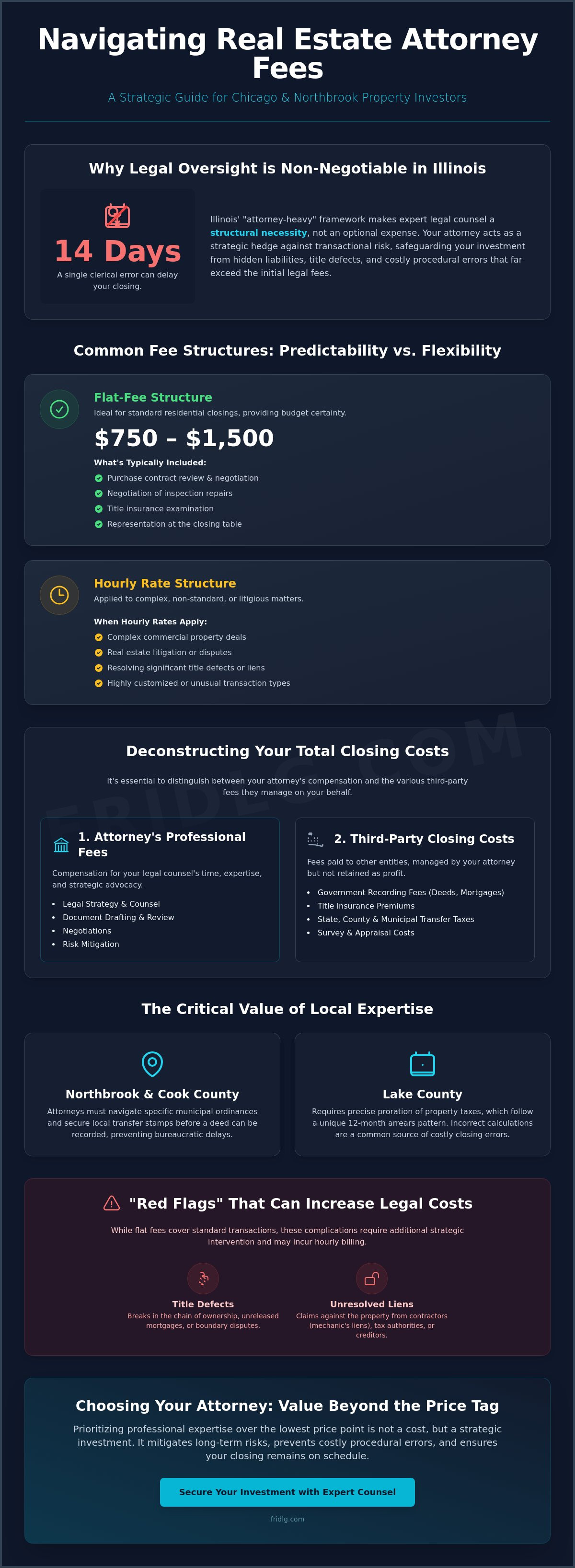
Real estate attorney fees represent the professional compensation for the rigorous legal oversight required during property title transfers. In Illinois, the residential and commercial markets operate under an "attorney-heavy" framework. This distinguishes the region from escrow states, where title companies handle the majority of closing logistics. Because Illinois law allows for specific attorney review periods in standard purchase agreements, a lawyer's presence isn't merely traditional; it's a structural necessity for risk mitigation.
The primary objective of these fees is to secure expert representation that shields your financial interests throughout the transaction. Whether you're a buyer or a seller, the legal professional ensures that the contractual terms align with your strategic goals. They identify hidden liabilities in the chain of title and verify that all liens are satisfied. Without this specialized intervention, parties often face post-closing disputes that far exceed the initial lawyer fees for real estate transactions.
Why Local Expertise Matters in the Chicago Suburbs
Northbrook and the surrounding Cook County areas possess unique regulatory requirements that demand localized knowledge. Specific municipal ordinances dictate the issuance of transfer stamps, which must be secured before the deed is recorded. For properties bordering Lake County, the complexity increases. Lake County's property tax cycles follow a specific 12-month arrears pattern, requiring precise mathematical adjustments on the settlement statement. A lawyer familiar with these nuances prevents the costly delays associated with incorrect tax prorations or missing municipal certificates.
The Difference Between Legal Fees and Closing Costs
Distinguishing between professional legal fees and the broader category of closing costs remains essential for accurate budgeting. Attorney fees cover the time, expertise, and advocacy provided by your legal counsel. These are distinct from third-party expenses that the attorney manages but doesn't retain as profit. Common examples include:
- Government recording fees for deeds and mortgages.
- Title insurance premiums paid to the underwriter.
- State, county, and municipal transfer taxes.
- Survey fees and appraisal costs.
Prospective clients should be wary of "all-in" quotes from non-lawyer entities. These estimates often omit variable third-party costs or hide administrative surcharges. Transparent lawyer fees for real estate should be clearly itemized, ensuring you understand exactly what portion of your capital supports legal strategy versus administrative compliance. This clarity provides the stability required for high-stakes property acquisitions in the Chicago metropolitan area.
Common Fee Structures: Flat Fees vs. Hourly Rates
The financial architecture of legal representation in property transactions is designed to reflect the complexity and risk profile of the engagement. Most lawyer fees for real estate in the Northbrook and Chicago markets follow two primary paths: predictable flat fees for standard residential transfers or hourly billing for sophisticated commercial and litigious matters. Selecting the correct structure is a matter of strategic planning, as it ensures that the legal costs remain proportionate to the value of the asset and the intensity of the work required.
Flat-Fee Residential Closings: What is Included?
Standard residential transactions in Illinois typically utilize a flat-fee model to provide Northbrook families with budget certainty. This fee covers a clearly defined scope of work, including the attorney review of the purchase contract, negotiation of inspection repairs, title insurance examination, and professional representation at the closing table. In Illinois, these standard residential fees generally range from $750 to $1,500 depending on the specific demands of the lender and the property type.
While this fee is a fixed line item, it represents only a portion of the total financial obligation at the end of a transaction. Legal counsel ensures that these costs are balanced against the average closing costs, which include transfer taxes and recording fees. By utilizing a flat-fee structure, clients avoid the uncertainty of fluctuating bills during what is often a stressful transition period.
When Hourly Rates Apply: Litigation and Complex Disputes
Hourly billing is the standard for matters involving civil litigation, construction law disputes, or high-stakes commercial deals. These scenarios don't follow a linear path, making a fixed price impractical for both the firm and the client. In these cases, a retainer is required at the outset. This serves as a dedicated fund from which the firm draws as specific milestones are achieved or hours are logged.
The value of this model is inextricably linked to the counsel's depth of knowledge. O. Allan Fridman leverages 20 years of experience in complex real estate matters to ensure that every hour billed is focused on strategic resolution. Senior-level expertise often results in fewer billable hours overall because an experienced attorney identifies the core legal issue faster than a junior associate might. When lawyer fees for real estate are calculated hourly, the precision of the work becomes the primary driver of cost-efficiency.
Hybrid Models and the Impact of Experience
Occasionally, a standard transaction encounters an unexpected legal hurdle, such as a clouded title or a breach of contract by the opposing party. These situations may necessitate a hybrid model. The attorney maintains the initial flat fee for the closing but transitions to an hourly rate for the specific litigation or resolution of the "extraordinary" obstacle. This ensures the client only pays for the additional complexity actually encountered. Securing strategic transactional support from the beginning allows for a seamless transition if these hurdles arise, protecting the client's interests without disrupting the entire fee agreement.
Buyer vs. Seller: Who Pays What in a Real Estate Transaction?
In the Illinois real estate market, the division of legal responsibilities is strictly defined by the divergent interests of the buyer and the seller. While both parties aim for a successful closing, their legal priorities remain diametrically opposed. Illinois Supreme Court Rule 1.7 effectively prohibits a single attorney from representing both parties in a transaction due to inherent conflicts of interest. Each side must retain independent counsel to ensure their financial and legal interests remain shielded throughout the process.
Legal Fees for Sellers: Protecting the Equity
A seller's attorney focuses on the delivery of a marketable title and the preservation of sale proceeds. The legal tasks are intensive during the pre-closing phase. Counsel must identify and resolve outstanding liens, judgments, or unreleased mortgages that could stall the transaction. They handle the drafting of the Warranty Deed, the Bill of Sale, and the PTAX-203 Illinois Real Estate Transfer Declaration.
Coordination forms a significant portion of the workload. The attorney manages communication with the title company to ensure all municipal requirements are met. In Northbrook, this includes local transfer stamps; in Chicago, it involves obtaining the necessary water certificates and zoning certifications. The lawyer fees for real estate on the selling side reflect this administrative precision and the risk associated with clearing the property's financial history.
- Reviewing the title commitment to identify encumbrances.
- Calculating precise prorations for property taxes and association dues.
- Representing the seller's interests during the attorney review and inspection period.
Legal Fees for Buyers: Ensuring a Clear Title
For the purchaser, the attorney acts as a risk mitigator. The scope of work involves a meticulous audit of the seller's claims and the lender's requirements. A real estate lawyer for closing provides several critical protections that extend beyond the physical transfer of the keys. They examine Schedule B of the title report to identify encroachments or easements that might restrict future property use or renovations.
The attorney also reviews mortgage loan documents to ensure the interest rates, points, and terms align with the buyer's original agreement with the lender. This oversight prevents future litigation by identifying property line discrepancies via the survey before the deed is recorded. Statistical data suggests that thorough legal review during the due diligence period reduces the likelihood of post-closing boundary disputes by approximately 72%.
Fee structures often differ based on the side of the table. Seller fees are frequently deducted from the sale proceeds at the closing table, meaning the seller doesn't pay out of pocket upfront. Conversely, buyer lawyer fees for real estate are typically included in the final "cash to close" figures. While residential transactions in the Chicago area generally utilize flat-fee models, complex commercial acquisitions or properties with clouded titles may require hourly billing to account for the additional hours of research and negotiation.
Factors That Can Increase Your Real Estate Legal Costs
Standardized pricing models often fail when a transaction encounters structural or legal anomalies. While a typical closing in Northbrook follows a linear path, certain red flag issues necessitate intensive billable hours. Complexity isn't a choice; it's a structural reality of certain assets. Short sales and foreclosure-related acquisitions represent significant departures from the norm. These transactions require exhaustive communication with institutional lenders and a meticulous review of court filings to ensure the transfer of clear title. When a deal involves a distressed property, the legal workload often doubles due to the administrative requirements of the lienholders.
Property line disputes or ongoing construction litigation also disrupt the standard fee structure. If a 2026 survey reveals an encroachment or a builder's breach of contract, your legal representative must pivot from transactional oversight to active dispute resolution. This shift naturally influences the final invoice. Strategic counsel is required to navigate these conflicts without jeopardizing the entire transaction. Precision in these moments is paramount. A single oversight in a boundary dispute can lead to decades of litigation. Professional oversight ensures that lawyer fees for real estate remain a productive investment rather than a reactive expense.
Title Issues and Lien Resolution
Unresolved encumbrances, such as unreleased mortgages or mechanic's liens, demand immediate strategic intervention. Statistics from Cook County property records indicate that approximately 15% of title searches reveal clouds that require legal clearance before a deed can be transferred. Resolving these defects early prevents the collapse of a deal during the final stages of escrow. Our firm utilizes specialized methodologies in debt settlement to negotiate lien releases effectively. This proactive approach mitigates the risk of long-term financial liability and ensures the chain of title remains unbroken.
Commercial vs. Residential Complexity
Commercial assets introduce a higher tier of due diligence. Unlike residential properties, commercial deals require a rigorous analysis of zoning ordinances, environmental phase reports, and lease abstractions. These variables explain the variance in lawyer fees for real estate within the Chicago market. Commercial due diligence periods frequently extend 30 to 60 days beyond residential timelines, requiring sustained legal engagement. Professional representation in commercial real estate transactions ensures that every regulatory hurdle is cleared before capital is committed. We focus on the structural integrity of the deal, protecting your interests in complex modern business environments.
Secure your investment with strategic legal counsel from Fridrich & Lutter.
Choosing the Right Attorney: Value Beyond the Price Tag
Selecting legal counsel based solely on the lowest quote is a strategy fraught with risk. While lawyer fees for real estate represent a tangible line item in your closing costs, the hidden expense of an inexperienced practitioner can be astronomical. In the Chicago area, municipal requirements and property tax prorations are notoriously complex. An attorney operating at a cut-rate price often lacks the time to perform the due diligence required for these intricacies. This leads to delays that can jeopardize your mortgage rate lock or result in post-closing liabilities that far exceed the initial savings.
A boutique firm provides a level of scrutiny that high-volume operations simply can't afford. When you're involved in a high-stakes Northbrook transaction, personalized service isn't a luxury; it's a risk-management necessity. Direct access to your attorney ensures that specific concerns, such as zoning issues or complex title clouds, are addressed before they become deal-breakers. This proactive approach reduces the inherent stress of the closing process by providing a predictable, structured path to ownership.
Before committing to a firm, use this checklist to evaluate their suitability for your specific transaction:
- How many real estate closings have you successfully managed in Cook or Lake County in the last 24 months?
- Will I have a direct line to the attorney, or will my file be managed primarily by administrative staff?
- How does your specific background in litigation inform the way you review my purchase agreement?
- What is your protocol for resolving unexpected title issues discovered 48 hours before closing?
- Do you have experience with the specific municipal transfer tax requirements in Northbrook or Chicago?
The Fridman Legal Advantage: Results-Driven Representation
O. Allan Fridman brings over 20 years of multi-disciplinary legal experience to the table. His extensive background in civil litigation provides a distinct advantage for real estate clients. He doesn't just process paperwork; he stress-tests contracts. Because he's seen how poorly drafted clauses fail in a courtroom, he knows exactly how to fortify them during the negotiation phase. This foresight allows for the creation of robust agreements that protect your assets and your peace of mind. At Fridman Legal, we prioritize the strategic integrity of your investment, offering a hussle-free experience rooted in professional excellence and transparent communication.
Next Steps for Your Northbrook Real Estate Closing
Efficiency in a real estate transaction begins with early preparation. We recommend that you gather your signed contract, most recent property tax information, and any relevant homeowner association documents before your initial consultation. Starting a file with our local Northbrook office is a streamlined process designed to integrate seamlessly with your schedule. We provide the structural support and elite legal advocacy required for both residential acquisitions and complex commercial deals. Contact Fridman Legal for a clear breakdown of your real estate legal needs and secure a partner dedicated to your transactional success.
Maximizing Transaction Security in the 2026 Market
Navigating the evolving Chicago property landscape requires a precise understanding of how lawyer fees for real estate correlate with the long-term protection of your interests. Whether you're coordinating a residential sale in Northbrook or a commercial acquisition downtown, the distinction between flat-fee and hourly structures is vital for your financial planning. Effective legal oversight mitigates risks during title clearance and contract negotiations, ensuring your investment remains sound from the initial offer to the final signatures.
Fridman Legal brings nearly 20 years of Illinois legal experience to every transaction. Our boutique approach provides the personalized attention your portfolio requires, combining deep expertise in transaction law with the rigor of complex civil litigation. We prioritize professional integrity and strategic precision to resolve potential hurdles before they escalate. It's our mission to provide the stability and meticulous detail necessary for a seamless transfer of property.
Secure your real estate transaction with Fridman Legal. Your path to a successful closing starts with a partner who values excellence and disciplined advocacy.
Frequently Asked Questions
Is a real estate attorney required for a closing in Illinois?
Illinois law doesn't strictly mandate an attorney for every transaction, but the customary practice in Cook County and Northbrook makes them essential for 95% of residential closings. They manage the critical Attorney Review period, which is typically a 5-business-day window defined in the Multi-Board Residential Real Estate Contract 7.0. Without professional counsel, you're personally liable for navigating complex title clearing and contractual obligations that arise during the process.
How much does a real estate attorney cost for a buyer in Chicago?
Buyer representation in the Chicago metropolitan area typically involves a flat fee structure, though specific rates vary based on the transaction's complexity. According to 2024 industry data from the Illinois Real Estate Journal, these costs reflect the depth of the title search and local municipal requirements. These lawyer fees for real estate cover contract review, title commitment analysis, and the attorney's presence at the final closing to ensure all documents are executed correctly.
What is the difference between a flat fee and a retainer?
A flat fee is a pre-negotiated, fixed sum for a defined scope of work, while a retainer is an upfront deposit held in an escrow account against hourly billing. Most residential closings in Northbrook utilize flat fees because they provide cost certainty for the parties involved. Retainers are more common in commercial litigation or complex 1031 exchanges where the time commitment remains unpredictable and requires ongoing strategic support.
Can a real estate lawyer help if my deal is falling through?
An attorney provides strategic intervention to salvage a transaction or ensure the lawful return of earnest money if the deal collapses. If a party defaults, your lawyer enforces the specific performance clauses or liquidated damages provisions found in your contract. Data from the National Association of Realtors suggests that roughly 5% of contracts terminated in 2023 required legal mediation to resolve deposit disputes effectively.
Are real estate attorney fees tax-deductible in 2026?
Real estate legal fees aren't usually deductible as a direct annual expense for primary residences, but they're added to the property's cost basis. According to IRS Publication 523, these costs reduce your eventual capital gains tax liability when you sell the asset. For investment properties, however, legal fees related to management or tax advice may be deductible under different sections of the Internal Revenue Code depending on your filing status.
Does the attorney fee include the cost of title insurance?
No, the legal fee is a separate professional charge from the title insurance premium. Title insurance costs are regulated by the Illinois Department of Insurance and are calculated based on the purchase price of the home. Your lawyer coordinates with the title company to ensure the policy is issued without restrictive exceptions, but the premium itself is a third-party closing cost paid at the time of settlement.
How do I know if an attorney’s fee is reasonable for my area?
You can verify the reasonableness of lawyer fees for real estate by comparing quotes against the 2025 Chicago Bar Association’s general guidelines for residential services. A fee is usually considered standard if it aligns with the complexity of local transfer tax ordinances and zoning certificates. In Northbrook, fees often reflect the additional due diligence required for specific village-level compliance and required inspections.
What happens if a title issue is discovered right before closing?
Your attorney immediately initiates a title clearance process to resolve the encumbrance or cloud on the title before the deadline. If a 2022 mechanic's lien or an unreleased mortgage appears, the lawyer negotiates an escrow holdback or requires the seller to cure the defect before funding occurs. Without this legal oversight, a buyer could inherit thousands of dollars in debt or face future challenges to their ownership rights.

Article by
O. Allan Fridman
O. Allan Fridman has been practicing law since 2001. His practice is unique in that he does not view himself as a litigation attorney or transactional attorney. Rather, he views each area of law as a tool to pursue the best results for his clients. By practicing in both areas of law, he is able to take a 360-degree view of law. This enables the firm to catch potential drawbacks that are readily identifiable.
By practicing in litigation and transactional law and taking a holistic approach in dealing with our clients, he doesn’t put clients in box — rather, as we are all individuals, so too are the legal services we may require.
Whether it is bankruptcy or litigation or transactional, each client brings challenges and does not fit in any one box. Often times, bankruptcy clients end up not filing bankruptcy because we can achieve a better result through litigation or through an out-of-court resolution with the lender, or through a real estate sale. On the other end of the spectrum, a litigation client with multiple issues and lawsuit may fare better in a bankruptcy.
Since 2001, Allan has practiced in states and federal court, and he is a member of the trial bar of the Northern District of Illinois and admitted in the Northern District of Indiana.
We are a debt relief agency. We help people file for bankruptcy relief under the Bankruptcy Code
The materials on this site are for informational purposes only and do not constitute legal advice. Viewing this site or contacting us does not create an attorney–client relationship, and you should not act or refrain from acting based on any information here without seeking professional legal counsel.


