

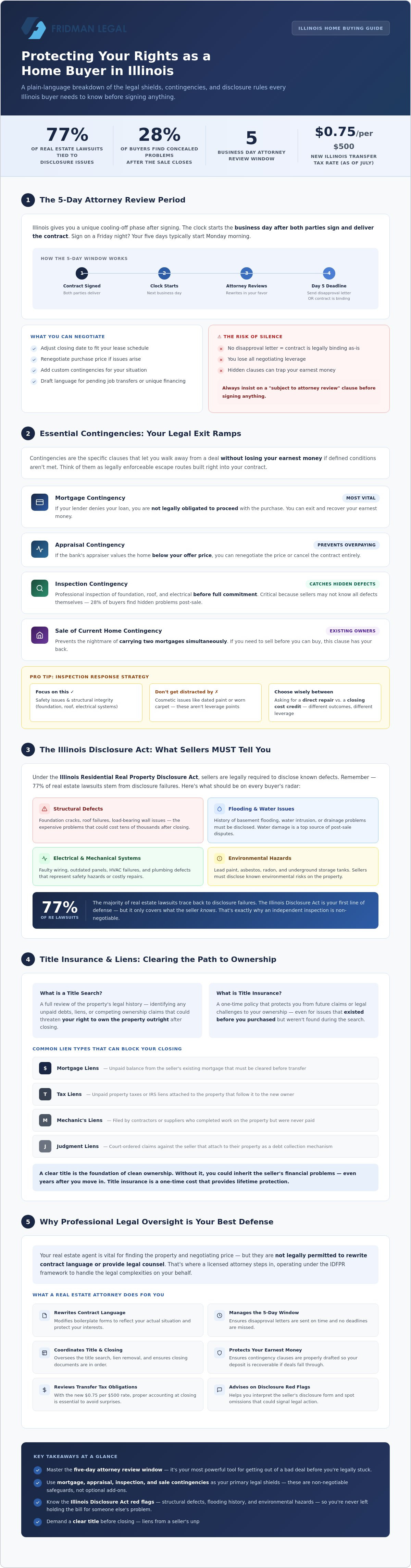
Did you know that roughly 77% of real estate lawsuits are tied to disclosure issues? It's a staggering number that explains why so many people feel a sense of dread when they finally find a house they love. When you're protecting your rights as a home buyer in Illinois, you're doing more than just reviewing paperwork. You're trying to ensure that your earnest money is safe and that you won't discover a structural nightmare the week after you move in. With the state's transfer tax rates having just increased to $0.75 per $500 this July, the financial stakes of getting your contract right have never been higher.
It's easy to feel lost in the shuffle of the five-day attorney review period or the fine print of title insurance. You want a stress-free closing where the only surprise is how much you like your new neighbors. This guide will show you how to navigate the Illinois home-buying process with a legal shield that protects your future. We'll look at how to handle seller non-disclosures, what to expect during the title search, and how to make sure your interests are prioritized from the first signature to the final handshake.
Key Takeaways
- Master the five-day attorney review window to ensure you aren't stuck in a contract that doesn't serve your best interests.
- Use specific mortgage and inspection contingencies as a primary tool for protecting your rights as a home buyer in Illinois.
- Identify the red flags sellers must disclose so you don't end up footing the bill for hidden structural defects or flooding issues.
- Learn how to secure a clear title by identifying and removing liens that could threaten your future ownership.
- Understand how expert guidance during the closing process helps you move from a signed offer to a secure, stress-free move-in day.
The Illinois Attorney Review Period: Your Five-Day Safety Net
You finally found the house. You signed the contract. In many other states, that would be the end of the negotiation, but Illinois operates differently. We have a unique "Attorney Review" period that serves as a critical cooling-off phase. It's essentially a five-day window where the law acknowledges that a home purchase is likely the biggest financial decision of your life, and you shouldn't be forced to make it based on a 15-minute walkthrough and a stack of boilerplate forms. This period is the cornerstone of protecting your rights as a home buyer in Illinois, giving you the chance to have a legal professional dismantle the contract and rebuild it in your favor.
The clock starts ticking the business day after both you and the seller have signed and delivered the contract. If you sign on a Friday night, your five days usually won't start until Monday morning. During this time, your lawyer isn't just checking for typos; they're acting as your strategic shield. While your real estate agent is vital for finding the property and negotiating the initial price, they aren't legally permitted to rewrite contract language or provide specific legal counsel. This boundary is a key part of the consumer protection framework overseen by the Illinois Department of Financial and Professional Regulation (IDFPR), which ensures that only licensed attorneys manage the legal complexities of the transaction.
What Can Be Negotiated During Review?
Think of this as the "second negotiation." Once your lawyer reviews the document, they might find that the closing date doesn't align with your current lease or move-out schedule. We can use this time to adjust the purchase price if immediate concerns arise or to add custom contingencies that protect your specific financial situation. If you're worried about a specific hurdle, like a pending job transfer or a unique financing structure, your lawyer can draft language that ensures you aren't trapped if those factors don't go your way.
The Risk of Silence
Silence is the most dangerous path during these five days. If the window closes and your attorney hasn't sent a formal "disapproval" or "modification" letter, the contract becomes legally binding exactly as it's currently written. You lose your leverage. Standard contracts often contain "hidden" pitfalls, such as clauses that make it difficult to recover your earnest money if your mortgage isn't approved. You should never sign an initial offer unless it clearly includes a "subject to attorney review" clause. It's the only way to ensure you have a legitimate exit strategy if the deal reveals itself to be a liability.
Essential Contingencies: Building Your Legal Shield
If the attorney review period is your time to rewrite the rules, contingencies are the specific shields you carry into the transaction. These clauses act as your legal exit ramps; they define the exact conditions under which you can walk away from the deal without losing your earnest money. In the high-stakes environment of protecting your rights as a home buyer in Illinois, these aren't just suggestions. They're non-negotiable safeguards for your financial future.
The mortgage contingency is perhaps the most vital. It ensures that if your lender denies your loan application, you aren't legally obligated to proceed with the purchase. Similarly, an appraisal contingency protects you from overpaying. If the bank's appraiser determines the home is worth less than your offer price, this clause gives you the leverage to either renegotiate the price or cancel the contract. For those who need to sell their existing property before moving, a sale of current home contingency prevents the nightmare scenario of carrying two mortgages simultaneously.
Then there is the inspection contingency. While the Illinois Residential Real Property Disclosure Act requires sellers to be honest about known defects, it doesn't account for things the seller truly doesn't know. Statistics show that 28% of buyers in the U.S. find concealed problems after the sale is finalized. A robust inspection contingency gives you the right to have professional eyes on the foundation, roof, and electrical systems before you're fully committed.
The Inspection Response Strategy
When the inspection report comes back, don't get distracted by "cosmetic upgrades" like dated paint or worn carpet. Focus your energy on safety issues and structural integrity. In Illinois, you'll often have to decide between asking for a direct repair or a closing cost credit. Credits are frequently the smarter choice. They give you the cash to hire your own trusted contractors rather than relying on a seller who might be tempted to use the cheapest possible fix just to get to the closing table. Using the report as a strategic tool ensures your investment remains sound from day one.
Protecting Your Earnest Money
Earnest money is the "good faith" deposit you provide to show the seller you're serious. It's often thousands of dollars, so it's essential to keep it safe. In a properly structured deal, these funds are held in a secure escrow account by a neutral third party, like a title company or a law firm. You are legally entitled to a full refund if you cancel the contract based on a valid contingency, such as a failed inspection or a mortgage denial. If you want to ensure your deposit is never at risk, professional oversight of your escrow terms is the most effective way to maintain control over your funds.
The Illinois Disclosure Act: What the Seller MUST Tell You
Imagine moving into your new home, only to discover a puddle in the basement after the first heavy rain. It's a scenario that plays out more often than you'd think. In fact, research suggests that disclosure issues are at the heart of approximately 77% of real estate lawsuits. This is why protecting your rights as a home buyer in Illinois requires a deep understanding of the Illinois Residential Real Property Disclosure Act. This law mandates that sellers complete a standard form covering 24 specific items, ranging from lead paint to structural shifts. If a seller knows about a material defect that would significantly affect the property's value or safety, they are legally bound to tell you.
The "Known Defect" rule is the pivot point for most of these legal battles. A seller isn't necessarily liable for every issue that exists; they are liable for the issues they actually knew about. Proving that knowledge can be tricky, which is why your paper trail is everything. Common omissions often involve intermittent flooding, foundation cracks hidden by fresh drywall, or previous pest infestations that were "solved" with a temporary patch. Even if a property is sold "as-is," the seller is still obligated to disclose these known problems. They can't use a contract clause to hide a crumbling foundation from a buyer.
Post-Closing Disputes
If you find a major issue after the keys are in your hand, you may need to pursue legal action to recover the costs of repairs. In Illinois, the statute of limitations for filing a claim under the Disclosure Act is generally one year from the date of the closing or the date you received the disclosure report, whichever is later. Because this window is relatively short, you shouldn't wait to act if you suspect a seller wasn't honest. Keeping records of every email, text, and listing description from the pre-sale period is vital for building a case that proves the seller intentionally withheld information. If a dispute escalates, having civil litigation representation ensures that your financial interests are defended in court.
The Role of the Home Inspector
While the disclosure form is a legal requirement, it has limits. It doesn't cover things the seller simply hasn't noticed. This is where your professional inspector becomes your first line of defense. A quality inspection report does more than just list repairs; it provides the physical evidence needed to link a property's current state to the legal disclosure requirements. If an inspector finds evidence of a long-term leak that was painted over, that finding can be the smoking gun needed to prove the seller violated the Act. Your inspector finds the problem, but your lawyer uses that finding to ensure you aren't the one paying for it.
Title Insurance and Liens: Clearing the Path to Ownership
You've navigated the inspections and the attorney review. Now, you're facing the final hurdle: the title search. In Illinois, title insurance is non-negotiable because it's the only thing standing between you and a hidden legal nightmare. Imagine moving in only to find out the previous owner didn't pay their property taxes or a contractor from three years ago still has a claim against the house. Protecting your rights as a home buyer in Illinois means ensuring that when you get the keys, you aren't also inheriting someone else's financial baggage. As of May 1, 2026, new title insurance rates went into effect; for a home valued at $400,000 in Cook or DuPage County, the owner's policy premium is approximately $2,650. It's a small price for the certainty that your ownership is absolute.
Your lawyer's role during this phase is to act as a forensic investigator for your deed. We look for "clouds on title," which are any issues that could cast doubt on who actually owns the property. If an old mortgage wasn't properly released or there's an unresolved boundary dispute with a neighbor, we don't let the deal move forward until the seller clears the record. This process transforms a risky transaction into a secure investment, providing the peace of mind you need to sign those final documents.
Understanding Liens on a Home
A lien on home is essentially a legal claim against the property that acts as security for a debt. These clouds can take many forms. It might be a tax lien from the IRS or a mechanic's lien from a kitchen renovation that was never fully paid for. If these aren't cleared before you close, they could technically stay with the house, meaning the creditor could come after your new home for the previous owner's debt. We identify these hurdles early and ensure the seller pays them off from their sale proceeds so you start your ownership with a completely clean slate.
The Closing Table Experience
The final meeting, especially in Cook County, is where the theory of the contract meets the reality of the transaction. You'll be presented with a significant stack of documents, each requiring a signature that carries legal weight. Your lawyer's job is to explain every page, from the deed to the closing disclosure. You'll see the breakdown of taxes, including the Chicago transfer tax of $5.25 per $500 of sale price if you're buying within city limits. Once the lender funds the loan and the title company gives the green light, the keys finally change hands. It's a moment of relief that only comes when you know every detail has been meticulously handled.
If you want to walk into your closing with total confidence, contact Fridman Legal today to ensure your residential real estate transaction is handled with the precision it deserves.
Why Professional Legal Oversight is Your Best Defense
Buying a home is often framed as a hunt for the best price, but the real victory is securing a safe deal. Anyone can sign a contract; the challenge lies in understanding the long term obligations you're assuming. When you focus on protecting your rights as a home buyer in Illinois, you're essentially hiring a strategist to scan for risks that aren't visible on a listing site. Fridman Legal doesn't just process paperwork. We handle the heavy lifting of contract law by anticipating where a transaction might derail before the earnest money is even at risk.
Having a litigator's perspective on your side is a distinct advantage. Because we represent clients in civil litigation, we know exactly how real estate disputes look when they end up in a courtroom. This experience allows us to draft and modify contracts that prevent those disputes from ever starting. We've seen the worst case scenarios, so we know how to build a defense into your purchase agreement from day one. You're not just getting a closing attorney; you're getting a legal advocate who understands the mechanics of enforcement.
Personalized Legal Guidance in Northbrook
Local knowledge is vital when you're dealing with the specific property tax structures and municipal requirements of Cook County and the Northbrook suburbs. We offer a transparent flat-fee structure for residential closings, so you know exactly what your legal investment looks like before we even start. This removes the stress of billable hours and lets us focus entirely on the precision of your deal. If you're ready to move forward with a property, you can contact us to begin a thorough contract review that puts your interests first.
Beyond the Closing
A home is more than a place to live; it's a foundational asset in your financial portfolio. This is why we often discuss how your new property fits into your larger estate planning goals. Whether you're a first time buyer or adding to an investment portfolio, ensuring your property is properly titled and protected for the long term is essential. We believe in maintaining a relationship with our clients that lasts well beyond the day you get your keys. You don't have to navigate these complex regulatory environments alone. By prioritizing protecting your rights as a home buyer in Illinois, you can move into your new home with the confidence that your future is secure.
Securing Your Future Home with Confidence
Navigating a real estate transaction in 2026 requires more than just a good eye for property; it requires a strategy that anticipates legal hurdles before they arise. You now understand how the five-day attorney review period serves as your primary safety net and why specific contingencies are essential for keeping your earnest money safe. By focusing on protecting your rights as a home buyer in Illinois, you ensure that hidden liens or seller non-disclosures don't derail your financial stability. Whether it's clearing a title or negotiating repairs, these steps are what turn a risky offer into a secure investment.
With nearly 20 years of Illinois legal experience, Fridman Legal brings a litigator's precision to every residential closing. We provide the personalized, results-driven representation you need in Northbrook and across Chicago to close with total certainty. Ready to protect your investment? Schedule a consultation with Fridman Legal today to ensure your home buyer rights are secured. You've worked hard to find the right house; we'll work hard to make sure it's a safe one.
Frequently Asked Questions
Is Illinois a "lawyer state" for real estate transactions?
Yes, Illinois is considered a lawyer state because attorneys traditionally handle the contract modifications and the closing process. While real estate agents are vital for finding the property and negotiating the price, they aren't legally permitted to rewrite contract language or offer legal counsel. Having an attorney is a standard part of the process here, ensuring that someone with a legal background is looking out for your long term interests from the moment the contract is signed.
How much does a real estate attorney cost for a home buyer in Illinois?
The cost of legal representation varies based on the complexity of the transaction and the specific needs of the buyer. Many firms, including ours, utilize a flat-fee structure for residential closings to provide transparency and predictability. This approach allows you to understand your legal costs upfront without worrying about billable hours. It's best to discuss your specific situation with an attorney to get a clear picture of the investment required for your particular deal.
What happens if I want to back out of a home purchase after the attorney review period?
Backing out after the five-day attorney review window is much more difficult and usually requires a valid contingency. If you have an active mortgage, inspection, or appraisal contingency, you can still cancel the deal if those specific conditions aren't met. However, if you try to walk away without a contractual reason, you'll likely lose your earnest money. This is why protecting your rights as a home buyer in Illinois starts with drafting strong, clear contingencies during that initial five-day review.
Can a seller back out of a contract during the attorney review period?
Yes, the attorney review period is a two-way street that allows both the buyer and the seller to propose changes or cancel the contract. Just as your lawyer can suggest modifications to protect you, the seller's lawyer can do the same. If the parties cannot reach an agreement on the proposed changes within those first five business days, either side can usually terminate the contract and the buyer receives their earnest money back. It's a period of mutual evaluation.
What is the difference between a home inspection and a title search?
A home inspection focuses on the physical condition of the property, while a title search focuses on the legal ownership. Think of the inspection as checking for leaky pipes or a cracked foundation; it's about the house itself. The title search is about the deed and is a major part of protecting your rights as a home buyer in Illinois. It ensures there aren't any old mortgages, tax liens, or boundary disputes that could threaten your ownership after you move in.
Do I need a lawyer if I am buying a home for cash in Illinois?
You aren't legally required to have a lawyer for a cash purchase, but it's highly recommended to protect your investment. Even without a bank involved, the risks regarding title issues, undisclosed property defects, and local zoning laws remain the same. A lawyer ensures that the deed is properly recorded and that the seller has the legal right to transfer the property. Skipping legal oversight in a cash deal can leave you vulnerable to expensive liens you didn't know existed.
How long does the average real estate closing take in Northbrook?
The average closing in Northbrook and the surrounding suburbs typically takes between 30 and 45 days from the time the contract is signed. This timeline is largely driven by the buyer's mortgage process, which involves appraisals and final underwriting. Cash deals can close much faster, sometimes in as little as two weeks. However, we always recommend allowing enough time for a thorough title search and a proper home inspection to ensure no details are overlooked in the rush to move.
What should I do if I find out the seller lied on the disclosure form?
If you discover a material defect that the seller failed to disclose, you should contact your attorney immediately to discuss your options. You may have grounds for a lawsuit under the Illinois Residential Real Property Disclosure Act, especially if you can prove the seller knew about the issue. Keep in mind that you generally have a one-year window from the date of closing to file a claim. Documenting the problem with photos and contractor estimates is a vital first step in building a case for recovery.

Article by
O. Allan Fridman
O. Allan Fridman has been practicing law since 2001. His practice is unique in that he does not view himself as a litigation attorney or transactional attorney. Rather, he views each area of law as a tool to pursue the best results for his clients. By practicing in both areas of law, he is able to take a 360-degree view of law. This enables the firm to catch potential drawbacks that are readily identifiable.
By practicing in litigation and transactional law and taking a holistic approach in dealing with our clients, he doesn’t put clients in box — rather, as we are all individuals, so too are the legal services we may require.
Whether it is bankruptcy or litigation or transactional, each client brings challenges and does not fit in any one box. Often times, bankruptcy clients end up not filing bankruptcy because we can achieve a better result through litigation or through an out-of-court resolution with the lender, or through a real estate sale. On the other end of the spectrum, a litigation client with multiple issues and lawsuit may fare better in a bankruptcy.
Since 2001, Allan has practiced in states and federal court, and he is a member of the trial bar of the Northern District of Illinois and admitted in the Northern District of Indiana.
We are a debt relief agency. We help people file for bankruptcy relief under the Bankruptcy Code
The materials on this site are for informational purposes only and do not constitute legal advice. Viewing this site or contacting us does not create an attorney–client relationship, and you should not act or refrain from acting based on any information here without seeking professional legal counsel.