

On a Tuesday morning in October 2023, a Northbrook resident discovers their driveway empty, the victim of a sudden vehicle seizure under Section 9-609 of the Illinois Uniform Commercial Code. This immediate loss of transportation disrupts professional commitments and creates a profound sense of vulnerability. It's a jarring reality that the aggressive tactics of recovery agents often occur without prior judicial oversight. Engaging a skilled repossession lawyer provides the necessary strategic intervention to challenge these actions and preserve your primary assets through precise legal frameworks.
You're likely aware that every hour without your vehicle compounds your financial risk and complicates your daily commute to the Northbrook business district. This guide demonstrates how a Northbrook repossession lawyer utilizes the automatic stay under the U.S. Bankruptcy Code and specific Illinois protections to halt seizures and eliminate deficiency balances. We'll examine the exact legal mechanisms available to restore your financial stability and secure a clear path forward through structured debt resolution and statutory defense.
Key Takeaways
- Navigate the complexities of the Illinois Uniform Commercial Code to understand the specific legal thresholds that permit "self-help" repossession.
- Identify the primary legal defenses against wrongful seizure, focusing on the "Breach of Peace" doctrine and state consumer protection statutes.
- Discover how engaging a skilled repossession lawyer to invoke the federal Automatic Stay can provide an immediate shield for your vehicle and other critical assets.
- Evaluate the strategic distinctions between Chapter 7 and Chapter 13 bankruptcy as effective mechanisms for permanent debt resolution and asset retention.
- Master the essential communication and documentation protocols required to effectively challenge a lender’s actions and secure your financial position.
Understanding Repossession Laws in Northbrook and Cook County
The legal framework governing asset recovery in Illinois operates on a foundation of creditor rights and consumer obligations. Under the Illinois Uniform Commercial Code (UCC), lenders possess the authority to utilize "self-help" repossession. This mechanism allows a secured creditor to seize a vehicle or other collateral without obtaining a prior court order, provided they don't breach the peace during the process. For those seeking a broader context on how these secured transactions function globally, Understanding Repossession offers a comprehensive overview of the legal foundations that inform state-specific statutes.
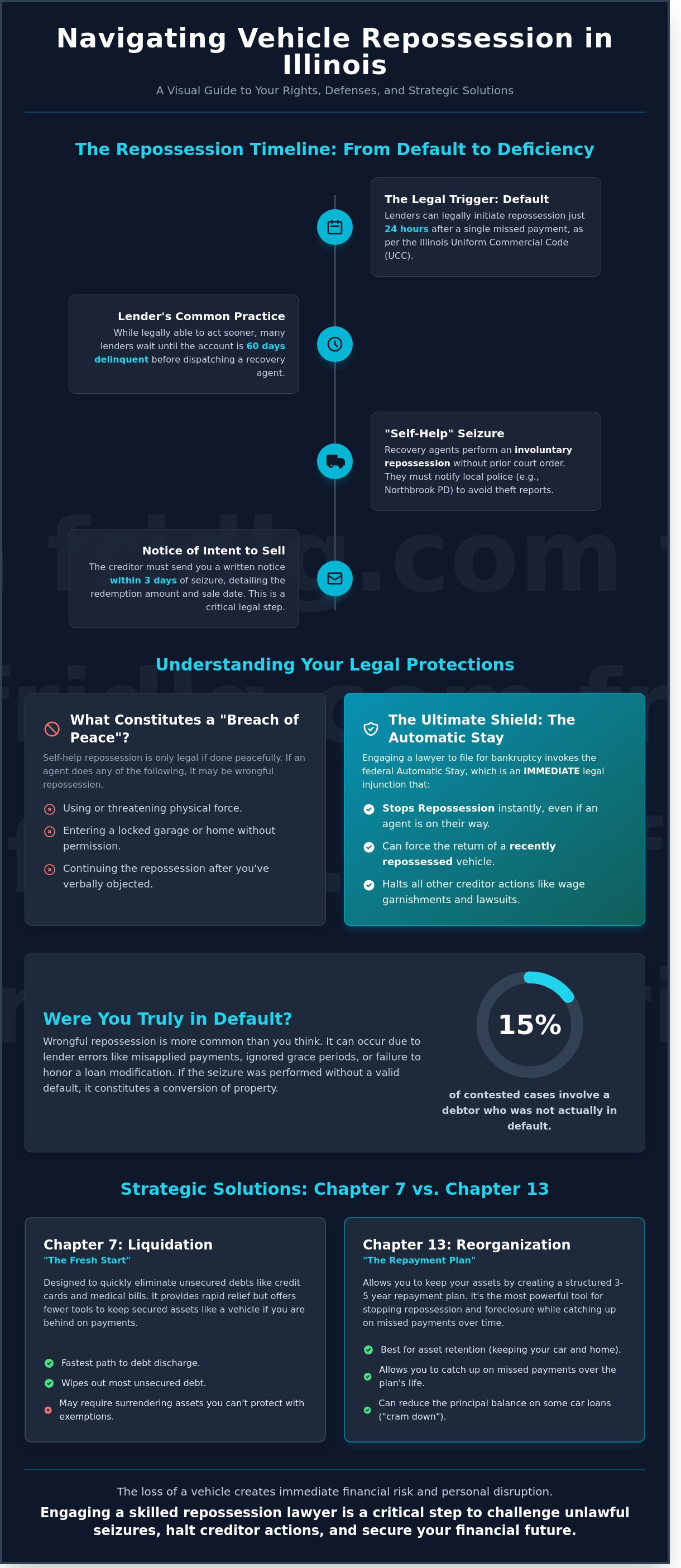
The technical threshold for default in Illinois is remarkably low. Legally, a lender can initiate the repossession process the moment a borrower misses a single payment by 24 hours. While many financial institutions wait for a 60-day delinquency period before dispatched a recovery agent, the contractual right to act exists immediately upon the breach of the installment agreement. Engaging a repossession lawyer during this narrow window is a strategic necessity to prevent the physical loss of the asset. Once the vehicle is seized, the window for protection narrows significantly, as the creditor moves toward a public or private auction to satisfy the debt.
In a suburban Chicago context, Northbrook residents face a choice between voluntary and involuntary repossession. Voluntary surrender involves the debtor returning the asset to the lender, which can mitigate high towing and storage fees. Involuntary repossession occurs without warning, often at residential driveways or place of employment. Regardless of the method, the debtor remains liable for the "deficiency balance" if the auction price doesn't cover the remaining loan amount and associated legal costs.
The Role of the Secured Creditor in Illinois
Lenders must adhere to strict post-seizure protocols to maintain the legality of their actions. Within three days of seizing the property, the creditor is required to deliver a written notice to the borrower. This "Notice of Intent to Sell" is a critical document. It must detail the exact amount required to redeem the asset and provide a specific date for the upcoming sale. Failure to provide this notice accurately can create a legal opening for a repossession lawyer to challenge the creditor’s right to a deficiency judgment.
Local Jurisdiction: Cook County vs. Surrounding Suburbs
While Illinois state law is uniform, local procedural nuances in Cook County impact how cases are handled. Repossession agents operating in Northbrook must notify the Northbrook Police Department immediately after a seizure to distinguish the action from a vehicle theft. From a litigation standpoint, Cook County courts often demand higher standards of documentation from creditors than neighboring jurisdictions. Debtors should also be aware of the Illinois "wildcard" exemption, which can sometimes protect up to $2,400 in vehicle equity, though this is typically applied in broader debt-related litigation rather than stopping a self-help seizure in progress.
Legal Protections Against Wrongful Repossession in Illinois
The seizure of a vehicle or high-value asset represents a critical disruption to a client's professional and personal stability. Illinois law provides a rigorous framework to prevent predatory practices during this process. A repossession lawyer serves as the primary shield against creditors who bypass these statutory mandates. Under the Illinois Uniform Commercial Code (UCC), lenders possess the right to self-help repossession only if they can execute the recovery without a breach of peace. If a lender violates these protocols, they risk substantial legal repercussions, including the forfeiture of their right to a deficiency judgment and liability for statutory damages under the Illinois Consumer Fraud and Deceptive Business Practices Act (815 ILCS 505).
Wrongful repossession often stems from administrative negligence. In approximately 15% of contested cases, the debtor is not actually in default at the time of seizure. This occurs when payments are misapplied, grace periods are ignored, or a lender fails to honor a formal loan modification. When a Northbrook attorney evaluates the legality of an agent's actions, they scrutinize the security agreement and the payment ledger for discrepancies. If the repossession was initiated without a valid default, the lender has committed a conversion of property, which may entitle the owner to compensatory damages. Understanding Consumer Rights in Repossession is the first step in identifying these institutional errors.
What Constitutes a "Breach of Peace"?
Illinois courts maintain a strict interpretation of what is permissible during a self-help recovery. Under IL UCC Section 9-609, a "breach of peace" is defined as any action by a secured party that involves unauthorized entry into a private structure, the use of physical force, or the threat of violence to obtain collateral. Specific case law, such as Pantoja-Cahin v. Ford Motor Credit Co., illustrates that entering a locked garage or breaking a physical barrier constitutes a violation. If a debtor verbally protests the repossession while it is in progress, the agent must immediately cease operations. Continuing the seizure against an active, present objection is a breach of peace that invalidates the repossession. For those facing such aggressive tactics, seeking guidance from a repossession lawyer is essential to document these violations for future litigation.
Deficiency Judgments and Your Financial Future
The loss of the physical asset is frequently the precursor to a secondary financial crisis: the deficiency judgment. After a car is repossessed, the lender typically sells it at a private or public auction. If the sale price is lower than the remaining loan balance, the lender can sue the debtor for the difference. This remaining debt can lead to wage garnishments or bank account freezes. Strategies to contest these judgments include:
- Commercial Reasonableness: Illinois law requires the sale to be conducted in a "commercially reasonable" manner. If a vehicle worth $15,000 is sold for $5,000 to a preferred wholesaler, the lender's claim for the deficiency may be dismissed.
- Notice Violations: Lenders must provide a "Notice of Intent to Sell" and a "Notice of Sale" within specific timeframes, often 10 to 20 days depending on the contract.
- Accounting Errors: Challenging the calculation of interest, late fees, and repossession costs added to the final balance.
By analyzing the auction results and the lender's pre-sale notifications, a strategic legal defense can often eliminate or significantly reduce the financial burden of a deficiency claim.
Strategic Solutions: Bankruptcy vs. Debt Negotiation
The moment a lender initiates the seizure process, the window for informal negotiation narrows. A repossession lawyer prioritizes the deployment of the Automatic Stay, a powerful provision under 11 U.S.C. § 362. This federal injunction halts all collection activities, including active repossessions and foreclosure proceedings, immediately upon filing a bankruptcy petition. It provides a necessary pause in the legal timeline, allowing for a structured evaluation of your financial architecture. While debt negotiation offers a non-judicial path to settlement, it lacks this statutory force. Lenders aren't legally required to stop a tow truck because a negotiation is in progress. In contrast, violating an Automatic Stay can result in severe court-ordered sanctions against the creditor.
Choosing between bankruptcy and debt settlement involves analyzing your Northbrook credit profile. A settlement often results in a "settled for less than full balance" notation, which can depress credit scores for several years. Bankruptcy carries a more significant initial impact but offers a definitive end to liability. Understanding the nuances of Illinois repossession regulations is vital here, as the Illinois Commerce Commission oversees the licensing of the agents who carry out these seizures. Professional legal counsel ensures that these agents adhere to strict conduct standards during the transition period.
Chapter 13: The "Cure and Maintain" Strategy
Chapter 13 bankruptcy provides a structured reorganization path for individuals with regular income. This strategy allows you to "cure" the default by paying the past-due arrears over a three to five year period. Simultaneously, you must "maintain" your regular monthly payments. If your vehicle loan was originated more than 910 days before your filing, you may qualify for a "cramdown." This allows you to reduce the loan principal to the actual fair market value of the car. Eligibility in the Northern District of Illinois requires a stable income sufficient to fund the court-approved payment plan while meeting essential living expenses.
Chapter 7 and Debt Liquidation
For those without the means to fund a repayment plan, Chapter 7 bankruptcy Illinois offers a path to eliminate deficiency debt. If you surrender the vehicle, the lender may sell it for less than the total loan balance. Chapter 7 discharges your personal liability for that remaining balance. Alternatively, you may pursue "redemption" under Section 722 of the Bankruptcy Code. This process enables you to purchase the vehicle back from the lender in a single lump sum payment equal to its current market value. Before selecting this route, verify how often can you file bankruptcy to ensure your current filing is timed for maximum relief. A repossession lawyer will evaluate your asset exemptions to determine if the vehicle can be retained through the liquidation process.
Critical Steps to Take When Facing Vehicle or Asset Seizure
When a creditor initiates the seizure of a vehicle or high-value asset, the window for strategic intervention is narrow. Immediate action dictates the eventual outcome of the case. You should first consolidate your loan contract and a certified payment history to identify any clerical or procedural errors by the lender. If you're facing an active seizure, don't attempt to physically obstruct the agent; instead, focus on securing all personal property from the interior. These items aren't part of the collateral, and lenders must allow for their retrieval under Illinois law.
Consulting a Northbrook repossession lawyer immediately allows for an evaluation of the "Automatic Stay" timeline. If a bankruptcy petition is filed, this federal injunction halts all collection activities, including the sale of a seized vehicle, provided the filing occurs before the asset is liquidated. A repossession lawyer can determine if this path is the most effective way to force the return of the property while restructuring the underlying debt.
Documenting the Event
Precision in documentation serves as the foundation for "Breach of Peace" claims. If the repossession agent uses force, enters a locked garage without consent, or continues despite your verbal protest in a public Northbrook location, they've likely violated the law. Use a mobile device to capture video evidence of the process without escalating the conflict. Keep a meticulous log of every interaction with the repo agency, noting the time, date, and names of individuals involved. Collect written statements from witnesses who observed the seizure. This evidence is critical when seeking to invalidate the repossession in court.
Negotiating a Reinstatement
Illinois law provides specific protections regarding the recovery of assets. It's vital to distinguish between the "Right to Redeem" and the "Right to Reinstate." Reinstatement allows you to recover the vehicle by paying only the past-due amounts and repossession costs, rather than the entire loan balance. Most Illinois contracts include a 21-day window following the seizure where this right can be exercised. A lawyer can facilitate a debt settlement to resolve the underlying delinquency and prevent permanent loss. Missing this 21-day deadline often results in the asset being moved to an auction house, where recovery becomes significantly more complex and expensive.
Secure your financial future by engaging a strategic legal defense to protect your assets from aggressive creditors.
Why Fridman Legal is Your Repossession Defense Partner in Northbrook
Selecting a repossession lawyer requires more than finding a practitioner who understands the basic bankruptcy code. It demands a partner who recognizes the sophisticated intersection of civil litigation and debt restructuring. Fridman Legal brings nearly twenty years of direct experience in the Northern District of Illinois bankruptcy courts to every engagement. This tenure, spanning from 2005 to the present, provides a level of procedural foresight that high-volume firms simply cannot replicate. We prioritize the retention of your primary assets while establishing a framework for long-term fiscal health through precise legal maneuvers.
Our approach is built on professional integrity and a hued understanding of the emotional weight these cases carry. We don't rely on generic templates. Instead, we conduct a granular analysis of your specific financial landscape. By combining expertise in both bankruptcy law and civil litigation, we offer a comprehensive defense that addresses both the immediate threat of seizure and the underlying debt structure. To ensure cost certainty during a period of financial volatility, we utilize flat-fee structures for our bankruptcy services. This transparency allows you to focus on your recovery without the distraction of unpredictable billing cycles.
Local Expertise in Chicago and Suburbs
The Northern District of Illinois operates under specific local rules and cultural expectations that vary between different trustees. Our firm maintains a deep familiarity with the Cook County trustees and the specific judicial preferences of the local bench. This localized knowledge is a critical advantage. Unlike a high-volume bankruptcy "mill" where cases are often processed by junior staff, O. Allan Fridman provides direct oversight on every file. His extensive litigation background is particularly valuable in contested repossession cases. If a lender has failed to comply with the Illinois Uniform Commercial Code or other statutory requirements during the seizure process, we have the technical proficiency to challenge their standing in court. We focus on the details that larger firms often overlook, ensuring your rights are protected with surgical precision.
Securing Your Financial Legacy
Effective repossession defense is the first step in a broader strategy of asset preservation. Once the immediate crisis is stabilized, our focus shifts toward the future. We help clients transition from the chaos of a debt crisis to a structured financial environment where growth is possible again. This often involves integrating your immediate defense with long-term estate planning to ensure that the assets you save today remain protected for your family tomorrow. We don't just solve the problem at hand; we provide the strategic support necessary to safeguard your entire financial legacy. Our goal is to provide a sense of security and a clear path forward through the complexities of the legal system.
Securing Your Financial Future Through Strategic Asset Defense
Facing the threat of asset seizure requires a disciplined legal strategy rather than a reactive approach. Understanding the specific protections afforded by Illinois law is the first step toward reclaiming control. Whether you’re navigating the complexities of Chapter 7, 11, or 13 bankruptcy, these legal frameworks provide structured pathways to stabilize your financial position. Engaging a qualified repossession lawyer ensures that your rights are strictly enforced and that any procedural errors by creditors are identified and addressed immediately. Precision in these matters is not just a preference; it's a necessity for preserving your professional and personal standing.
Fridman Legal provides the sophisticated counsel necessary for such high-stakes matters. With nearly 20 years of Illinois legal experience, our firm delivers the technical expertise required to navigate the Cook County court system effectively. We provide boutique, personalized service directly from our Northbrook office, ensuring every client receives a tailored strategy designed for their unique asset portfolio. You don't have to face these institutional pressures without a seasoned advocate. We stand ready to implement a decisive plan that protects your interests and secures your long-term stability.
Protect your assets and stop repossession; contact Fridman Legal today.
Frequently Asked Questions
Can a repossession lawyer stop my car from being taken today?
A repossession lawyer can halt an active seizure immediately by filing a petition for bankruptcy under the U.S. Bankruptcy Code. Once filed, the court issues an Automatic Stay under Section 362, which legally prohibits creditors from continuing collection efforts or seizing assets. This federal injunction takes effect the moment the case is electronically filed, providing an immediate shield for vehicles located in Northbrook or surrounding Cook County areas.
Does a repo man in Illinois have to give notice before taking my car?
Illinois law doesn't require lenders to provide advance notice before a repossession agent seizes a vehicle. According to the Illinois Uniform Commercial Code, a creditor can take possession of collateral without judicial process if they do so without breaching the peace. You'll typically only receive a formal Notice of Sale after the vehicle is already in the lender's possession and the recovery process is complete.
What is a "Breach of Peace" during an Illinois repossession?
A breach of peace occurs when a repossession agent uses physical force, threats, or enters a secured enclosure like a locked private garage to seize a vehicle. Under 810 ILCS 5/9-609, agents can't break into secured structures or continue the seizure if the owner physically objects at the scene. If an agent cuts a lock or threatens violence, the repossession is legally invalid and may lead to significant litigation.
Can I get my car back after it has already been repossessed in Northbrook?
You can recover your vehicle by exercising your right of redemption or by filing a Chapter 13 bankruptcy petition within the 21 day window following the seizure. In Illinois, lenders must send a Notice of Our Plan to Sell Property detailing the exact amount required to buy back the car. A repossession lawyer often utilizes federal law to compel the return of the asset if the lender hasn't yet liquidated it at auction.
How does filing for Chapter 13 bankruptcy help with car payments?
Filing for Chapter 13 bankruptcy allows you to consolidate car loan arrears into a court supervised repayment plan lasting 36 to 60 months. This legal strategy often lowers monthly payments by stretching the loan term or reducing the interest rate to a court approved Till rate. It provides a structured path to retain the vehicle while discharging other unsecured debts that might be straining your monthly budget.
Will I still owe money after my car is repossessed and sold at auction?
You'll likely owe a deficiency balance if the auction proceeds don't cover your total loan amount plus repossession fees and storage costs. For example, if you owe $15,000 and the car sells for $10,000, the lender will pursue you for the $5,000 difference. In Cook County, lenders frequently file lawsuits to obtain deficiency judgments, which can lead to wage garnishments or bank account freezes if left unaddressed.
Can a lender repossess my car if I am only one day late on a payment?
A lender can legally repossess a vehicle the moment you miss a single payment, provided the underlying contract defines one day of delinquency as a default. Most Illinois retail installment contracts grant the creditor the right to accelerate the debt immediately upon default. While some lenders offer a 10 day grace period, it's a contractual courtesy rather than a statutory requirement under the Illinois Motor Vehicle Retail Installment Sales Act.
Is it possible to sue a lender for wrongful repossession in Cook County?
You can file a lawsuit for wrongful repossession in the Circuit Court of Cook County if the lender or agent violated the Illinois Uniform Commercial Code. Legal grounds include seizing the wrong vehicle, repossessing despite being current on payments, or breaching the peace during the process. Statutory damages under Section 9-625 can include the recovery of the vehicle plus a penalty equal to the finance charge plus 10 percent of the principal.

Article by
O. Allan Fridman
O. Allan Fridman has been practicing law since 2001. His practice is unique in that he does not view himself as a litigation attorney or transactional attorney. Rather, he views each area of law as a tool to pursue the best results for his clients. By practicing in both areas of law, he is able to take a 360-degree view of law. This enables the firm to catch potential drawbacks that are readily identifiable.
By practicing in litigation and transactional law and taking a holistic approach in dealing with our clients, he doesn’t put clients in box — rather, as we are all individuals, so too are the legal services we may require.
Whether it is bankruptcy or litigation or transactional, each client brings challenges and does not fit in any one box. Often times, bankruptcy clients end up not filing bankruptcy because we can achieve a better result through litigation or through an out-of-court resolution with the lender, or through a real estate sale. On the other end of the spectrum, a litigation client with multiple issues and lawsuit may fare better in a bankruptcy.
Since 2001, Allan has practiced in states and federal court, and he is a member of the trial bar of the Northern District of Illinois and admitted in the Northern District of Indiana.
We are a debt relief agency. We help people file for bankruptcy relief under the Bankruptcy Code
The materials on this site are for informational purposes only and do not constitute legal advice. Viewing this site or contacting us does not create an attorney–client relationship, and you should not act or refrain from acting based on any information here without seeking professional legal counsel.