

A single undisclosed lien or a miscalculated tax proration in Cook County can transform a high-value property acquisition into a multi-year litigation liability. In the 2026 market, the margin for error during residential real estate closings has narrowed as filing requirements for the Illinois Real Estate Transfer Declaration become increasingly stringent. You recognize that securing a home in Northbrook or Chicago represents more than a lifestyle change; it's a sophisticated financial commitment that demands absolute precision. The complexity of the mandatory five-day Attorney Review period and the technicalities of title clearance create legitimate concern, especially since title defects appeared in 25% of national transactions according to recent industry audits. This guide provides the strategic framework necessary to master these legal complexities and protect your property investment through expert oversight. We'll examine the critical phases of the Illinois transfer process, from contract modifications to the final execution of deed documents, ensuring a transition defined by accuracy and professional integrity.
Key Takeaways
- Understand the critical role of legal counsel in Illinois, an "attorney state," to ensure a secure and transparent transfer of property ownership.
- Identify and resolve potential "clouds" on a title while navigating municipal-specific requirements unique to Northbrook and Cook County transactions.
- Learn how to safeguard your investment during residential real estate closings by detecting predatory lending tactics and eliminating unnecessary junk fees.
- Master the final closing day roadmap, including the essential protocols for the final walk-through and the precise verification of your Closing Disclosure.
- Explore the strategic synergy between real estate acquisition and long-term estate planning to preserve your family's financial legacy.
Understanding the Residential Real Estate Closing Process in Illinois
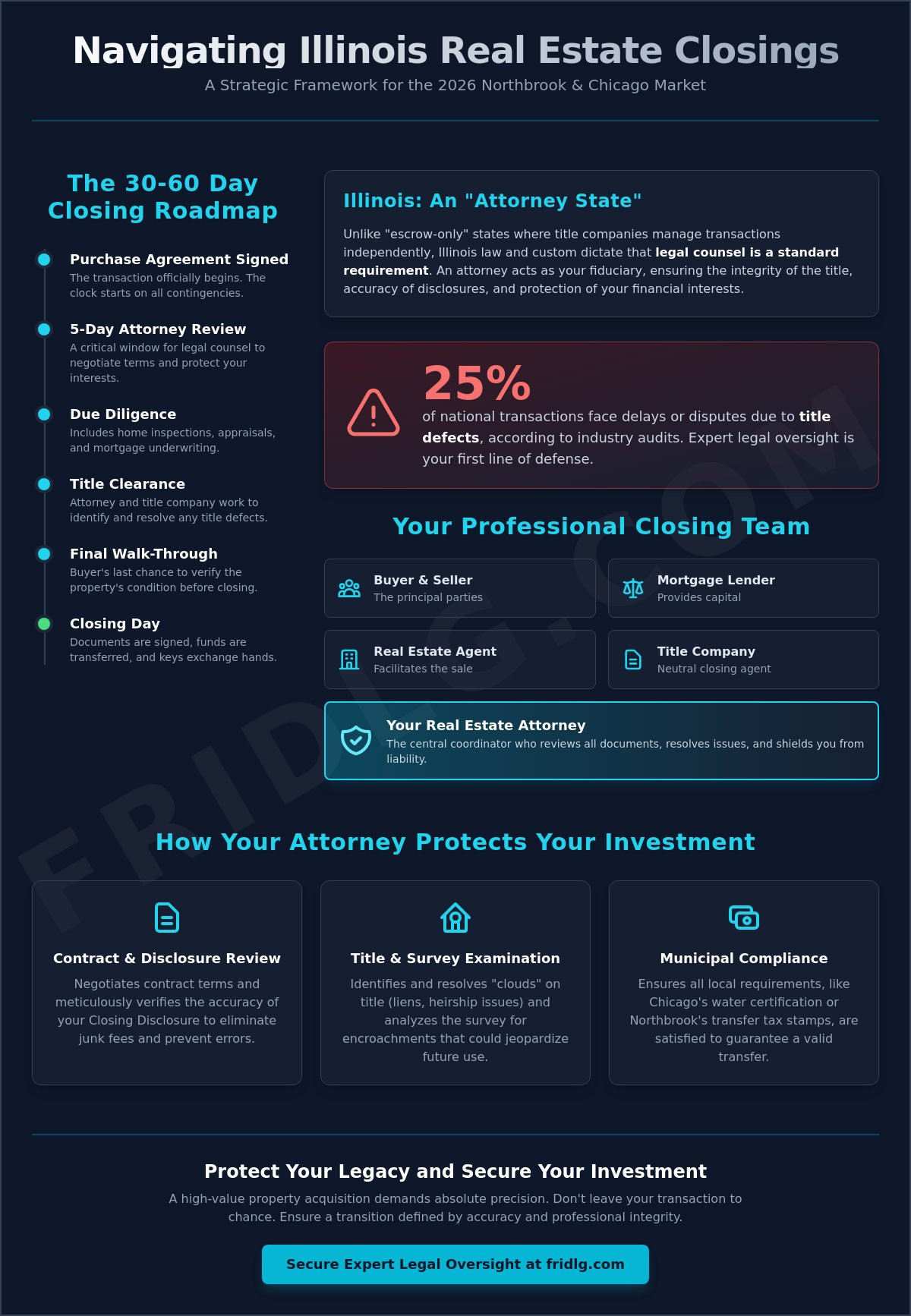
In the 2026 Illinois property market, residential real estate closings represent the final, formal execution of a property transfer where the deed passes to the buyer and funds are disbursed to the seller. This milestone concludes a complex series of legal and financial obligations. Unlike "escrow-only" states where title companies manage the entire transaction independently, Illinois operates as a traditional "attorney state." This distinction means that legal counsel is a standard requirement to ensure the integrity of the title and the accuracy of the closing disclosures.
The real estate closing process in Northbrook and Chicago typically follows a 30 to 60 day trajectory. It initiates the moment both parties sign the purchase agreement. From that point, the timeline moves through the attorney review period, home inspections, mortgage underwriting, and title clearing. A real estate attorney serves as the strategic coordinator; they manage the interplay between lenders, title agents, and municipal authorities to prevent delays that could jeopardize the transaction.
The Significance of the Attorney Review Period
The standard Multi-Board Residential Real Estate Contract provides a five-business-day window for legal modifications. During this phase, attorneys negotiate specific terms that go beyond the initial offer price. This includes addressing structural issues found during inspections or requesting credits for deferred maintenance. Proceeding without a formal legal review exposes parties to rigid contract terms that can't be easily altered once this window closes. It's the primary mechanism for aligning the contract with the client's specific risk tolerance and financial goals.
Key Participants in a Chicago-Area Closing
A successful closing requires the synchronization of several professional entities:
- The Buyer and Seller: The principal parties who must fulfill all contractual contingencies by the specified deadlines.
- Mortgage Lenders: Institutions providing the capital, requiring strict adherence to federal lending guidelines and 2026 compliance standards.
- Real Estate Agents: Facilitators of the initial sale who coordinate property access for inspections and appraisals.
- The Title Company: Acts as the neutral closing agent, issuing title insurance and hosting the final document signing.
- The Attorney: The central figure who reviews the title commitment, prepares the deed, and calculates the final residential real estate closings figures.
The attorney's role is to act as a shield against title defects and mathematical errors in the settlement statement. They ensure that all municipal requirements, such as Chicago's water certification or Northbrook's local transfer tax stamps, are fully satisfied before the keys change hands. This oversight provides the necessary security for high-value suburban and urban property transfers.
The Legal Anatomy of a Northbrook Property Transaction
The structural integrity of residential real estate closings in Northbrook depends on the exhaustive verification of property rights and the mitigation of hidden liabilities. Precision is paramount. A comprehensive title search serves as the primary diagnostic tool, identifying "clouds" such as unreleased mortgages, heirship disputes, or historical indexing errors that could jeopardize ownership. In the competitive 2026 market, these defects must be cured long before the parties reach the closing table to prevent costly delays or litigation.
A current Plat of Survey remains a non-negotiable component of the due diligence process. This document reveals the physical realities of the land, including encroachments by neighboring fences or the existence of utility easements that might restrict future improvements. For investors looking beyond the immediate purchase, these details dictate the feasibility of transitioning a site from its current use to future commercial real estate transactions. Identifying a two-inch setback violation now prevents a catastrophic title claim during a subsequent high-value sale.
Title Insurance and Lien Mitigation
Title insurance provides the necessary indemnity against undiscovered claims that a standard search might overlook. In the Chicago suburbs, mechanics liens from recent renovations and delinquent tax liens remain the most frequent obstacles to a clear transfer. Under Illinois law, a mechanics lien can be filed up to four months after work completion to remain effective against third-party purchasers. Our firm ensures all contractor waivers are collected and verified. This rigorous clearing of title requirements is the standard protocol before a lender authorizes the final funding of the loan.
Cook County and Municipal Compliance
Compliance in Northbrook involves a specific sequence of regulatory approvals. While the Village of Northbrook does not currently impose a municipal transfer tax, it requires a "No-Debt" certification. This involves verifying that all final water readings are paid and no outstanding building code violations exist. Conversely, Cook County requires a transfer tax of $0.50 per $500 of the purchase price, while the State of Illinois adds $1.00 per $500.
- Verification of zoning certificates for multi-family units.
- Submission of the MyDec portal declarations for state and county stamps.
- Procurement of the paid water bill receipt from the Northbrook Finance Department.
Municipal compliance serves as a prerequisite for a clean deed transfer. Without these stamps and certificates, the Cook County Recorder will reject the filing, leaving the buyer's interest unperfected. Securing a strategic legal partnership ensures these administrative hurdles don't disrupt the timeline of your residential real estate closings. We focus on the granular details so the transition of ownership remains seamless and legally sound.
Why a Real Estate Attorney is Essential in Illinois
Illinois operates under a legal framework that distinguishes it from "title states" like Arizona or Florida. In those regions, title companies often lead the process. However, residential real estate closings in the Chicago area are fundamentally attorney-led. This structure exists because a real estate transaction isn't merely a business exchange; it's a complex transfer of legal rights and liabilities. While real estate brokers are vital for market analysis and property sourcing, their authority is legally restricted. The Illinois Supreme Court ruling in Chicago Bar Association v. Quinlan & Tyson, Inc. establishes that brokers cannot draft or modify legal documents beyond filling in basic blanks on standard forms. Relying on a non-lawyer to navigate these complexities invites significant risk.
Legal counsel serves as a shield against predatory lending and the accumulation of "junk fees." During the review of the Closing Disclosure, an attorney identifies redundant administrative charges that can inflate costs by $600 to $1,200 without providing any tangible value. It's also the attorney’s responsibility to translate the technical language of the Promissory Note and the Mortgage. The Note represents your personal promise to repay the debt, while the Mortgage is the document that grants the lender a security interest in your home. Understanding the interplay between these two documents is essential for any homeowner's long-term financial security.
Drafting and Reviewing the Deed
The deed is the instrument that actually transfers ownership, but not all deeds offer the same protection. A General Warranty Deed provides the highest level of security, as it guarantees the title is clear of all defects. In contrast, a Quitclaim Deed transfers interest without any warranties, which is often inappropriate for standard residential real estate closings. We ensure the legal description is 100% accurate, as even a minor typographical error in the lot or block number can cloud a title for decades. Furthermore, we advise on vesting options, such as Tenancy by the Entirety, which offers unique asset protection benefits for married couples in Illinois.
Mitigating Post-Closing Disputes
Precision in contract language is the primary tool for preventing litigation. If a pre-closing walkthrough reveals that a seller didn't complete agreed-upon repairs, the attorney negotiates an escrow holdback. This mechanism keeps a portion of the seller's proceeds in a neutral account until the work is verified. If a party attempts to breach the contract before the closing date, legal counsel provides the necessary framework for specific performance or the recovery of earnest money. These safeguards ensure that the transition of property is final and that disputes don't follow the parties into the following year.
The Closing Day Roadmap: Preparation and Execution
The successful execution of residential real estate closings in the Chicago metropolitan area demands a disciplined adherence to procedural timelines. Within 24 hours of the scheduled appointment, the buyer conducts the final walk-through. This inspection isn't a formality. It's a critical verification that the property's condition hasn't deteriorated since the initial inspection and that the seller has fulfilled all repair obligations. Buyers must confirm that all fixtures remain, debris is removed, and mechanical systems function as intended.
Simultaneously, legal counsel performs a final audit of the Closing Disclosure (CD). Under the TILA-RESPA Integrated Disclosure (TRID) guidelines, buyers must receive this document three business days before the event. We cross-reference every line item against the original Loan Estimate to identify discrepancies in origination fees, title insurance premiums, or escrow requirements. Precision at this stage prevents delays at the title company table.
Final Financial Preparations
The movement of capital is governed by the Illinois Good Funds Act. For transactions exceeding $50,000, the law mandates the use of electronic wire transfers to ensure immediate availability. Smaller amounts may occasionally permit certified checks, but wiring remains the professional standard for security and speed. Our oversight ensures that the breakdown of buyer and seller credits, particularly the prorated Illinois property taxes, is mathematically sound. Good Funds must be available before the deed is recorded.
- Wire Transfers: Initiated at least 24 hours prior to ensure clearance by the title agent's bank.
- Prorations: Calculation of utility bills, association dues, and tax credits based on the specific calendar day of the transfer.
- Government Fees: Allocation of municipal transfer stamps required by the City of Chicago or specific Northbrook ordinances.
Understanding the Paperwork Marathon
The signing process represents the formal transition of liability and ownership. During residential real estate closings, the volume of documentation can be overwhelming without structured guidance. The Bill of Sale transfers personal property, while the ALTA Settlement Statement provides the definitive financial ledger of the transaction. We prioritize the review of the Affidavit of Title; this sworn statement by the seller confirms the absence of undisclosed liens or legal encumbrances that could cloud the buyer's ownership.
Clerical errors in the legal description or the misspelling of a name can lead to significant title defects in the future. Having an attorney present to scrutinize these documents in real-time ensures a smooth exit from the transaction and protects the long-term integrity of the investment. Once the lender issues the Funding Authorization, the title company releases the keys, and the transfer of possession is complete.
To ensure your interests are protected through every stage of the transaction, contact our firm for strategic legal counsel regarding your upcoming closing.
Securing Your Investment with Fridman Legal
O. Allan Fridman brings 20 years of focused Chicago legal experience to the closing table. This tenure allows for the identification of subtle title defects and contractual risks that high-volume firms often overlook. While many "flat-fee" factories prioritize quantity over quality, Fridman Legal maintains a boutique approach. Every transaction receives meticulous attention, ensuring that residential real estate closings proceed without the delays caused by administrative oversight. We don't view a closing as an isolated event; it's a critical component of your financial portfolio that requires precise execution.
The 2026 real estate market in Northbrook demands a higher level of scrutiny due to evolving Cook County tax assessments and local zoning ordinances. Our firm provides the strategic advisory necessary to navigate these complexities. We move beyond the standard checklist to offer a comprehensive legal review that protects your equity from the moment the contract is signed until the keys are delivered. This professional integrity ensures that your interests remain the primary focus throughout the entire process.
Integrating Real Estate into Your Financial Legacy
A residence represents a cornerstone of personal wealth. Failing to coordinate this acquisition with your estate planning strategy can lead to unnecessary probate complications or tax liabilities. Placing a home into a trust immediately after closing provides a layer of asset protection that standard ownership doesn't offer. Our office ensures that your deed is structured to remain consistent with your broader living trust or will. This alignment is vital for maintaining a seamless transition of assets to future generations without the intervention of the court system.
Contacting a Northbrook Real Estate Specialist
The intake process at Fridman Legal is designed for efficiency and clarity. New buyers or sellers begin with a comprehensive contract review to identify potential liabilities before they become binding. This initial step is crucial for residential real estate closings where timing is often dictated by strict contingency deadlines. When preparing for your initial consultation, please have your signed purchase agreement, the residential property disclosure report, and valid government identification ready. These documents allow for an immediate assessment of your legal standing and the creation of a timeline for your closing.
Taking the first step toward a secure transaction is straightforward. Our team handles the logistical burdens of title searches, municipal inspections, and mortgage coordination, allowing you to focus on your move. You can Schedule your residential closing consultation with Fridman Legal to ensure your Northbrook investment is managed with the professional rigor it deserves.
Navigate Your 2026 Property Transaction With Precision
Navigating the complexities of residential real estate closings in the Chicago suburbs requires more than a standard checklist. It demands a rigorous legal framework that integrates property law with sophisticated asset protection strategies. Successfully executing a transaction in Northbrook involves a meticulous review of title commitments, local ordinances, and contractual obligations to preemptively mitigate risk. This structured approach ensures that every legal contingency is addressed before you reach the closing table.
O. Allan Fridman brings nearly 20 years of legal experience to every transaction, ensuring that your real estate interests are managed with the precision of a strategic partner. We don't just facilitate signatures; we provide a defensive perimeter for your capital. This personalized, results-driven representation focuses on the strategic alignment of your property acquisition with your broader financial goals. By leveraging specialized expertise in both real estate and asset protection, we transform a standard transaction into a secure investment. Your transition into a new property should be defined by legal certainty and professional excellence.
Protect your investment—Schedule a Northbrook real estate closing consultation today
Frequently Asked Questions
Do I legally need an attorney for a real estate closing in Illinois?
Illinois law doesn't strictly mandate an attorney's presence, but local customs and title company protocols make legal representation essential for residential real estate closings. In Cook County, approximately 98% of transactions involve legal counsel to manage the complexities of the Multi-Board Residential Real Estate Contract 7.0. Our firm provides the necessary oversight to ensure all contractual obligations meet the rigorous standards established by the Illinois Department of Financial and Professional Regulation.
How long does the typical residential closing process take in Northbrook?
The standard timeline for residential real estate closings in Northbrook spans between 30 and 45 days from the execution of the initial contract. This period incorporates the five-day attorney review window and the 30-day mortgage contingency period required by most institutional lenders. Efficiency depends on the prompt delivery of the title commitment and the completion of municipal transfer tax requirements specific to the Village of Northbrook.
What are the most common reasons for a closing delay in the Chicago area?
Financing complications account for approximately 30% of closing delays in the Chicago metropolitan area according to data from the National Association of Realtors. Issues frequently arise from unreleased prior mortgages or unresolved building code violations documented in the city's Department of Buildings database. These technical obstacles require precise legal intervention to clear title and maintain the scheduled date without incurring per diem penalties.
What is the difference between a title search and a home inspection?
A title search examines public records to verify legal ownership and identify liens, while a home inspection evaluates the physical structure and mechanical systems of the property. The title search, governed by the Illinois Title Insurance Act, ensures the buyer receives a clear deed at the conclusion of the transaction. Conversely, the inspection identifies material defects like foundation cracks or outdated electrical systems that might necessitate a financial credit before the deal closes.
How much should I expect to pay in closing costs in Cook County?
Buyers in Cook County typically encounter closing costs ranging from 2% to 5% of the total purchase price. These expenses include the Cook County transfer tax of $0.75 per $500 of value, along with municipal taxes that vary significantly by specific zip code. You'll also face title insurance premiums and recording fees mandated by the Cook County Recorder of Deeds, which are standardized across the jurisdiction for all residential transactions.
What happens if I find a problem during the final walk-through?
You're entitled to request an escrow holdback or a closing credit if the final walk-through reveals new damage or uncompleted repairs. If the property's condition has materially changed since the initial inspection, your attorney can negotiate a specific dollar amount to be held by the title company until the seller rectifies the issue. This legal mechanism protects your investment and ensures the seller fulfills their obligation to deliver the unit in "broom clean" condition.
Can a real estate attorney help if I am also considering debt relief?
A real estate attorney provides strategic guidance when property transactions intersect with debt relief strategies like short sales or deed-in-lieu of foreclosure. Under the Illinois Mortgage Foreclosure Law, legal counsel ensures that any negotiated settlement with a lender includes a full release of personal deficiency liability. This integrated approach protects your remaining assets and establishes a stable financial foundation following the sale of a distressed asset.
What is the "Attorney Review" period and can I cancel the contract during it?
The attorney review period is a standard five-business-day window following contract acceptance where legal counsel can propose modifications or terminate the agreement. During this timeframe, either party can cancel the contract without penalty if the proposed changes aren't mutually agreed upon in writing. This phase is critical for addressing specific legal contingencies and ensuring the terms align with your long-term financial and strategic objectives.

Article by
O. Allan Fridman
O. Allan Fridman has been practicing law since 2001. His practice is unique in that he does not view himself as a litigation attorney or transactional attorney. Rather, he views each area of law as a tool to pursue the best results for his clients. By practicing in both areas of law, he is able to take a 360-degree view of law. This enables the firm to catch potential drawbacks that are readily identifiable.
By practicing in litigation and transactional law and taking a holistic approach in dealing with our clients, he doesn’t put clients in box — rather, as we are all individuals, so too are the legal services we may require.
Whether it is bankruptcy or litigation or transactional, each client brings challenges and does not fit in any one box. Often times, bankruptcy clients end up not filing bankruptcy because we can achieve a better result through litigation or through an out-of-court resolution with the lender, or through a real estate sale. On the other end of the spectrum, a litigation client with multiple issues and lawsuit may fare better in a bankruptcy.
Since 2001, Allan has practiced in states and federal court, and he is a member of the trial bar of the Northern District of Illinois and admitted in the Northern District of Indiana.
We are a debt relief agency. We help people file for bankruptcy relief under the Bankruptcy Code
The materials on this site are for informational purposes only and do not constitute legal advice. Viewing this site or contacting us does not create an attorney–client relationship, and you should not act or refrain from acting based on any information here without seeking professional legal counsel.


