

On a Tuesday morning in 2026, a Northbrook resident discovers that 15% of their gross earnings vanished before the paycheck even reached their bank account. This sudden loss of liquidity often triggers immediate concern regarding essential expenses like rent and groceries. When a creditor secures a judgment, the legal mechanics of Illinois law can feel insurmountable without the intervention of a qualified wage garnishment lawyer. You likely recognize that an unaddressed deduction isn't just a financial burden, it's also a source of professional embarrassment within your payroll department.
You've probably realized that waiting for the debt to expire isn't a viable strategy for financial recovery. This article provides the precise legal framework required to halt these deductions and secure your future income through strategic representation. We'll examine the specific Illinois exemption laws that protect your assets, discuss how to negotiate lower settlements with creditors, and determine if a Chapter 7 or Chapter 13 filing serves as your most effective exit strategy. By understanding these professional pathways, you can regain control over your financial obligations and restore your peace of mind.
Key Takeaways
- Understand the legal framework of the Illinois Wage Deduction Act and the specific financial triggers that jeopardize your monthly earnings.
- Navigate the procedural nuances of Cook and Lake County courts to ensure your defense is executed within the correct jurisdictional parameters.
- Consult with a strategic wage garnishment lawyer to implement immediate shielding mechanisms, such as the Affidavit of Exemptions, to protect your income.
- Determine your protected income thresholds under 2026 Illinois statutes to ensure your financial stability remains legally secured.
- Discover the long-term benefits of a boutique legal approach that emphasizes personalized strategy and comprehensive debt relief solutions.
Understanding Wage Garnishment in Illinois: Why Your Paycheck is at Risk
Financial stability in 2026 requires a precise understanding of the Illinois Wage Deduction Act. This legislation dictates the parameters under which a creditor may legally intercept your earnings. Wage garnishment is not a sudden occurrence; it represents the culmination of a legal process where a portion of your compensation is diverted to satisfy an outstanding debt. Common triggers for these actions include delinquent credit card balances, unresolved medical bills, or defaulted personal loans. In the current economic climate, where Northbrook residents face fluctuating living costs, the sudden reduction of a paycheck creates immediate liquidity crises.
The procedure involves three distinct parties: the Creditor, who seeks payment; the Debtor, who owes the obligation; and the Garnishee, which is typically your employer. What is wage garnishment? It's a statutory mechanism that forces an employer to withhold funds from an employee's wages to pay a third-party debt. When you're facing this scenario, engaging a wage garnishment lawyer is a critical step in asserting your rights and evaluating potential exemptions that may stop the drain on your resources.
The Illinois Wage Deduction Order Process
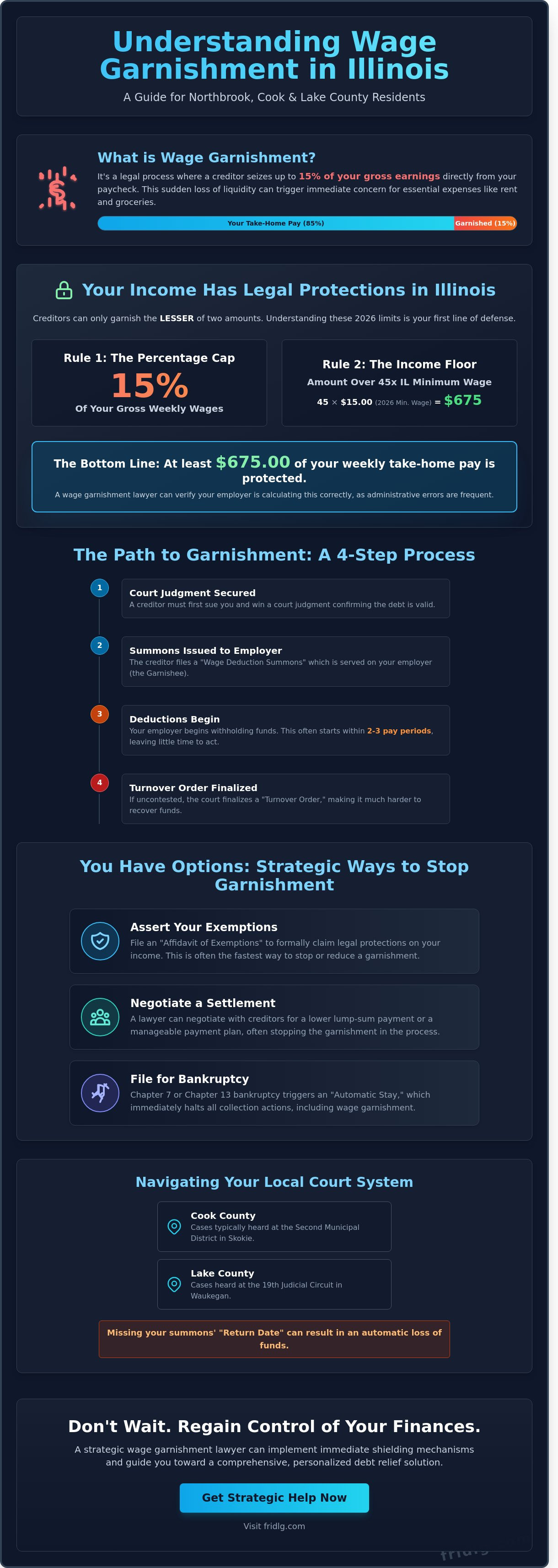
A creditor cannot initiate a garnishment simply because a payment was missed. The process requires a prior court judgment, establishing the debt's validity. Once this judgment is secured, the creditor files a "Summons and Interrogatories" which are served upon your Northbrook employer. This document compels the employer to disclose your earnings and calculate the non-exempt portion. Usually, the first deduction occurs within two to three pay periods following the service of the summons, leaving very little time for strategic intervention.
How Much Can Be Taken? Illinois Exemption Limits
Illinois law provides specific safeguards to ensure debtors retain enough income for basic subsistence. The amount withheld is limited to the lesser of 15% of your gross weekly wages or the amount by which your weekly disposable earnings exceed 45 times the state minimum wage. As of January 1, 2026, the Illinois minimum wage remains at $15.00 per hour, meaning that at least $675.00 of your weekly disposable income is generally protected from most creditors. A wage garnishment lawyer can verify if your employer has calculated these figures accurately, as administrative errors are frequent.
The head of household exemption in Illinois serves as a legal protection intended to shield a larger portion of income for individuals who are the primary financial providers for dependents, though it requires specific judicial approval to be fully realized.
The Legal Landscape in Cook and Lake County Courts
The jurisdiction where a creditor initiates a citation to discover assets or a wage deduction summons dictates the procedural timeline and the specific rules of engagement. While the Richard J. Daley Center in downtown Chicago manages a high volume of Cook County litigation, Northbrook residents typically find their cases routed to the Second Municipal District in Skokie. For those residing near the northern border, Lake County cases are heard at the 19th Judicial Circuit in Waukegan. These distinctions aren't merely geographical; they represent different administrative ecosystems that a wage garnishment lawyer must navigate with precision.
The Clerk of the Circuit Court acts as the central hub for processing deductions. Once a creditor files the necessary paperwork, the Clerk issues the summons that your employer receives. The return date of this summons is a critical juncture. If an attorney isn't present to contest the validity of the underlying judgment or to assert statutory exemptions, the court will likely enter a turnover order. This order finalizes the transfer of your earned income to the creditor, making it significantly harder to recover those funds later.
- Procedural Integrity: Each district maintains specific standing orders that govern how motions are heard and when evidence must be presented.
- Return Date Importance: This is the deadline for filing a response; missing it often results in an automatic loss of the contested funds.
- Exemption Assertions: Illinois law protects certain income levels, but these protections aren't always applied automatically by the Clerk's office.
Effective debt defense requires a deep understanding of Handling a wage garnishment within these specific local frameworks. It's not just about the law; it's about knowing the administrative habits of the local courthouse.
Navigating the Second Municipal District (Skokie)
For Northbrook residents, the Skokie courthouse at 5600 Old Orchard Road is the primary venue for debt-related motions. The Second Municipal District operates with a focused docket, meaning cases often move faster than they do in the Daley Center. Proximity to Northbrook allows our team to provide a rapid legal response, often filing emergency motions to stay garnishment within 24 hours of a client's initial consultation. A wage garnishment lawyer familiar with the Skokie bench understands the specific documentation judges require to approve a hardship stay.
Lake County vs. Cook County Procedures
Clients living on the Northbrook and Deerfield border may face litigation in Waukegan instead of Skokie. Filing a "Motion to Quash" service of process involves different fee structures and filing windows in Lake County compared to Cook County's 1st and 2nd Districts. For example, Lake County’s electronic filing requirements and local rules for special process servers vary from the Cook County Sheriff’s standard protocols. Our firm maintains the logistical capacity to manage cases across both county lines, ensuring that jurisdictional boundaries don't compromise your financial stability. If you're facing a summons in either county, seeking strategic counsel early in the process is the most effective way to protect your earnings.
Comparing Your Options: How to Stop Wage Garnishment in Northbrook
Ignoring a garnishment order isn't a viable financial strategy. In Illinois, creditors can seize up to 15% of your gross weekly wages once a judgment's entered. Passive acceptance ensures a long-term drain on your resources that can last for years. Active legal intervention through a wage garnishment lawyer provides the only structured path to reclaiming your income. You have several procedural levers to pull, ranging from immediate exemptions to comprehensive debt restructuring.
The first line of defense is often the Affidavit of Exemptions. This document serves as a shield for specific types of income that Illinois law deems untouchable, such as Social Security benefits, disability payments, or a minimum threshold of earned wages. For those with access to a lump sum of capital, engaging debt settlement lawyers can resolve the underlying debt for a fraction of the total balance. This negotiation removes the garnishment entirely without the long-term public record of a bankruptcy filing. It's a strategic move for individuals who have liquid assets but struggle with monthly cash flow.
Challenging the Garnishment via Legal Defenses
You can contest the validity of the garnishment itself through specific court filings. If you weren't properly served with the original lawsuit, a Motion to Vacate Judgment can nullify the creditor's authority to seize your pay. Additionally, checking the debt collection statute of limitation is critical. In Illinois, written contracts generally have a 10 year limit, while oral agreements expire after 5 years. If the debt is older than these statutory windows, the garnishment is legally unenforceable. You may also claim hardship exemptions if the 15% deduction prevents you from meeting basic living requirements, though this requires detailed financial disclosure to the court.
Bankruptcy as a Permanent Solution
When multiple creditors are circling, Chapter 7 bankruptcy in Illinois acts as the definitive "nuclear option." The moment your wage garnishment lawyer files the petition, the court issues an Automatic Stay under 11 U.S.C. § 362. This federal injunction halts all collection activities instantly, including active garnishments. While a garnishment can linger for years and damage your credit profile every pay period, bankruptcy offers a singular, controlled entry on your report. This allows you to begin rebuilding your financial standing from a position of stability rather than constant depletion. It's often the most efficient way to reset your balance sheet when debts exceed your annual income.
Step-by-Step: Working with a Wage Garnishment Lawyer to Protect Your Income
Engaging a wage garnishment lawyer transforms a chaotic financial crisis into a structured legal process governed by the Illinois Code of Civil Procedure. The procedure begins with a forensic review of the Wage Deduction Notice and the underlying judgment. In 2026, Illinois law requires strict adherence to notification timelines; any deviation by the creditor can provide grounds to vacate the order. Your counsel evaluates the validity of the original debt and identifies procedural defects that might nullify the garnishment entirely.
We calculate your protected income based on the 2026 Illinois statutory thresholds. This involves comparing your net earnings against the state's minimum wage multipliers, which currently protect the greater of 45 times the federal or state minimum wage. If your income falls below these levels, the creditor cannot legally touch those funds. After identifying these protections, your attorney files a formal appearance in the Cook County or Lake County circuit court system to assert your rights.
Resolution occurs through either a negotiated settlement or a contested hearing. A skilled wage garnishment lawyer often leverages litigation risks to force creditors into favorable payment plans that don't involve direct payroll deductions. Once a judge signs the necessary order, your attorney ensures your employer's payroll department receives the "Order to Release" immediately to halt deductions before the next pay cycle.
Preparing Your Documentation
Precise documentation is the foundation of a successful defense. To expedite the process, you'll need to gather specific records that prove your financial standing and the history of the debt. You'll need to provide:
- The last 90 days of pay stubs to calculate exemption mathematics.
- The original Summons and Complaint if they were served.
- All correspondence from the judgment creditor's legal firm.
Identifying the specific judgment creditor is vital. Debt often changes hands through third-party collectors, and verifying their legal standing to collect is a primary defense. Attempting this "pro se" frequently results in technical dismissals. Illinois courts maintain rigid filing protocols that self-represented individuals rarely navigate successfully, often leading to avoidable financial loss.
The Court Hearing and Beyond
During the hearing, your attorney argues a "Motion to Stay" or "Motion to Quash." These motions challenge the creditor's right to continue the deduction based on exemptions or improper service. If the judge rules in your favor, the court issues an "Order to Release" or an "Order to Modify." Swift action is paramount. Legal intervention within 48 hours of receiving a garnishment notice remains the most effective strategy for preserving your 2026 income. Once the order is recorded, we confirm with your employer that the drain on your paycheck has ceased.
Secure your financial future and stop the cycle of debt by consulting with an experienced wage garnishment lawyer to review your case options.
Fridman Legal: Strategic Debt Relief and Bankruptcy Solutions in Northbrook
Selecting a qualified wage garnishment lawyer is a decision that requires careful consideration of both experience and methodology. Since 2006, O. Allan Fridman has navigated the complexities of Illinois bankruptcy and civil litigation, providing a stable foundation for clients facing financial instability. Fridman Legal operates as a boutique practice, which stands in direct contrast to high-volume "bankruptcy mills" that often prioritize processing speed over individualized strategy. This focused approach ensures that every financial detail is scrutinized to build a defense that protects your future earnings.
The firm's commitment to transparency is reflected in its flat-fee structure for bankruptcy services. This model eliminates the uncertainty of hourly billing, allowing clients to understand their total financial commitment from the outset. In an environment where every dollar is already allocated to creditors, cost certainty provides much-needed relief. O. Allan Fridman's 20 years of experience in the Illinois court system allows him to anticipate potential challenges before they arise, ensuring a streamlined process for those seeking to end the cycle of debt.
Why a Local Northbrook Attorney Matters
Engaging a wage garnishment lawyer with a physical presence in Northbrook offers distinct advantages over firms located in distant downtown Chicago offices. Local representation means your attorney possesses a nuanced understanding of the specific preferences and procedural expectations of judges and opposing counsel within the Cook County and Lake County suburban circuits. This familiarity often leads to more efficient negotiations and smoother court appearances.
The Northbrook office serves as a dedicated space for in-person strategy sessions, where complex financial documents can be reviewed with the attention they deserve. Beyond stopping paycheck deductions, the firm provides comprehensive debt solutions, including sophisticated foreclosure defense strategies. This holistic view of your financial health ensures that saving your paycheck also aligns with the broader goal of saving your home and stabilizing your long-term assets.
Contacting Fridman Legal for an Immediate Evaluation
Timing is the most critical factor when a garnishment order is active. Once an employer receives a summons, they're legally obligated to withhold up to 15 percent of your gross wages. It's vital to act before the next payroll cycle begins to prevent further loss of liquidity. Fridman Legal prioritizes rapid response times to evaluate the viability of your case and determine which legal exemptions or filings will provide the most immediate protection.
The firm's reputation is built on results-driven, professional representation that treats every client with the discretion their situation demands. You won't be handed off to a junior associate; you'll work directly with an attorney who has spent two decades mastering the intricacies of debt relief. To secure your earnings and regain control of your financial narrative, contact the Northbrook office to schedule a formal evaluation of your options.
Take Decisive Action to Reclaim Your Income
Wage garnishment isn't just a financial setback; it's a formal legal process that requires a structured and precise response. Under Illinois law, creditors can seize a significant percentage of your earnings, yet the legal framework also provides specific avenues for relief if you act within the required timelines. Navigating the complexities of the Cook and Lake County court systems demands a high level of professional integrity and strategic insight. With nearly 20 years of Illinois legal experience, our firm specializes in protecting clients from aggressive collection tactics through proven methodologies.
Retaining a skilled wage garnishment lawyer allows you to shift from a defensive position to one of control. We provide flat-fee options for bankruptcy filings to ensure transparency and predictability during your recovery. Our approach focuses on the technical details of your case to stop the immediate drain on your resources. You don't have to face these challenges without expert advocacy. By prioritizing professional precision and a deep understanding of local judicial procedures, we help you secure the stability your future requires.
Protect your paycheck today; schedule a consultation with Fridman Legal in Northbrook
Restoring your financial independence is a manageable process when you have the right legal partner supporting your interests.
Frequently Asked Questions
Can a wage garnishment lawyer stop a garnishment that has already started?
Yes, a wage garnishment lawyer can halt active collections by utilizing federal and state legal protections. If you file for bankruptcy, the court issues an Automatic Stay under 11 U.S.C. § 362, which legally requires creditors to stop all garnishment actions immediately. Alternatively, your counsel may file a motion to vacate the original judgment if the creditor failed to provide proper legal notice during the initial lawsuit.
How much does a wage garnishment lawyer cost in the Chicago area?
Legal fees in the Chicago metropolitan area vary based on the complexity of the debt portfolio and the specific strategy required for your case. Most firms offer a structured fee arrangement or a flat rate for bankruptcy filings, while litigation to contest a judgment is often billed at an hourly rate. You'll receive a precise fee schedule during your initial consultation after we analyze your financial documents.
Is there a way to stop wage garnishment in Illinois without filing for bankruptcy?
You can stop a garnishment without bankruptcy by negotiating a lump-sum settlement or a voluntary payment plan directly with the creditor's counsel. Illinois law under 735 ILCS 5/12-801 also allows you to challenge the garnishment in court if the funds are exempt or if the underlying judgment is legally flawed. Your attorney will determine if a "Motion to Quash" is a viable strategic option for your specific situation.
Can my employer fire me because of a wage garnishment in Illinois?
Your employer cannot terminate your employment for a single wage garnishment under Title III of the Consumer Credit Protection Act. This federal law protects workers from being fired when their earnings are subjected to one garnishment for any single indebtedness. However, these protections don't necessarily apply if you're facing multiple garnishments from different creditors, making it vital to resolve these legal claims quickly before they impact your professional standing.
What is the maximum amount that can be garnished from my paycheck in 2026?
Illinois law limits the amount a creditor can take to the lesser of 15% of your gross weekly wages or the amount by which your weekly disposable income exceeds 45 times the state minimum wage. Since the Illinois minimum wage reached $15.00 per hour on January 1, 2025, the protected threshold remains high for lower-income earners. A wage garnishment lawyer ensures your employer applies these statutory calculations correctly to prevent excessive deductions from your pay.
How long does it take for a lawyer to stop a garnishment once hired?
The timeline for relief depends on the legal mechanism used to intervene. Filing a bankruptcy petition provides nearly instantaneous protection, often stopping a garnishment within 24 to 48 hours once the court notifies your employer. If your legal strategy involves filing a motion to contest the garnishment in an Illinois court, the process typically takes 30 to 45 days as it requires a scheduled hearing before a judge.
Will a wage garnishment lawyer help me with other debts as well?
A qualified wage garnishment lawyer provides a comprehensive analysis of your entire financial landscape rather than focusing solely on a single creditor. The goal is to create a long-term strategy that addresses credit card debt, medical bills, and personal loans to prevent future legal actions. We evaluate whether a strategic restructuring or a full discharge of liabilities is the most effective way to secure your financial stability.
What happens if the creditor is garnishing my bank account instead of my wages?
Bank account garnishments, known as "citations to discover assets," follow different rules than wage deductions. In Illinois, you're entitled to a "wildcard exemption" under 735 ILCS 5/12-1001(b), which protects up to $4,000 of your personal property, including cash in a bank account. Your attorney must file a timely claim of exemption to protect these funds, or the bank will be legally required to freeze and turn over the money.

Article by
O. Allan Fridman
O. Allan Fridman has been practicing law since 2001. His practice is unique in that he does not view himself as a litigation attorney or transactional attorney. Rather, he views each area of law as a tool to pursue the best results for his clients. By practicing in both areas of law, he is able to take a 360-degree view of law. This enables the firm to catch potential drawbacks that are readily identifiable.
By practicing in litigation and transactional law and taking a holistic approach in dealing with our clients, he doesn’t put clients in box — rather, as we are all individuals, so too are the legal services we may require.
Whether it is bankruptcy or litigation or transactional, each client brings challenges and does not fit in any one box. Often times, bankruptcy clients end up not filing bankruptcy because we can achieve a better result through litigation or through an out-of-court resolution with the lender, or through a real estate sale. On the other end of the spectrum, a litigation client with multiple issues and lawsuit may fare better in a bankruptcy.
Since 2001, Allan has practiced in states and federal court, and he is a member of the trial bar of the Northern District of Illinois and admitted in the Northern District of Indiana.
We are a debt relief agency. We help people file for bankruptcy relief under the Bankruptcy Code
The materials on this site are for informational purposes only and do not constitute legal advice. Viewing this site or contacting us does not create an attorney–client relationship, and you should not act or refrain from acting based on any information here without seeking professional legal counsel.