

What if the salary on your tax return isn't the final word on whether you can file for debt relief? It’s a common misconception that earning a solid paycheck automatically bars you from the fresh start you need. If you're dealing with the stress of potential wage garnishment or the fear of losing your Northbrook home, you've likely worried that the Illinois bankruptcy means test will disqualify you before you even begin. It is frustrating to feel stuck in a financial gray area where you earn too much to feel "broke" but not enough to keep up with mounting bills.
In this guide, we'll demystify how this formula actually works and show you why it’s a strategic calculation rather than a simple "keep out" sign. You'll learn the updated 2026 median income limits, such as the $71,304 threshold for single households and $91,526 for couples, which apply to cases filed through early May 2026. More importantly, we'll explore how you can often qualify for Chapter 7 by properly accounting for your specific monthly expenses. We are going to walk through the math, the state exemptions, and the specific steps to lowering your disposable income calculation to get the clear answers you need to move forward.
Key Takeaways
- We'll break down why the Illinois bankruptcy means test is more like a financial filter than a brick wall, especially for families in the Chicago suburbs.
- You can check your current standing against the updated 2026 median income limits to see if you pass the first hurdle automatically.
- Learn how to use your mortgage, car payments, and other daily costs to lower your "disposable income" and qualify for a fresh start.
- Find out if your business debt or military service status gives you a legal shortcut to skip the income math entirely.
- See why professional math is the only way to avoid the risks of inaccurate online calculators and ensure a successful filing.
What Exactly is the Illinois Bankruptcy Means Test?
Think of the bankruptcy court as having a high-security gate. To get through to the "fresh start" of a Chapter 7 filing, you have to pass through a specific gatekeeper. What Exactly is the Illinois Bankruptcy Means Test? This process acts as a financial filter for the court system. It was introduced as part of a 2005 legal overhaul to prevent what the government calls "abuse" of the system. Essentially, the court wants to make sure that people who have enough income to pay back some of their debt don't get a total discharge of those balances for free. It isn't a trap; it's a tool that determines which legal path fits your actual financial reality.
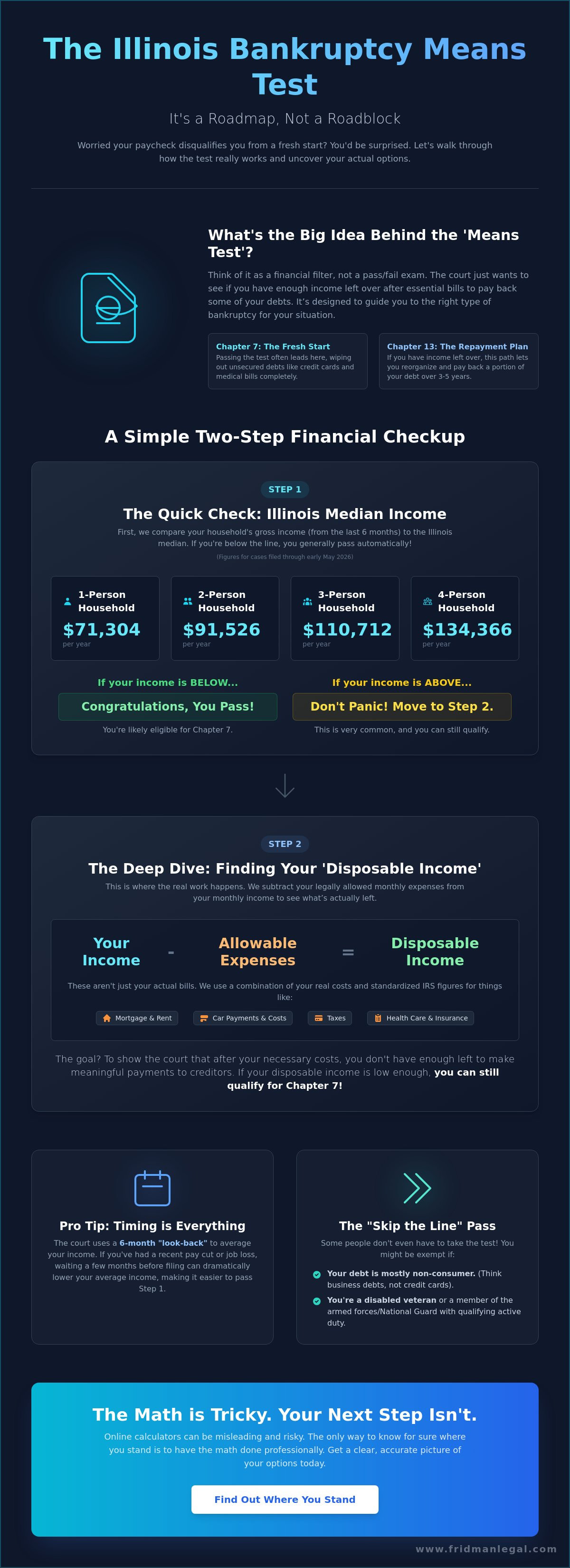
The Illinois bankruptcy means test consists of two distinct stages. The first stage is a simple comparison: the Median Income Test. If your gross household income is lower than the median for a family of your size in Illinois, you generally pass automatically. However, if you earn more than that limit, you move to the second stage, which is the Disposable Income Calculation. This is where we look at your actual, necessary expenses to see if you have anything left at the end of the month to pay your creditors. This specific test only applies to Chapter 7 filings. While Chapter 13 involves its own set of complex math for repayment plans, it doesn't use this specific "pass or fail" gatekeeping mechanism.
Why Illinois Filers Specifically Need to Pay Attention
Even though bankruptcy is governed by federal law, the math is incredibly local. The Illinois bankruptcy means test uses IRS-allowed expense figures that are adjusted for the cost of living in our state. Since living in Northbrook or the surrounding Chicago suburbs is more expensive than living in rural areas, these local standards are vital. The test doesn't just look at what you're making today, either. It takes a snapshot of your average gross income from the last six months. This means if you recently lost a high-paying job, the timing of your filing becomes a strategic decision that can make or break your eligibility.
The Difference Between Chapter 7 and Chapter 13 Eligibility
Passing the means test is the primary hurdle for a Chapter 7 bankruptcy Illinois filing. This is the path most people prefer because it wipes out unsecured debts like credit cards and medical bills in just a few months. If the math shows you have too much disposable income, the court will likely steer you toward Chapter 13. That involves a 3 to 5 year repayment plan where you pay back a portion of what you owe. While Chapter 13 is excellent for stopping a foreclosure and saving a home, qualifying for Chapter 7 is often the faster, more direct route to debt relief.
Illinois Median Income Limits for 2026
The Census Bureau updates median income figures twice a year, typically in April and November. These benchmarks serve as the foundational starting point for the Illinois bankruptcy means test. If your gross annual income is below the Illinois median for your family size, you automatically pass the means test. For cases filed between November 1, 2025, and May 5, 2026, the court uses the following thresholds to determine eligibility.
- 1-Person Household: $71,304
- 2-Person Household: $91,526
- 3-Person Household: $110,712
- 4-Person Household: $134,366
Defining a "household member" is often more nuanced than simply counting the people in your home. The legal standard generally focuses on individuals who are financially dependent on you or those who contribute to the household's economic life. This could potentially include a child at university or an elderly relative you support. Precision here is essential since every additional member increases the income limit, making it easier to qualify for a Chapter 7 discharge.
How to Calculate Your "Current Monthly Income"
The court doesn't just review your most recent tax return. Instead, they look at a "6-month look-back" period. You calculate the average of all gross income received during the six full months prior to your filing date. This includes your regular salary, side gig earnings, and even unemployment compensation. Social Security benefits are a notable exception and don't count toward this total. Since this is an average, the timing of your filing can be a powerful strategic tool. If you had a period of high income that ended recently, waiting a few months could significantly lower your calculated average income for the Illinois bankruptcy means test.
What if Your Household Has More Than 4 People?
If your household exceeds four people, the income limit increases by $11,100 for each additional person. In areas like Northbrook or the wider Chicago suburbs, multi-generational homes or complex roommate situations are common. Determining who counts under the official bankruptcy means test information requires a careful review of your financial interdependencies. To ensure your math is accurate before you file, it’s a good idea to contact us for a professional assessment of your household size and income.
What Happens if Your Income is Above the Median?
If you looked at the 2026 Illinois Median Income Limits and realized your household earnings are higher than the threshold, take a deep breath. It isn't a dead end. Earning more than the state median doesn't automatically disqualify you from debt relief. It simply means you've reached the "deduction phase" of the Illinois bankruptcy means test. Instead of the simple comparison we talked about earlier, you'll now use Form 122A-2 to provide a more granular look at your financial life. This form is designed to show the court that despite a higher salary, your mandatory monthly obligations leave you with very little left over to pay back creditors.
The goal during this second part of the test is to calculate your "disposable income" by subtracting specific, IRS-approved expenses from your gross earnings. The court uses a mix of national standards and local Chicago-area data to decide what a reasonable person should spend on things like food, clothing, and housing. If the math shows that your disposable income is below a certain level after these deductions, you can still pass the test and file for Chapter 7. It's a strategic process of accounting where every legitimate expense helps prove your need for a fresh start.
Allowable Expenses That Help You Qualify
The IRS allows you to deduct several key costs that can quickly bring an over-median income back into the qualifying range. You can subtract actual payments for "secured" debts, such as your mortgage or car loans. You also get to account for mandatory payroll deductions like taxes, union dues, and retirement contributions. Out-of-pocket medical expenses and health insurance premiums are also critical factors. Working with a bankruptcy lawyer in Chicago is vital during this stage. A professional knows how to find every allowable cent to ensure your disposable income calculation is as low as legally possible.
The "Presumption of Abuse" and How to Overcome It
If the Illinois bankruptcy means test shows you have enough money left over each month to pay a meaningful amount to your creditors, the court will "presume" that filing for Chapter 7 is an abuse of the system. However, this is a "rebuttable" presumption. You can overcome it by showing "Special Circumstances." This might include a sudden medical crisis, a job loss that happened after the six-month look-back period, or even an impending hike in necessary expenses. Precise documentation is the only way to win this argument. You need to prove that your situation is unique and that the standard math doesn't reflect your true ability to pay.
Who Can Skip the Illinois Means Test Entirely?
While we've spent a lot of time talking about income limits and expense deductions, there's a small group of people who get to bypass the Illinois bankruptcy means test entirely. Think of it as a legal hall pass that allows you to file for Chapter 7 regardless of how much money you bring home each month. This isn't common, but for those who qualify, it removes a massive layer of stress and paperwork from the filing process. The court essentially decides that because of your specific situation or the nature of your debt, the standard income math shouldn't apply to you.
The most frequent way to skip the math is through the non-consumer debt rule, often called the 51% rule. If more than half of your total debt was incurred for something other than personal, family, or household purposes, you're exempt from the test. This is a game-changer for people who have seen a business venture struggle or who are dealing with significant tax liabilities. Instead of proving you don't make "too much" money, you simply have to prove that your debt is primarily commercial in nature. It's a distinct legal path that rewards entrepreneurial risk-taking even when things don't go as planned.
The Business Debt Exception for Northbrook Entrepreneurs
Business debt includes things like commercial leases, loans for specialized equipment, or credit lines used for inventory. Even if you're filing as an individual, if you personally guaranteed a business loan that later defaulted, that balance often counts as non-consumer debt. For entrepreneurs in Northbrook who are facing larger, more complex corporate restructuring, a Chapter 11 bankruptcy filing might be a more appropriate path, but for many, the business debt exception is the key to a straightforward Chapter 7. It allows you to protect your future income while resolving past business failures.
Military Service and Bankruptcy Exemptions
Veterans and active-duty service members also have specific protections that can bypass the Illinois bankruptcy means test. If you're a disabled veteran with a disability rating of at least 30%, and your debt was primarily incurred while you were on active duty or performing a homeland defense activity, you're likely exempt from the test. Similarly, members of the National Guard or Reservists who were called to active duty for at least 90 days are exempt for a period of 540 days after their service ends. This 540-day rule is a temporary exemption designed to provide a window of relief for those returning from service. You should always disclose your military status to your attorney immediately, as it can drastically simplify your case. If you think you might fall into one of these categories, it's a good idea to explore your bankruptcy options with a professional who understands these specific exemptions.
Taking the Next Step with a Northbrook Bankruptcy Attorney
It’s tempting to look for a quick answer by using an online "Means Test Calculator." However, these tools are often inaccurate and carry significant risks. They frequently rely on outdated national averages rather than the specific, current standards required for the Illinois bankruptcy means test. A small error in calculating your gross income or a missed deduction can lead to a rejected filing or a forced conversion to a different bankruptcy chapter. This is why professional oversight is essential. O. Allan Fridman brings nearly 20 years of experience to every case, ensuring that your forms are handled with the precision that a complex legal formula requires.
Financial distress is already stressful enough without worrying about hidden legal costs. We utilize a flat-fee model for our services. This approach provides you with clarity and predictability from the very beginning. You won't have to deal with unexpected surprises or hourly billing spikes while you're trying to reorganize your life. Ultimately, filing for bankruptcy isn't a sign of failure. It is a legal mechanism designed to provide a "Fresh Start" so you can regain control of your financial future and move forward with confidence.
What to Bring to Your Initial Consultation
To get an accurate picture of your eligibility, you'll need to gather some specific "raw data." Please bring your pay stubs for the last six months, as this is the timeframe the court uses to calculate your average monthly income. You should also have your most recent tax returns and a detailed list of your monthly unavoidable expenses, such as housing, utilities, and insurance. Finally, bring a comprehensive list of all your creditors. Even if you intend to keep paying a specific loan, the court needs to see the full scope of your financial obligations to perform the Illinois bankruptcy means test correctly.
How Fridman Legal Simplifies the Filing Process
Based in our Northbrook office, we provide personalized, results-driven legal solutions to residents across the greater Chicago suburbs. We don't believe in a one-size-fits-all approach. Instead, we take the time to understand your unique goals, whether that involves saving your home from foreclosure or negotiating a debt settlement. We handle the complex math and the heavy paperwork so you can focus on your recovery. When you're ready to get a definitive answer on your eligibility, schedule a consultation to run your means test today.
Secure Your Financial Future Today
The Illinois bankruptcy means test doesn't have to be an impossible hurdle. It is simply a tool that determines the best path for your specific financial situation. Whether you are clearly below the 2026 income limits or need to use detailed expenses to prove your eligibility, there is almost always a way to find relief. Even if you are an entrepreneur or a veteran, there are specific rules that could make your filing much simpler than you expect.
Instead of guessing with inaccurate online tools, you can rely on professional experience to navigate the paperwork. O. Allan Fridman has spent nearly 20 years helping people in Northbrook and across the Chicago suburbs find their footing again. We focus on both personal and business debt relief using a flat-fee model for Chapter 7 filings, so you won't face any surprises. Let us handle the math and contact Fridman Legal for a free means test evaluation. You deserve a fresh start that isn't defined by past financial stress. It is time to take that first step toward a clean slate.
Frequently Asked Questions
What is the income limit for Chapter 7 bankruptcy in Illinois for 2026?
For cases filed between November 1, 2025, and May 5, 2026, the gross income limit for a single-person household is $71,304. If you have a household of two, the limit rises to $91,526, while a family of four has a threshold of $134,366. For every person beyond a household of four, you add $11,100 to the limit. If your total earnings fall below these specific numbers, you generally pass the first phase of the Illinois bankruptcy means test automatically.
Can I file for Chapter 7 if I make more than the median income?
Yes, you can still qualify even if your paycheck is higher than the state median. In this situation, we move to the second part of the test to calculate your "disposable income." By subtracting allowed monthly expenses like your mortgage, car payments, and taxes, we can often show the court that you don't actually have enough money left over to pay back your creditors. This deduction phase is where many Northbrook residents find their path to eligibility.
Does my spouse’s income count if they aren’t filing for bankruptcy with me?
Yes, your spouse's income is typically included in the household total even if you are filing individually. The court looks at the entire household's ability to pay debt. However, we can often apply a "marital adjustment" to subtract expenses that are solely for your spouse's benefit. This helps ensure the final calculation only reflects the money truly available to the household for debt repayment.
What happens if I fail the Illinois means test?
If the math shows you have too much disposable income for Chapter 7, you'll likely look at a Chapter 13 filing instead. This isn't a failure; it’s just a different route to relief. Chapter 13 involves a three to five year repayment plan where you pay back a portion of your debt based on what you can afford. It is a particularly effective tool for stopping foreclosure and catching up on missed mortgage payments.
Is Social Security income included in the means test calculation?
No, Social Security benefits are specifically excluded from the Illinois bankruptcy means test income calculation. This is a significant protection for retirees and disabled individuals. Even if your monthly Social Security checks are substantial, they won't count against you when the court determines if you have "too much" income to file for a Chapter 7 discharge.
How far back does the means test look at my income?
The court reviews your gross income from the six full calendar months before your filing date. They take the average of every dollar you received during that window, including wages, bonuses, and side hustle earnings. Because the test uses a six-month average, the timing of your filing is a critical strategy. If you had a high-paying job that ended recently, waiting a month or two could drastically lower your average income.
What expenses are allowed as deductions in the Illinois means test?
You can deduct a combination of your actual monthly costs and IRS national and local standards. This includes mandatory payroll deductions like taxes and retirement contributions, as well as your mortgage, car loans, and health insurance premiums. We also use specific Illinois standards for housing, utilities, and transportation to ensure the calculation reflects the real cost of living in the Chicago suburbs.
Do I have to take the means test if most of my debt is from a failed business?
No, you can skip the test entirely if more than 51% of your total debt is non-consumer or business-related. This is known as the business debt exception. It is a vital loophole for entrepreneurs and business owners whose financial difficulties stem from a commercial venture rather than personal spending. If you meet this criteria, your current income level doesn't matter for Chapter 7 eligibility.

Article by
O. Allan Fridman
O. Allan Fridman has been practicing law since 2001. His practice is unique in that he does not view himself as a litigation attorney or transactional attorney. Rather, he views each area of law as a tool to pursue the best results for his clients. By practicing in both areas of law, he is able to take a 360-degree view of law. This enables the firm to catch potential drawbacks that are readily identifiable.
By practicing in litigation and transactional law and taking a holistic approach in dealing with our clients, he doesn’t put clients in box — rather, as we are all individuals, so too are the legal services we may require.
Whether it is bankruptcy or litigation or transactional, each client brings challenges and does not fit in any one box. Often times, bankruptcy clients end up not filing bankruptcy because we can achieve a better result through litigation or through an out-of-court resolution with the lender, or through a real estate sale. On the other end of the spectrum, a litigation client with multiple issues and lawsuit may fare better in a bankruptcy.
Since 2001, Allan has practiced in states and federal court, and he is a member of the trial bar of the Northern District of Illinois and admitted in the Northern District of Indiana.
We are a debt relief agency. We help people file for bankruptcy relief under the Bankruptcy Code
The materials on this site are for informational purposes only and do not constitute legal advice. Viewing this site or contacting us does not create an attorney–client relationship, and you should not act or refrain from acting based on any information here without seeking professional legal counsel.