

Imagine sitting at your kitchen table surrounded by a mountain of unopened envelopes and past-due notices. You know you need a fresh start, but the thought of digging through years of financial history feels more exhausting than the debt itself. It's completely normal to feel paralyzed by the paperwork, especially when you're worried that forgetting one single creditor might jeopardize your entire case. If you're wondering what documents do I need to file for bankruptcy in Illinois, you aren't just looking for a list; you're looking for a way to regain control over a chaotic situation.
We understand that the legal system's obsession with detail can be overwhelming. That's why we've created this clear, updated 2026 checklist to turn that pile of stress into an organized strategy. By following this guide, you'll know exactly which pay stubs, tax returns, and bank statements are required to satisfy the court's requirements and the Illinois Means Test. We'll walk you through the essential records you need to gather so you can walk into your initial consultation feeling prepared, calm, and ready to move forward with your financial recovery.
Key Takeaways
- Understand why the court requires a complete "financial snapshot" and how gathering these records now prevents legal headaches later.
- Get a clear answer to "what documents do I need to file for bankruptcy in Illinois" by identifying the specific paystubs and tax returns required for the 2026 Means Test.
- Learn the best way to compile a master list of creditors and bank statements so you don't risk leaving out a single debt.
- Identify the non-financial must-haves, like your Social Security card and counseling certificates, that are mandatory for a successful discharge.
- Discover how professional legal guidance turns your disorganized paperwork into a precise, strategic plan for a fresh start.
Why Organizing Your Paperwork is the First Step to Financial Peace
It's understandable if that stack of unopened mail on your kitchen table feels like an immovable object. When you're facing financial hardship, the initial question is often, "what documents do I need to file for bankruptcy in Illinois?" but the real hurdle is usually the emotional exhaustion of facing the numbers. Think of this process as creating a high-definition financial snapshot. The court doesn't just look at a single balance; they examine the entire trajectory of your finances. This documentation serves as the bedrock for your Chapter 7 bankruptcy Illinois strategy, ensuring your assets are protected while every eligible debt is accounted for.
The legal framework governing Bankruptcy in the United States is designed to offer a second chance, yet it operates with remarkable rigidity. Precision isn't just a professional courtesy; it's a mandatory requirement for a successful discharge. If your records are disorganized, you risk facing "adversary proceedings" or having your case dismissed entirely. Organizing your paperwork isn't merely about compliance; it's about building a strategic shield. When you know exactly what you owe and what you own, you take the power away from creditors and put it back into your own hands.
The Consequences of Missing Documents
The court requires a complete, honest picture of your finances to grant a discharge. If you omit a medical bill or a credit card statement, that specific debt might not be erased. You'd be responsible for the very balance you sought to eliminate. Accuracy is your primary legal protection. By providing verifiable records, you demonstrate good faith to the trustee and simplify the path to your fresh start.
A Simple Way to Start Your Filing Cabinet
You don't need a sophisticated system to get started. A simple physical folder or a secure digital drive is sufficient. The most critical step is to stop discarding mail immediately. Even those intimidating collection notices contain essential data like account numbers and payoff amounts. As you gather what documents do I need to file for bankruptcy in Illinois, separate current bills from historical tax returns to save time later.
Proving Your Income: The Financial Records for the Illinois Means Test
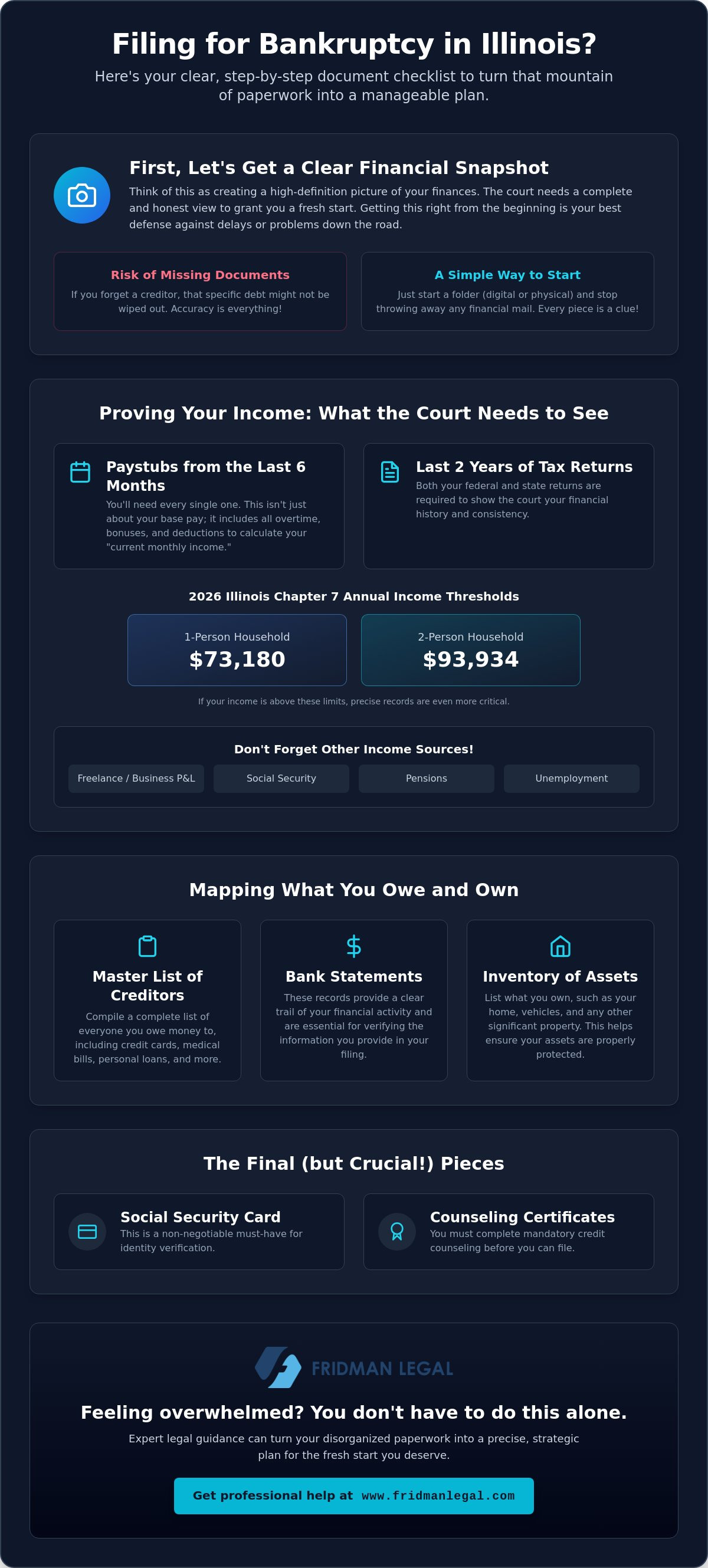
When you sit down to determine what documents do I need to file for bankruptcy in Illinois, the most critical category is your income. The court doesn't just take your word for it; they require a forensic look at how much money has entered your household over the last six months. This "6-Month Rule" is the foundation of your filing. You'll need to provide every single paystub received during this period. It isn't enough to provide a year-to-date summary; the trustee needs to see the raw data of every paycheck, including overtime, bonuses, and deductions, to calculate your current monthly income accurately.
For cases filed on or after April 1, 2026, the gross annual household income thresholds in Illinois have been updated. To automatically qualify for Chapter 7, a one-person household must earn below $73,180, while a two-person household limit is $93,934. If your income exceeds these amounts, gathering precise records becomes even more vital. You'll also need your federal and state tax returns from the last two years to prove consistency in your reporting. While you can view the official bankruptcy forms online, the data you provide in those documents must be backed by these concrete financial records.
If you're a freelancer or small business owner in Chicago, your requirements are slightly different. Since you don't have traditional paystubs, you'll need to create a detailed profit and loss statement for the last six months. Additionally, don't overlook "non-traditional" income. This includes Social Security benefits, pensions, unemployment compensation, or even regular financial contributions from family members who help with your rent or groceries. Every dollar counts toward the court's assessment of your financial health. If the math feels daunting, a quick conversation with a professional at Fridman Legal can help you categorize these numbers correctly.
Navigating the Illinois Means Test
The Means Test is essentially a mathematical formula used to determine your eligibility for debt liquidation. Even if your income is above the Illinois median, you might still qualify by deducting specific "allowable expenses" like mortgage payments, taxes, and health insurance. The Means Test serves as the primary gateway to a Chapter 7 discharge in 2026.
What if You Do Not Have Your Tax Returns?
It's common to realize a return is missing right when you need it most. You can quickly request a free tax transcript from the IRS website to satisfy the court's requirements. For state records, the Illinois Department of Revenue offers similar retrieval services. A bankruptcy lawyer Chicago can often help pull these records directly if you're struggling to navigate the government portals on your own.
Mapping What You Owe and Own: Assets and Debt Inventory
Once you've established your income, the next phase of determining what documents do I need to file for bankruptcy in Illinois involves a comprehensive inventory of your liabilities and assets. This isn't just about listing your credit cards; it's about creating a "Master List of Creditors." You'll need to gather every recent bill, collection notice, and credit card statement you've received. It's vital to include everyone you owe money to, even if you intend to keep paying them, like a family doctor or a local utility company. If a debt isn't listed, it might not be discharged, leaving you legally responsible for the balance after your case closes.
The court also requires a transparent look at your liquid assets. You'll generally need to provide bank statements for the last three to six months for every account with your name on it, including joint accounts or those you only use for business. As of January 1, 2026, Illinois law provides an automatic exemption of $1,000 in a bank account, which protects that specific amount from being seized. To ensure you gather financial documents accurately, you should also include records for any "store of value" apps like Venmo, PayPal, or crypto wallets, as these are considered part of your estate.
Property documentation is equally critical. For your home in Northbrook or Chicago, you'll need your most recent mortgage statement and a property tax bill. These help establish equity, which is protected by the Illinois homestead exemption. Effective January 1, 2026, this exemption has increased to $50,000 per person, or $100,000 for jointly owned property. For vehicles, keep your car titles and loan statements handy. The motor vehicle exemption now sits at $3,600, allowing you to protect a significant portion of your car's value during the process. When you're asking what documents do I need to file for bankruptcy in Illinois, remember that these papers prove you qualify for these specific legal protections.
Don't Forget the "Invisible" Assets
Some of your most valuable assets don't sit in a garage or a bank account. You must provide statements for retirement accounts like a 401(k) or an IRA. While these are almost always fully protected in Illinois, the trustee still needs to see the current balance. Similarly, if you have a pending legal claim, such as a personal injury lawsuit where you're the plaintiff, that "right to sue" is an asset that must be disclosed. Life insurance policies with a cash value also fall into this category and require documentation from the insurer.
Local Resources for Property Records
If you've misplaced your deed or don't know your exact property PIN, the Cook County Recorder's Office is an excellent resource for deed information. For estimating the value of your possessions, online tools like Zillow or Kelley Blue Book provide a "rough" starting point, though they aren't formal appraisals. If you're concerned about how your property is titled or how a filing affects your home's status, a professional real estate lawyer for closing can help navigate these property nuances to ensure your primary residence remains secure.
The Non-Financial Essentials: Identification and Counseling
While most people focus heavily on the dollars and cents, the legal system is equally concerned with your identity and your understanding of the process. When you're figuring out what documents do I need to file for bankruptcy in Illinois, don't overlook the procedural basics. You'll need a valid government-issued ID, like a driver's license or state ID card, to prove who you are. This is mandatory for the Meeting of Creditors, where the trustee will verify your identity against your filing. You'll also need proof of your Social Security number. An original card is best; however, a formal tax document like a W-2 or a 1099 showing your full number is often acceptable.
Domestic support obligations also require clear documentation. If you pay or receive alimony or child support, the court needs to see those records. These obligations are non-dischargeable, meaning they don't go away after bankruptcy. Having the specific court orders or payment histories ready ensures that your filing accurately reflects these ongoing commitments. It's about ensuring every legal obligation is transparently handled from day one so that your case moves toward a discharge without unnecessary delays.
The Credit Counseling Requirement
Before you can even file your petition, you must complete a pre-bankruptcy credit counseling course. This isn't a pass or fail test; it's a simple session, usually taken online or over the phone, to ensure you've explored all your options. It must be completed through an agency approved by the U.S. Trustee for the Northern District of Illinois. These courses typically cost between $10 and $50. Fee waivers are available if your household income is below 150% of the federal poverty guidelines. Remember that a second course, known as debtor education, is required after you file to receive your final discharge.
Personal Records and Special Circumstances
If you've navigated a divorce in the last few years, the court will likely want to see your divorce decree and any property settlement agreements. This helps the trustee determine if you're entitled to any assets or if you have specific liabilities stemming from the split. Additionally, gather any active lawsuit papers, including summons or garnishment notices. A wage garnishment lawyer can step in to stop these aggressive collection actions immediately once your case is officially filed. Dealing with these unique circumstances early prevents surprises during your meeting with the trustee. If you're feeling stuck on how to find these specific records, reaching out to Fridman Legal can provide the clarity you need to move forward with confidence.
How Fridman Legal Turns Your Paperwork into a Fresh Start
Gathering your financial records is a significant achievement, but those papers are only the raw materials for your recovery. O. Allan Fridman takes that information and translates it into a precise legal strategy designed to protect your interests. It isn't just about filling out forms; it's about analyzing your history to ensure you receive the full benefit of the law. When you're identifying what documents do I need to file for bankruptcy in Illinois, you're essentially providing the evidence we need to prove your eligibility and safeguard your assets. We take those paystubs, tax returns, and bank statements to build a petition that stands up to the scrutiny of the court.
A primary value of professional representation is our ability to spot "red flags" before the Trustee ever sees your case. Trustees are tasked with finding assets or inconsistencies that could benefit your creditors. We perform a meticulous audit of your schedules to ensure everything is disclosed accurately and that your exemptions are applied aggressively. This proactive approach is the most effective way to reach your ultimate goal: the discharge. This legal order is the finish line, officially erasing your qualifying debts and preventing creditors from ever contacting you again.
We also understand that financial stress is already high, so we prioritize clarity in our professional relationship. Our "Flat-Fee" approach ensures there are no surprises or hidden costs during the process. You'll receive high-level legal guidance and specialized support without the anxiety of fluctuating invoices. By handing over the technical details to an expert, you can stop focusing on the past and start looking toward your financial future.
Your First Consultation in Northbrook
You don't need to have a perfect, organized file to start the process. For your first meeting, bring whatever you have, even if it's just a partial pile of bills or a few recent paystubs. We'll help you identify exactly what's missing and provide clear instructions on how to fill in the gaps. There's an immediate sense of peace that comes from handing the "mess" over to a professional who knows exactly how to handle it. We'll clarify any remaining questions you have about what documents do I need to file for bankruptcy in Illinois so you can feel confident in your filing.
Ready to Stop the Stress?
The hardest part of the bankruptcy process is often just making the decision to begin. Once you take that first step, the path toward a fresh start becomes much clearer. We proudly serve clients in Northbrook, Chicago, and all the surrounding suburbs, providing the local expertise needed to navigate the Northern District of Illinois courts. Don't let the weight of your debt hold you back for another day. Contact Fridman Legal today for a personalized bankruptcy evaluation.
Take the First Step Toward Your Financial Recovery
The path to debt relief isn't just about the numbers; it's about the preparation. While the initial question of what documents do I need to file for bankruptcy in Illinois might've felt overwhelming, you now have a clear roadmap to navigate the 2026 requirements with confidence. By gathering your paystubs, tax returns, and property records, you're doing more than just filling out forms. You're building a strategic exit from financial stress and setting the stage for a successful discharge.
O. Allan Fridman brings nearly 20 years of Illinois bankruptcy experience to your case, providing the personalized attention necessary to protect your assets. We believe in transparency, which is why we offer flat-fee Chapter 7 filing services so you can focus on your recovery instead of worrying about legal costs. You don't have to sort through the paperwork alone. We're here to review your records for potential issues and guide you through every step of the court process.
Schedule a Consultation with Fridman Legal to Start Your Fresh Start and take that critical first step today. Your new beginning is closer than you think.
Frequently Asked Questions
Do I need a lawyer to file bankruptcy in Illinois, or can I do it myself?
You can legally file for bankruptcy without an attorney, but it's a path filled with technical traps. The court expects individuals who file on their own to follow the same complex rules as legal professionals. A single error in your schedules or a missed deadline can lead to the loss of property you thought was protected. Most people find that the security of having an expert handle the filing far outweighs the stress and risk of doing it alone.
How far back do I need to go for my tax returns when filing in Chicago?
The court typically requires your signed tax returns from the last two years. This helps the trustee verify your income history and look for potential assets like upcoming tax refunds. If you haven't filed your returns for those years, you'll need to complete them before your case can proceed. The trustee uses these documents to ensure the data on your petition matches what you've officially reported to the government.
What happens if I cannot find a specific bill or creditor address?
If you're missing a specific bill, your credit report is the best place to start. Most major creditors are listed there along with their contact information. If a debt is still missing, you can search for the creditor's "bankruptcy notice address" online. It's vital to be thorough when deciding what documents do I need to file for bankruptcy in Illinois, as unlisted creditors might not be included in your final discharge.
Is credit counseling mandatory for both Chapter 7 and Chapter 13 in Illinois?
Yes, credit counseling is a mandatory federal requirement for all individual bankruptcy filers regardless of the chapter. You must complete an approved course before you file your petition and a second debtor education course before you can receive your final discharge. These sessions are designed to ensure you understand your options and are prepared for life after debt. Most people complete these courses online or over the phone in about an hour.
Can I file for bankruptcy if I do not have a Social Security card?
You don't necessarily need the physical card, but you must provide proof of your number. An official document like a W-2, a 1099, or a Social Security Benefit Statement is usually sufficient to satisfy the court's identification requirements. If you've lost your card, it's a good idea to order a replacement from the Social Security Administration, though your attorney can often use other tax records to verify your identity in the meantime.
How do I get my credit report for free to make sure I list all my debts?
You can get a free copy of your reports from all three major bureaus at AnnualCreditReport.com. This is the only site authorized by federal law to provide free reports from Equifax, Experian, and TransUnion. Pulling these reports is the most reliable way to ensure you're listing every creditor on your petition. Listing everyone correctly prevents creditors from trying to collect on old debts after your case is successfully closed.
What documents do I need if I am filing for bankruptcy as a business owner?
Business owners need to provide a deeper level of transparency regarding their operations. You'll need to gather profit and loss statements, balance sheets, and any business-specific tax filings from the last few years. When you're determining what documents do I need to file for bankruptcy in Illinois as an entrepreneur, these records help the trustee understand the relationship between your personal income and your business's operational costs and assets.
Will the bankruptcy trustee come to my house to look at my assets?
It's highly unlikely that a trustee will ever visit your home. Most trustees in the Northern District of Illinois rely on the documents and testimony you provide to verify the value of your property. They may ask for photos of high-value items or professional appraisals for real estate; to obtain a professional inspection that helps document your property's condition for these evaluations, click here. Unless there's a strong suspicion of hidden assets or significant discrepancies in your filing, the process is handled through paperwork and the Meeting of Creditors.

Article by
O. Allan Fridman
O. Allan Fridman has been practicing law since 2001. His practice is unique in that he does not view himself as a litigation attorney or transactional attorney. Rather, he views each area of law as a tool to pursue the best results for his clients. By practicing in both areas of law, he is able to take a 360-degree view of law. This enables the firm to catch potential drawbacks that are readily identifiable.
By practicing in litigation and transactional law and taking a holistic approach in dealing with our clients, he doesn’t put clients in box — rather, as we are all individuals, so too are the legal services we may require.
Whether it is bankruptcy or litigation or transactional, each client brings challenges and does not fit in any one box. Often times, bankruptcy clients end up not filing bankruptcy because we can achieve a better result through litigation or through an out-of-court resolution with the lender, or through a real estate sale. On the other end of the spectrum, a litigation client with multiple issues and lawsuit may fare better in a bankruptcy.
Since 2001, Allan has practiced in states and federal court, and he is a member of the trial bar of the Northern District of Illinois and admitted in the Northern District of Indiana.
We are a debt relief agency. We help people file for bankruptcy relief under the Bankruptcy Code
The materials on this site are for informational purposes only and do not constitute legal advice. Viewing this site or contacting us does not create an attorney–client relationship, and you should not act or refrain from acting based on any information here without seeking professional legal counsel.